Introduction
Picnic Cutlery Kits sourcing is easier to control when a buyer starts with the end-user task instead of a supplier photograph. outdoor-kitchen buyers and gift-program teams comparing component count, material handling, storage case design and retail pack-out need a version that works for a stated sales channel, package and customer expectation, not a loosely similar sample. That means recording the commercial brief, checking an honest production-relevant sample, defining factory testing and using shipment inspection to compare the packed lot with an approved reference.
This guide uses one primary buyer query and five related procurement terms: picnic cutlery kit wholesale, portable cutlery supplier, camping cutlery OEM, private label picnic cutlery, reusable cutlery set packaging, outdoor kitchen kit supplier. They help buyers find the relevant decision points, but the shipment release should always rely on the approved specification and product-specific evidence.
This guide is for buyers planning a Picnic Cutlery Kits program for picnics, camping meals, travel gifts, corporate events and outdoor specialty retail. It covers product application, supplier comparison, installation preparation where relevant, factory testing and shipment inspection. It is not legal, laboratory or market-access advice. Requirements vary by destination, claim and use case, so the useful output is a dated product file that the buyer and supplier can retrieve for a repeat order.
Start With a Comparable Buyer Brief
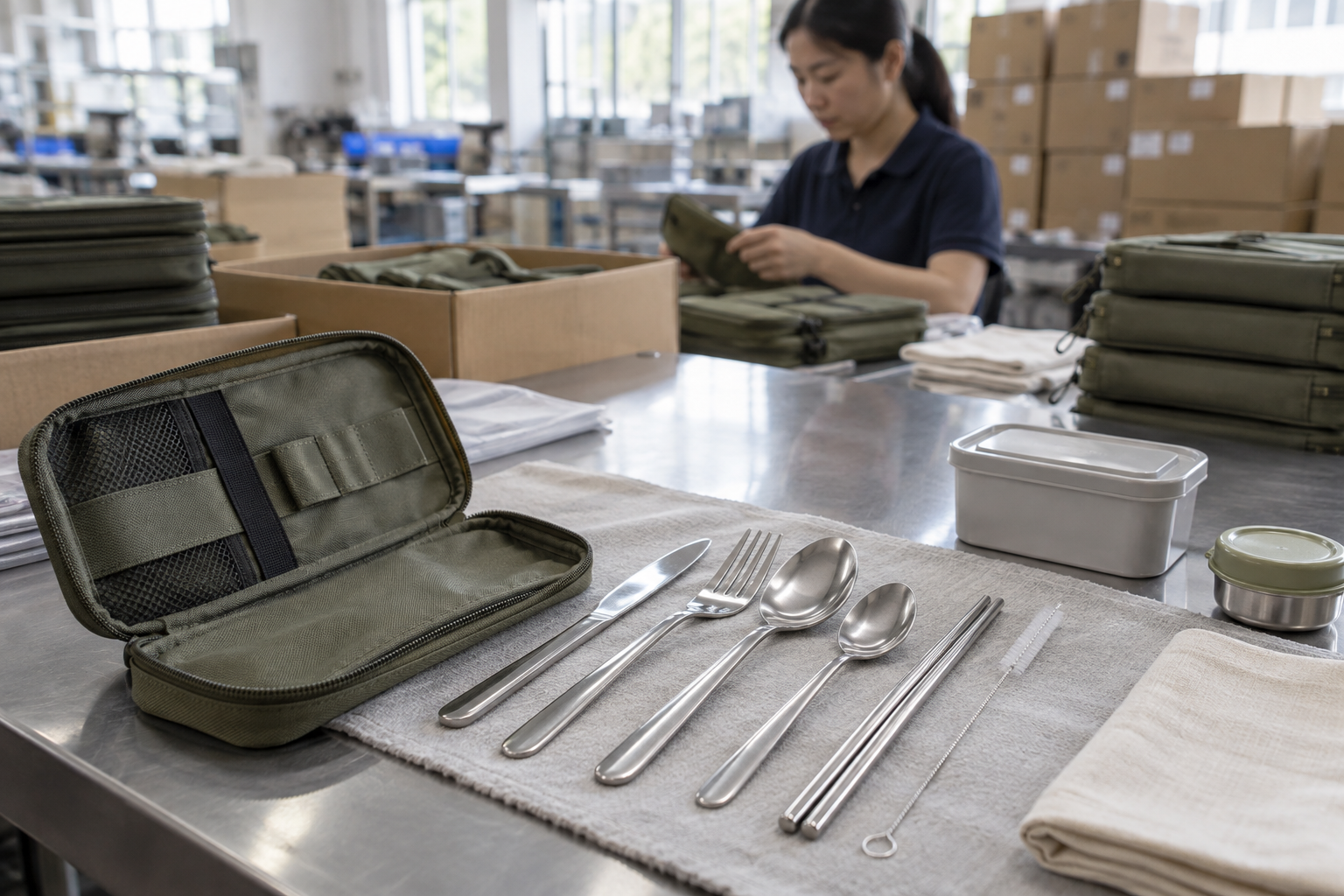
The first sourcing document should answer five practical questions: who will use the product, where will it be used, what must be in the retail unit, which features are non-negotiable and who approves a change. For Picnic Cutlery Kits, describe utensils, storage case, cutting board where supplied, spice pods, napkin pouch, care sheet, labels and retail packaging. Ask the supplier to identify the quoted model or revision, the included accessories, the proposed package, dimensions, estimated carton data and any detail that remains provisional. A photograph alone cannot tell a buyer whether two quotations describe the same retail unit.
Separate the brief into fixed requirements and preferences. Fixed requirements may include product function, target market, materials, finish, pack-out, barcode position, cleaning or storage instructions, warning language and delivery window. Preferences may include colorway, bundle direction, display treatment and optional accessories. This distinction helps a supplier flag a cost, capacity or lead-time issue before it becomes an undocumented substitution. It also makes three supplier quotations comparable without pretending that every line item has equal risk.
Turn the RFQ Into a Reviewable Record
Request a quotation, sample lead time, expected production lead time, order quantity, artwork options, tooling assumptions, carton dimensions and gross weight. Ask which parts influence component count, utensil nesting, case closure, cleaning access, label match, pouch fit and pack completeness. Capture each answer in one comparison sheet with the supplier name, model, revision, sample status, package version, open questions and release owner. The goal is not paperwork for its own sake. It is a record that prevents an early chat message from becoming a forgotten product requirement.
Buyers should also identify the first-use experience. Open the pack, locate the instructions, assemble or install the unit as a customer would, perform the core task, clean or store it, and repack it. This short exercise exposes practical problems that a technical list may miss. A component may be present but difficult to reach; a control may be hard to understand; a closure may work once but not repeatedly. Record the observed condition and decide whether the next sample must address it.
Review a Production-Relevant Sample
An attractive presentation sample is not automatically a production sample. Before approval, ask whether the proposed materials, components, finishes, assembly route and pack-out match the version that would be supplied. For Picnic Cutlery Kits, a sample review should cover component count, utensil nesting, case closure, cleaning access, label match, pouch fit and pack completeness. Photograph the sample with a model or revision reference, then note what was observed, what was not evaluated and which points require factory confirmation. A useful sample report distinguishes a known result from an assumption.
Build the approval around a controlled reference. Retain the signed sample or a controlled reference set and link it to the current specification, artwork proof, component list and feedback sheet. Any material, sub-supplier, process, accessory, color, tool or packaging change should be communicated in writing before production. Not every change is unacceptable. The important rule is that a change becomes a buyer decision rather than an invisible production variance.
Test the Customer Scenario, Not Just a Feature
Factory testing works best when it mirrors the customer scenario without overstating what an internal check can prove. Write down the condition, sample quantity, acceptance criterion, equipment, record owner and what happens when a unit fails. For instance, the relevant questions for this category include component count, utensil nesting, case closure, cleaning access, label match, pouch fit and pack completeness. A pass on a factory bench is useful operational evidence, but it is not a substitute for independent testing, certification or professional advice when the product and market require them.
Use a short test script that another person can repeat. The script should say how the product is prepared, what accessory is used, what action is performed, what observation counts as acceptable and how the result is recorded. Add photographs of acceptable and unacceptable conditions if the inspection point is subjective. This gives the factory, buyer and third-party inspector the same frame of reference before the shipment window narrows.
Evaluate Suppliers Beyond Unit Price
Price should be compared beside product identity, communication discipline, component control and evidence quality. Capability means a supplier can explain how utensils, storage case, cutting board where supplied, spice pods, napkin pouch, care sheet, labels and retail packaging are sourced, assembled and checked. Evidence quality means the supplier can connect material notes, photographs, test records and packaging proofs to the exact version quoted. Communication discipline means a limitation is stated early, not hidden until inspection. A supplier that flags an uncertainty can be easier to manage than one that promises every feature without a controlled sample.
Ask who supplies critical parts, how incoming materials are identified, where final assembly occurs and how a production lot is tracked. Multi-supplier assembly is common and is not a problem by itself. The buyer needs to know whether there is a controlled way to receive, assemble, test and record those parts. Keep the brief, approved sample, product file, packaging proof, factory-test records, inspection report and shipment details in one evidence index.
| Review area | Evidence to request | Buyer release question |
|---|---|---|
| Product identity | Model, revision and approved sample | Is the quoted product the version evaluated? |
| Critical construction | Component list and material notes | Can the supplier explain utensils, storage case, cutting board where supplied, spice pods, napkin pouch, care sheet, labels and retail packaging? |
| Quality control | Factory test plan and records | Are component count, utensil nesting, case closure, cleaning access, label match, pouch fit and pack completeness observable and repeatable? |
| Packaging | Artwork proof and pack-out sample | Are included items and instructions unambiguous? |
| Shipment release | Inspection record and carton data | Can the lot be reconciled to the purchase order? |
Factory Testing and Shipment Inspection
Agree the inspection checklist before mass production. At the factory, inspect incoming components where they affect the buyer brief, then confirm assembly, finish, accessories, function and packaging during the relevant production stage. For Picnic Cutlery Kits, document component count, utensil nesting, case closure, cleaning access, label match, pouch fit and pack completeness. Record the model, lot reference, date, quantity checked, result, deviation and corrective-action owner. This creates an operational trail without describing routine factory checks as broad certification.
At shipment inspection, compare selected units and cartons with the approved sample and specification. Check visible construction, color, included items, labeling, instructions, package condition, carton count and the agreed function under the stated condition. When a difference appears, contain the affected goods, determine the likely scope and classify it as cosmetic, functional, documentation-related or critical. Release should follow the actual evidence and corrective action, not a verbal assurance.
Make Inspection Findings Actionable
Inspection notes should be observable. Replace a comment such as poor quality with a description of the specific result: the closure does not align, the specified accessory is absent, the control does not respond under the agreed condition or the printed pack shows a previous revision. Include photos, affected quantity where known, the proposed correction and who verifies it. This turns a complaint into a decision record the factory can use.
The most common avoidable problems in this category are incomplete sets, mixed utensils, unclear food-contact details, weak cases, missing care copy and inaccurate component lists. Put those risks into the sample review and shipment checklist before a purchase order is released. Buyers should avoid broad words such as premium, safe or universal unless a product-specific basis is documented. A careful statement of intended product application is more credible and more useful for a retail partner than a claim that the item suits every customer or environment.
Packaging, Claims and Product Application
The package should identify the product, included items and intended use accurately. Confirm the product name, model, color, component count, instructions, cleaning or storage direction, warnings, barcode placement and contact route against the approved proof. Marketplace listings should use the same reviewed facts. This is especially important when a supplier offers a family of similar versions: a complete package can still become a wrong retail unit if the copy or included accessory belongs to another model.
Write the product application as a customer scenario. For Picnic Cutlery Kits, that may mean picnics, camping meals, travel gifts, corporate events and outdoor specialty retail. Consider where the product sits, who handles it, what it contacts, how it is cleaned or recharged, foreseeable misuse, storage and the accessories a customer is likely to combine with it. Installation preparation matters whenever mounting, pairing, charging, filling or assembly changes the first-use result. Review that reality during sampling rather than relying on a studio image.
Use Official Guidance as a Starting Point
For market preparation, review official product and buyer guidance and the CPSC online seller safety guide alongside the detailed requirements for the finished SKU and destination market. These sources are starting points, not a blanket approval for any model, claim or sales channel. Keep dated links and product-specific decisions in the evidence file, then seek appropriate specialist support where the brief raises a regulatory, laboratory, customs or claim question.
Keep the Evidence Useful After Launch
After the first shipment, retain the approved reference, final artwork, purchase order, factory test notes, inspection result and any corrective-action record in a single SKU folder. When customer service or a retail partner raises a question, the team can then identify the exact version, what was specified and which condition was checked. This discipline also improves repeat-order preparation: changes are reviewed against a known baseline instead of being rediscovered after goods are packed.

Mid-Article CTA
Send Your Requirements. Review the Picnic Cutlery Kits product page, compare options in the KudBo catalog, use the contact form, or email info@kudbo.com with your target market, quantity, product requirements, packaging direction and launch date. KudBo can coordinate samples, factory communication and shipment inspection.
A Practical 30-Day Buyer Workflow
Days 1 to 5: Define the Program
Freeze the candidate product, target customer, sales channel, intended use and timeline. Separate essential requirements from preferences, identify any market-specific reviews and name a release owner. A clear initial brief reduces the chance that a supplier prices a different version from the one the retail team expects.
Days 6 to 12: Compare Samples and Suppliers
Collect quotations against the same brief. Review samples side by side, photograph differences, test the core user flow and consolidate feedback in a single controlled document. Compare evidence, response quality, component visibility and commercial terms as well as unit cost. When the supplier proposes an alternative, record what changes in the product, pack-out or lead time.
Days 13 to 20: Validate Production Controls
Confirm the production-relevant sample, packaging direction, factory-test plan and critical component list. Where the product has a higher consequence of failure, request a pilot-run photograph, an updated sample after key changes or a documented pre-production check. Do not release final retail artwork while product identity or included accessories remain unresolved.
Days 21 to 30: Prepare Shipment Release
Lock the purchase-order specification, approved artwork, carton information, inspection checklist and decision owner. Plan inspection with enough time for correction and retain the approved sample. Before final release, conduct a short retrieval drill: choose the SKU and confirm that the product identity, package version, factory record and shipment decision can be found quickly.
Frequently Asked Questions
What should buyers confirm before ordering Picnic Cutlery Kits?
Confirm the intended product application, exact model or revision, materials and components, pack-out, labeling, sample status, factory-test plan, lead time and target-market requirements. Record each decision against the final supplier quotation.
Is a factory test the same as independent certification?
No. Factory testing is a controlled production check that can provide useful operational evidence. It does not replace laboratory testing, regulatory review, certification or authorization when those are required for the intended product and market.
How should a buyer compare quotations for Picnic Cutlery Kits?
Compare the complete retail unit, including utensils, storage case, cutting board where supplied, spice pods, napkin pouch, care sheet, labels and retail packaging, accessories, packaging, carton data, sample lead time, production lead time, available evidence and change-control process. A lower quoted price may describe a different version or a reduced pack-out.
What should be checked during shipment inspection?
Use the approved sample and specification to check selected units for visible construction, included items, labeling, packaging, carton condition, quantity and the agreed core function. Record the sample scope and investigate meaningful differences before release.
When should a buyer hold shipment?
Hold affected goods when a mismatch changes product identity, construction, instructions, packaging, claims, required evidence or the agreed function. The release owner should assess the scope and corrective action before goods move.
Related Buyer Questions
For cross-category sourcing controls, review AQL pre-shipment inspection, retail-ready packaging, private-label product selection and the KudBo sourcing guide library. The same basic discipline applies across categories, but each SKU still needs its own approved product record.
Related KudBo Resources
Browse the KudBo product catalog, explore the buyer guide library, read more Smart Home sourcing guides, or send your product requirements for a focused sourcing discussion.
Conclusion
Reliable Picnic Cutlery Kits sourcing begins with a clear customer scenario and ends with a shipment that can be reconciled to an approved record. Define the intended use, request a production-relevant sample, control substitutions, plan factory testing, review the retail pack and retain the evidence for repeat orders. This approach does not remove every sourcing risk, but it makes the important decisions visible while they can still be managed.
Related Buyer Resources
Continue with the KudBo buyer guide library, compare the full product catalog, and review the Outdoor / Kitchen sourcing collection. For a product-specific brief, use the sourcing enquiry section.
Final CTA
Ask for a Product Sourcing Plan. Browse the KudBo catalog, review Picnic Cutlery Kits, use the contact form, or email info@kudbo.com with the product, target market, quantity, retail channel and timeline. KudBo can help organize samples, packaging inputs, factory communication and shipment inspection.