Introduction
Car Seat Gap Organizer Sourcing sourcing begins with the end customer, not with the lowest quotation. A retail buyer needs to know how the item will be handled, stored, cleaned, carried, charged or installed before a factory can quote the right construction. That matters for auto-accessory retailers, gas-station stores, ecommerce sellers and car-gift programs, where a product photo, package and first-use experience often decide whether the item can earn a repeat order.
This buyer guide covers seat-gap organizers, car storage trays, cable-management inserts and device-holding accessories. It is practical sourcing guidance rather than legal, laboratory or customs advice. Each target market, retail channel and finished product needs its own review. The aim is to help buyers ask precise questions, approve the right sample and make shipment decisions using records rather than assumptions.
What Buyers Should Define Before Requesting Prices
Start with the customer use case, expected retail price, destination market, target quantity, sales channel and delivery window. Write down the non-negotiable product functions and the features that are only preferred. This avoids comparing a complete retail unit from one supplier with a stripped-down version from another.
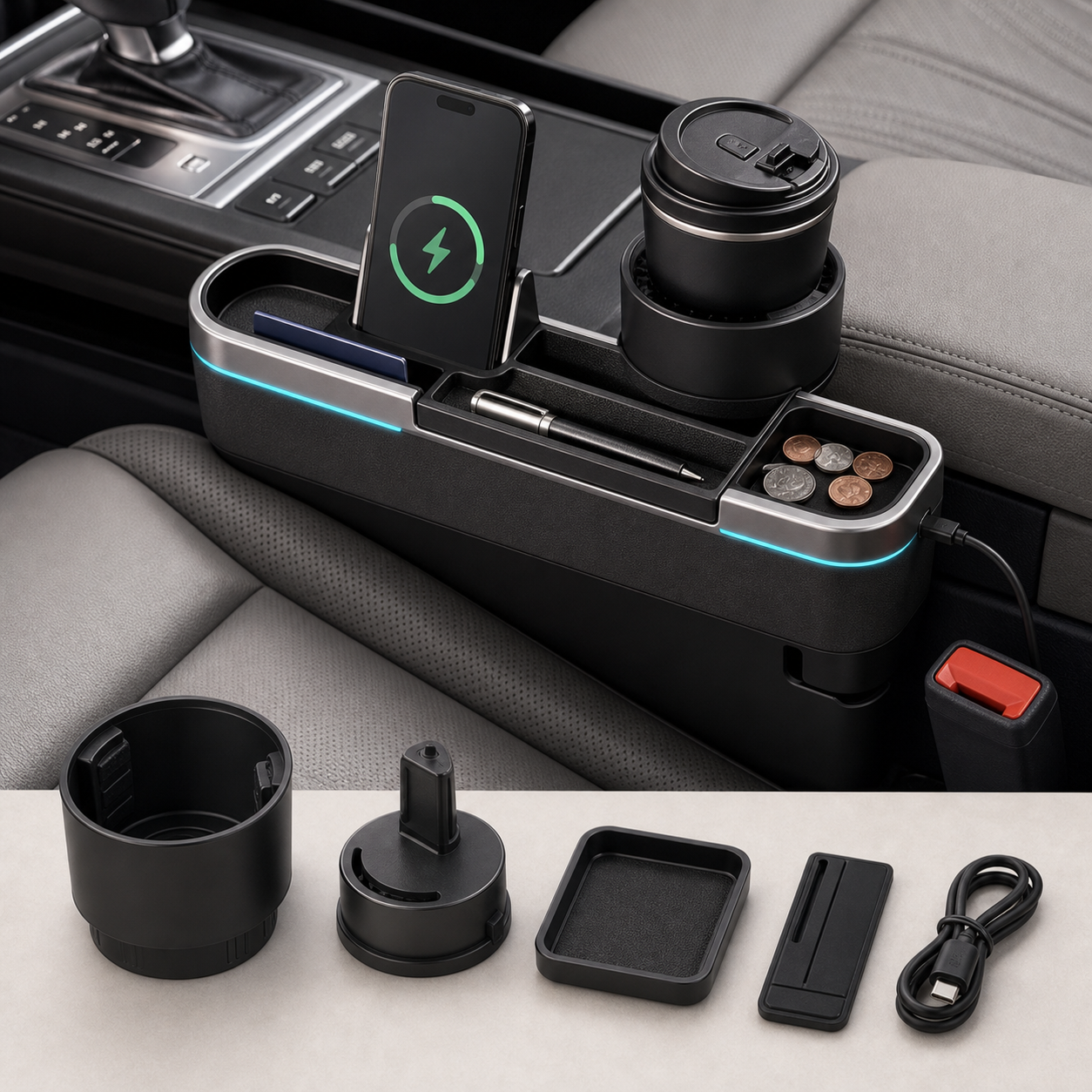
For car seat gap organizers, the buying brief should identify molded plastics, foam inserts, charging modules, cables, anti-slip pads, dividers and retail cartons. Ask suppliers to name the quoted model and revision, list included accessories, specify the retail pack and identify what is still provisional. A broad catalogue image or a generic material declaration does not prove that the proposed finished SKU has the required construction.
Build a Useful RFQ
Include nominal dimensions, unit weight, intended application, product color, material callouts, accessories, packaging target, barcode position, labeling needs, expected quantity and launch date. Request sample lead time, production lead time, master-carton dimensions and a statement of any tooling or setup cost. Require each supplier to identify where its quotation differs from the brief.
Ask a simple operational question: what would a customer notice on the first day of use? The answer helps distinguish a feature that adds value from a feature that only improves a product listing. It also guides the sample check and the instructions that should appear in the final retail pack.
Review the Production-Equivalent Sample
The right sample represents the intended materials, component sources, finish, package and function. If temporary tooling, substitute parts or hand-applied artwork are used, ask the supplier to mark those items clearly. A sample can look excellent while still being a poor reference for mass production.
Review fit assumptions, vibration behavior, seat-movement clearance, compartment strength, cable routing and pack-out protection. Record conditions, observations and unresolved issues. Do not describe a sample review as certification or independent testing. Its role is to identify practical weaknesses, define the factory testing plan and show whether the supplier understands the product application.
Photograph the sample from enough angles to identify construction details. Record model, color, revision, date, dimensions, included accessories and package. Retain an approved physical sample or a controlled reference set for factory testing and pre-shipment inspection. This is particularly useful where similar versions share a factory name or an internal sales code.
Change Control Before Production
Each requested change should state the affected component, reason, cost effect, lead-time effect, packaging impact and approval owner. Avoid instructions such as “make it stronger” or “use better material.” A controlled request tells the supplier which characteristic must change and how the result will be checked.
Changes in materials, dimensions, colors, components, factory location, packaging, instructions and claims may all affect the buyer decision. Set a rule that no substitute is used before the responsible buyer reviews it. The discipline is simple but prevents an unapproved improvement from becoming a production variance.
Evaluate the Supplier Beyond Unit Price
Compare product capability, evidence quality, communication discipline and commercial fit. Product capability covers whether the supplier makes or controls the critical process. Evidence quality means that drawings, photographs, test records and component information can be linked to the exact model. Communication discipline means the supplier identifies uncertainty instead of filling a gap with a confident promise.
Ask who supplies critical components, how incoming materials are checked, where assembly occurs and how a production lot is identified. A supplier can use specialist sub-suppliers and still be suitable when the process is documented and controlled. A supplier that cannot explain how its product changes are reviewed creates risk for a private-label program.
Use one evidence index with the approved specification, product photos, material notes, sample record, packaging proof, factory-test record and shipment report. This makes a repeat order much easier to manage and gives the buyer a factual starting point if the factory changes a component or a customer reports a problem.
Factory Testing and Shipment Inspection
Agree the factory testing plan before production. Define what is checked, the test condition, sample quantity, pass criterion, equipment used and record format. Keep the test relevant to the intended use. Factory testing is useful because it makes routine checks repeatable; it should not be presented as a laboratory certificate or as proof of legal compliance.
At shipment inspection, compare selected units and cartons to the approved reference. Check visible construction, color, accessories, labels, instructions, packaging, quantities and carton condition. Record the sampling plan and limitations. If a mismatch appears, contain the affected lot and assess whether it is cosmetic, functional, documentation-related or critical before release.
The release checklist should reconcile the purchase order, approved sample, final artwork, invoice, packing list and inspection findings. One correct product version should not be used as evidence for a different color, bundle or model without a documented reason.
Packaging, Applications and Claims
Packaging should clarify the product rather than make it appear more capable than it is. Confirm the final product name, model, color, included items, use instructions, warnings, contact details and barcode. For online selling, check that listing claims use the same approved facts as the packaging and sample record.
Product application drives the risk review. Note how the item is used in a real setting: in luggage, a kitchen, a vehicle, a classroom, on a desk, outdoors or at home. A successful bench demonstration does not automatically represent the customer environment. Installation preparation, cleaning, storage, charging, wet use and foreseeable mishandling should be raised during sample approval.
Consult NHTSA motor vehicle equipment information when building the product file, and retain dated links and product-specific decisions. Official guidance can explain a framework, but it does not replace a review of the exact finished product, market role and sales claim.
Common Failure Modes and Corrective Action
The recurring failure is approving an attractive sample without identifying which parts are provisional. The factory may later use a different material, component, process or pack-out because the buyer never recorded the approved basis. Another common error is asking a supplier for a broad promise such as “market compliant” rather than asking for source evidence, intended conditions of use and a named reviewer for each open question.
Avoid trying to fix every issue through a final inspection. Inspection is an important release control, but it happens after many commercial decisions have been made. The practical remedy is earlier control: a buyer brief that identifies the user, a sample record that identifies the model, a change log that identifies substitutions and a packing checklist that identifies the finished retail configuration.
When a defect is found, first contain the affected goods and define the scope. Then compare the finding to the approved reference and determine whether it is cosmetic, functional, documentation-related or critical. Corrective action should state the cause, affected lot, action owner, verification method and release condition. A statement that the issue has been “handled” is not enough for a buyer who needs to repeat the order later.
Build an Evidence File That Supports Repeat Orders
Create one folder or product record for the finished SKU. It should contain the buying brief, approved sample photos, revision-controlled specification, bill of materials or critical-component list, packaging artwork, available source documents, factory-test records, inspection report and final shipment data. Name a record owner and use dates and revision numbers rather than labels such as “latest.”
This evidence file is a commercial tool as well as a risk-control tool. It shortens repeat-order preparation because the next buyer can see what was actually approved, which supplier answer was conditional and what changed during development. It also makes it easier to compare a replenishment sample with the original order instead of relying on memory, a salesperson's screenshot or an outdated marketplace listing.
Run a retrieval drill before first shipment. Choose one real SKU and ask the team to produce the product identity, sample record, package version, key material notes, inspection result and release decision. If the information cannot be found quickly, improve the record structure before the order volume grows. This is particularly important when a brand sells several similar models, seasonal colors or bundle variations.
Manage Repeat Orders and Supplier Changes
A successful first order is not a reason to remove controls. Review the product and supplier file before every replenishment, especially when the order changes quantity, destination, packaging, sales claim, accessory mix or shipping method. Ask the supplier to confirm whether materials, sub-suppliers, tooling, process, factory location and packaging are unchanged. Record both confirmations and declared changes.
For a planned change, request a revised sample or clear production photographs and assess whether it affects product application, shipping, inspection, instructions or market requirements. The correct response to a change is not always to reject it. A substitute can improve availability or performance, but it needs a buyer decision before it becomes part of the finished retail item.
Set review triggers for complaints, returns, quality findings, regulatory updates, supplier ownership changes and new sales channels. A product that works for a local gift program may need a different packaging, warning or evidence review when it moves into a marketplace, distributor or export market. Keeping the original decision trail makes that expansion much easier to manage.
Buyer Decision Matrix
| Area | Evidence to request | Release question |
|---|---|---|
| Product construction | Approved sample and component list | Does the production version match the approved reference? |
| Supplier control | Process map and change procedure | Who records material or assembly changes? |
| Application | Intended-use note and instructions | Has the actual customer environment been considered? |
| Quality | Test plan and inspection checklist | Are acceptance criteria observable and documented? |
| Packaging | Artwork proof and pack-out sample | Does the pack match the listing and shipment plan? |
| Release | Purchase order and evidence index | Are critical gaps closed by the responsible owner? |
Mid-Article CTA
Send Your Requirements. Browse the KudBo product catalog, use the contact form, or email info@kudbo.com with your target market, product requirements, quantity, packaging direction and expected launch date. KudBo can coordinate product options, samples, factory communication and shipment inspection.
A 30-Day Buyer Workflow
Days 1-5: Define the SKU
Freeze the candidate product, target customer, selling channel and intended use. Identify product questions that require a laboratory, regulatory adviser, electrical specialist or claims review before packaging is printed. Set one owner for each open decision.
Days 6-12: Compare Samples and Suppliers
Collect quotations against one brief. Review physical samples, photograph differences, request component details and compile a single feedback list. Score suppliers for traceability and responsiveness as well as price. A supplier that identifies a real gap can be safer than one that immediately promises every requirement.
Days 13-20: Validate the Production Route
Approve the revised sample conditionally on closed critical issues. Confirm materials, accessories, product application, packaging, test plan and capacity. Where risk is higher, request a pilot-run confirmation or product-equivalent sample before final artwork and production booking.
Days 21-30: Prepare Release Controls
Lock the purchase-order specification, packaging proof, carton information and inspection checklist. Name the release owner and schedule shipment inspection with time for corrective action. Retain the sample and evidence index as the baseline for the next order.
Frequently Asked Questions
What should a buyer request before approving a car seat gap organizers sample?
Request the quoted model, material and component information, accessory list, dimensions, package specification, sample limitations, factory testing proposal and production lead time. Link every answer to the exact revision being considered.
Is a factory test the same as third-party certification?
No. Factory testing is a controlled production check. It can be valuable operational evidence, but it does not replace product-specific laboratory work, certification or market assessment when those are required.
How should buyers compare two supplier quotations?
Compare the full retail unit: construction, accessories, packaging, carton data, tooling, test support, order quantity, lead time and change-control discipline. A lower unit price may rely on a different material, component or packaging level.
What should be checked during shipment inspection?
Use the approved sample and specification to check selected units for visible construction, accessories, labeling, packing, carton condition and quantity. Record the sample scope and investigate material or function differences before release.
When should a buyer hold shipment?
Hold the affected goods when a critical mismatch affects product identity, construction, safety information, claims, required evidence or packaging. The release owner should evaluate scope and corrective action before the goods move.
Related Buyer Questions
Buyers can also review AQL pre-shipment inspection, retail-ready packaging, multi-category sourcing and private-label product selection. These controls overlap, but every product needs its own documented specification and market review.
Related KudBo Resources
Browse the KudBo product catalog, explore the buyer guide library, read more Automotive Accessories sourcing guides, or send your product requirements for a focused sourcing discussion.
Conclusion
Reliable car seat gap organizers sourcing begins with a clear user scenario and ends with a shipment that can be compared to an approved record. Define the customer use case, request a production-relevant sample, control substitutions, test practical functions, review the retail pack and retain the evidence needed for a repeat order. This process does not remove sourcing risk, but it makes the important risks visible while there is still time to manage them.
Final CTA
Ask for a Product Sourcing Plan. Visit the KudBo catalog, use the contact form, or email info@kudbo.com with the product, market, quantity, retail channel and timeline. KudBo can help organize samples, packaging inputs, factory communication and shipment inspection.