Introduction
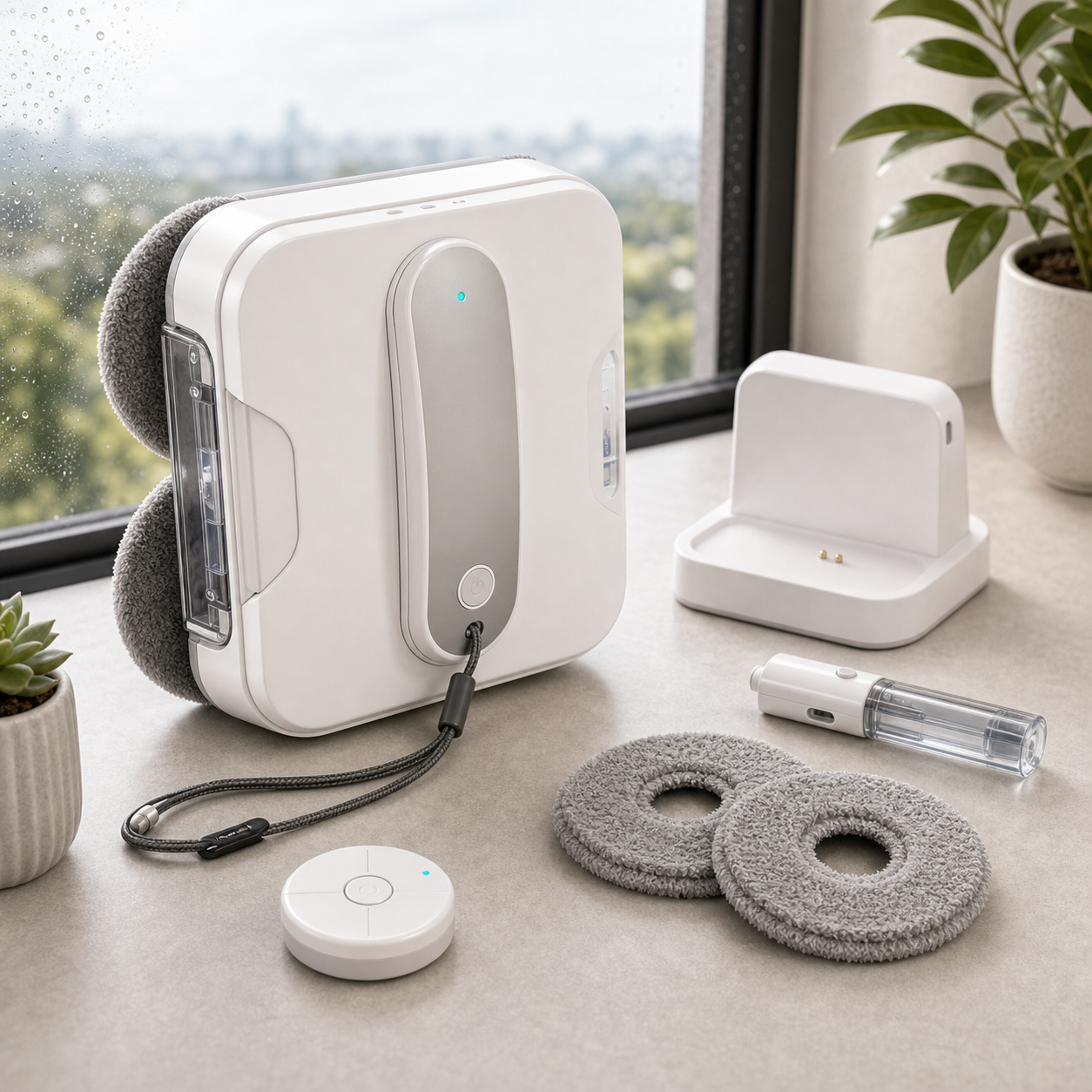
A window robot’s framed or frameless claim is valid only within the exact model’s operating envelope. Glass size, surface condition, boundary geometry, installation and recovery arrangements must be reviewed together. Edge detection is not a substitute for the prescribed safety tether or for excluding unsupported surfaces.
For distributors, the useful question is not whether a robot can clean glass in a demonstration. It is which customer windows the supplier has actually addressed, how the user prepares the task and what happens when operation is interrupted. A dramatic high-rise photograph can obscure those requirements rather than explain them.
This window robot framed vs frameless guide supports model-specific procurement of a window-cleaning robot. It proposes questions and low-risk review steps, not KudBo test results. Hazardous edge trials and safety-function assessment require qualified personnel and controlled facilities. Do not test uncertain compatibility on elevated or occupied areas.
Define the Window Robot Operating Envelope
Request the operating manual before selecting samples. Identify permitted window dimensions, surface types, orientation, frame requirements and installation exclusions. A broad glass-cleaning description can include limitations that materially change the addressable customer base. Put those limitations in the RFQ, not only in a booklet reviewed after the order.
Separate ordinary flat glass from curved, textured, coated, damaged or otherwise unusual surfaces. Do not infer permission for mirrors, shower screens or exterior panels from a photograph of a standard window. Ask which applications are expressly supported and what evidence applies to them. Unknown surfaces should remain excluded until reviewed.
ECOVACS’ WINBOT W1 PRO page is an example of a manufacturer describing model-specific features and precautions. It does not establish equivalent capability for another product. Competitor specifications can help frame questions, but they must not be copied into a KudBo product claim.
Framed Glass Is Not a Single Condition
A frame’s presence does not tell a buyer its effective geometry or whether the robot recognizes it as intended. Identify the boundaries described in the manual and how seals, recesses or transitions affect the supported application. Do not invent a minimum frame height for all models; the requirement must come from the actual design and evidence.
Ask how the product handles narrow panes and interruptions such as dividers. A window that is visually one unit may contain several separate operating areas. The robot may require repositioning rather than crossing the divider. Record the customer task accurately so the website does not imply automatic coverage of an entire assembly.
For samples, compare the manual with the physical setup using a safe demonstration panel. Verify dimensions and frame condition before powering the unit according to approved procedures. A successful pass on one panel should be recorded as that configuration, not generalized to every framed window.
Frameless Glass Needs a Different Evidence Question
Frameless glass robot evaluation should identify the intended edge-detection method and its assessment scope. Ask what conditions the manufacturer has validated and which conditions can affect recognition. A sensor label does not show how the complete system responds in every environment.
Do not create an uncontrolled edge challenge by removing a frame, changing traction or disabling protection. That is not an ordinary buyer trial. Request appropriate safety-function evidence from the supplier and competent reviewers. Where evidence is absent, do not solve the gap with a promotional demonstration above an exposed drop.
The retail claim should identify supported glass and setup conditions in a readable way. “Suitable for frameless glass” can imply a much broader scope than a particular laboratory configuration. Check whether the product’s instructions, report and website use consistent boundaries, and resolve contradictions before artwork approval.
Keep Edge Detection Separate From Fall Protection
Review the tether as an essential system part
Ask how the safety tether attaches, what anchoring arrangement is prescribed and which components are included. A tether shown loosely in a photograph does not demonstrate a correct installation. Its condition, connection and routing belong in the preparation checklist, following the manufacturer’s approved instructions.
ECOVACS’ published WINBOT manual illustrates model-specific tether and operating instructions. Do not transfer its dimensional rules to another model. The relevant lesson is that fall protection and surface compatibility are documented separately, not inferred from the marketing name.
Plan the area below the task
The buyer brief should consider people, property and access below the working area. A catalog image should not imply that a robot can be installed over an occupied public space without further planning. Local building, access and occupational requirements may apply and need competent review.
Keep the unit’s operating protection, tether arrangement and worksite controls distinct. One does not automatically eliminate the others. A distributor should avoid simplifying these requirements into a statement that the product cannot fall. No ordinary sample demonstration can justify an absolute guarantee.
Build a Glass Surface Compatibility Record
| Review field | Required record | Limitation to preserve |
|---|---|---|
| Surface | Material, finish and condition | No extension to unreviewed coatings or textures |
| Geometry | Pane dimensions and orientation | One panel does not validate all windows |
| Boundary | Frame or approved frameless configuration | Follow the exact model’s rules |
| Preparation | Pads, fluid and setup procedure | Do not substitute unknown materials |
| Safety | Tether and prescribed anchoring | Sensor claims do not replace installation |
| Recovery | Approved interruption response | No improvised access or forced operation |
Use labels such as supported by the manual, observed in a defined demonstration and not evaluated. This prevents a short sales trial from becoming a universal compatibility statement. Include the model revision, pad type and instructions used so the record can be interpreted later.
Mid-Article CTA
Send Your Requirements with representative window dimensions, surface type, intended setting and quantity. Email info@kudbo.com to discuss available models and the evidence to request before approving framed or frameless applications.
Review Preparation Before Cleaning Performance
Ask which pad, cleaning fluid and attachment sequence are permitted. Surface condition can affect operation, so a buyer should not invent a preparation method based on a household cleaning habit. The manual’s compatibility and care requirements control the demonstration.
Observe setup comprehension using a cool, unpowered sample where possible. Can a new user identify the pad, attachment points, power arrangement and tether? Have a qualified reviewer assess the draft insert. An attractive quick-start card should not omit a necessary safety step to make the product appear effortless.
For a live demonstration, use a reviewed low-level panel and an approved method with appropriate safeguards. Keep a record of preparation, equipment and conditions. Do not deliberately create dangerous faults to see what happens. Safety-function testing is separate specialist work, not a casual extension of product photography.
Define What Good Cleaning Means
Specify the reference surface condition and visible soil suitable for the model. Evaluate coverage, residual marks and the effort needed to prepare and finish the task. A robot may leave areas requiring manual attention; that limitation should be disclosed rather than hidden by cropping the photograph.
Separate navigation success from cleaning outcome. A unit that follows a path may still leave streaks, while a useful cleaning result does not prove edge-detection safety. Record these as different observations. Avoid merging them into a single pass score that conceals an unresolved risk.
Use the same approved panel and preparation for sample comparisons. If pads or fluid change, identify that change in the report. Do not compare a fresh pad on one model with a heavily used pad on another and attribute the difference entirely to the robot. Practical evaluation needs repeatable conditions.
Plan a Glass Robot Recovery Procedure
Ask what the user should do after a routine stop, loss of connection or other interruption addressed by the manual. Identify the prescribed actions and the safe access needed. A device installed on an unreachable pane may create a recovery problem even if its normal cleaning task is satisfactory.
Do not assume that a remote control, reserve power feature or app can always recover the unit. Request the actual feature description and limitations. Any interruption testing should be designed and conducted by competent personnel with safeguards. The retailer’s copy should not encourage customers to disconnect power as an experiment.
Support instructions should distinguish routine user actions from conditions requiring withdrawal from use or specialist help. Do not advise climbing, leaning outside, pulling a cord or bypassing a protection function. A clear escalation route is part of a credible product program.
Assess the Commercial Application Honestly
A robot may be suitable for a defined domestic application but not for a professional facade-cleaning service. Duty, access, supervision and site controls can differ. Ask which use the manufacturer intends and avoid expanding the promise to win an order without suitable evidence.
For a smart-home assortment, an air quality monitor kit may be a complementary product, but it has no role in validating window-robot safety. Keep related products as navigation resources rather than suggesting technical integration where none is documented.
The KudBo catalog can support assortment selection. The purchasing decision should still rely on the quoted model, supported surfaces and a manageable customer workflow. If many target customers have excluded windows, choose another product or narrow the offer instead of concealing the mismatch.
Control Pads, Parts and Production Revisions
Identify replaceable pads, approved fluid where relevant and other service components. Confirm whether the quoted set includes enough parts for the first-use task. A promotional image with multiple pads should not imply those pads are included if the retail-unit list says otherwise.
Require notification of changes affecting sensing, drive, suction, pads, control logic or safety components. A familiar shell does not establish that the new revision preserves earlier evidence. Ask how the supplier identifies versions and which changes trigger renewed assessment.
Factory testing and shipment inspection have different roles. Production checks may confirm assembly and basic function; lot inspection can verify identifiers, contents and agreed screening. Neither should be presented as proof that every unit has been tested on every window or that a sample trial certifies a safety system.
An Approval Scenario With a Clear Boundary
Imagine a hypothetical distributor targeting homes with both framed panes and large frameless panels. The supplier supports a defined framed configuration but offers no suitable evidence for the frameless claim. A successful sales demonstration on one framed panel cannot resolve that gap.
The buyer can restrict the assortment to the supported application, request an appropriately assessed alternative or postpone approval. Record the choice in the quotation and retail copy. This scenario is not a KudBo project; it demonstrates why application boundaries should determine the product decision rather than being treated as inconvenient small print.
Make the Sales Demonstration Match the Supported Window
Select a low-level, reviewed demonstration arrangement that falls within the manual. Show the complete setup, including prescribed fall-protection components and the relevant frame or edge. Do not crop away precautions to make operation look simpler. A realistic demonstration should teach the actual preparation, not an abbreviated version that customers cannot safely reproduce.
Record the panel identity and supported conditions in the demonstration notes. If the unit is moved to another surface for photography, that does not automatically extend the compatibility record. Keep presentation changes separate from technical approval and obtain review before depicting a new application.
The sales team should also know how to handle a customer photograph of an unfamiliar window. They can collect dimensions and surface information for assessment, but should not approve the installation from appearance alone. Coatings, geometry and access may be unclear in an image. A responsible response identifies the missing information and the manufacturer’s operating boundary.
Finally, keep the recovery task visible in the buying brief. If the customer cannot access the unit using the approved procedure, that limitation can determine the product choice even when the normal cleaning demonstration is successful. This practical boundary is more valuable than a dramatic elevated scene that shows only the robot in motion and none of the surrounding responsibilities.
Related Buyer Resources
Continue with NDIR CO2 vs eCO2: Selecting an Air Monitor for a complementary purchasing question. Compare the full product catalog, or browse the KudBo sourcing blog or the product sourcing topic collection for additional buyer guides. These resources provide decision context; each product still needs its own model-specific approval.
Frequently Asked Questions
Does a frame automatically make a window compatible?
No. Frame geometry, pane dimensions, surface condition and the model’s instructions still matter. Obtain the operating envelope and assess the actual target application. A product working on one framed demonstration panel does not prove compatibility with every framed window, divider or coated surface.
Can edge detection replace a safety tether?
Do not assume so. Follow the exact manufacturer’s installation and fall-protection instructions. Detection and tether arrangements serve different roles. A sensor feature or demonstration is not an absolute fall-prevention guarantee and should not be used to remove prescribed safety components or site controls.
How should buyers assess frameless-glass claims?
Request model-specific supported conditions and appropriate assessment evidence. Have competent personnel review the scope. Do not conduct uncontrolled edge trials or high-level demonstrations to fill an evidence gap. Keep unsupported surfaces excluded and make limitations consistent across the manual, quotation and retail page.
What belongs in a recovery plan?
Include the manufacturer’s approved responses to documented interruptions, required safe access and conditions needing escalation. Do not improvise climbing, cord-pulling or protection bypasses. A recovery plan should be practical for the target window and should not assume an app can always retrieve an inaccessible unit.
Which production changes need review?
Changes to sensing, drive, suction, control logic, pads or relevant safety components can affect the approved application. Require notification and evidence review. Retain the model revision and supported conditions so a visually similar unit is not automatically treated as equivalent in a repeat order.
Conclusion
The window robot framed vs frameless decision is a model-specific compatibility and preparation review. Verify the operating envelope, preserve tether and site precautions, and plan safe recovery. Useful cleaning evidence and safety-function evidence should remain distinct, with no application promise broader than the documentation supports.
Final CTA
Contact Us or email info@kudbo.com with your destination, quantity and representative glass configurations. KudBo can discuss catalog options and documentation requests. Confirm supported surfaces, installation requirements and competent safety review before production approval.