Introduction
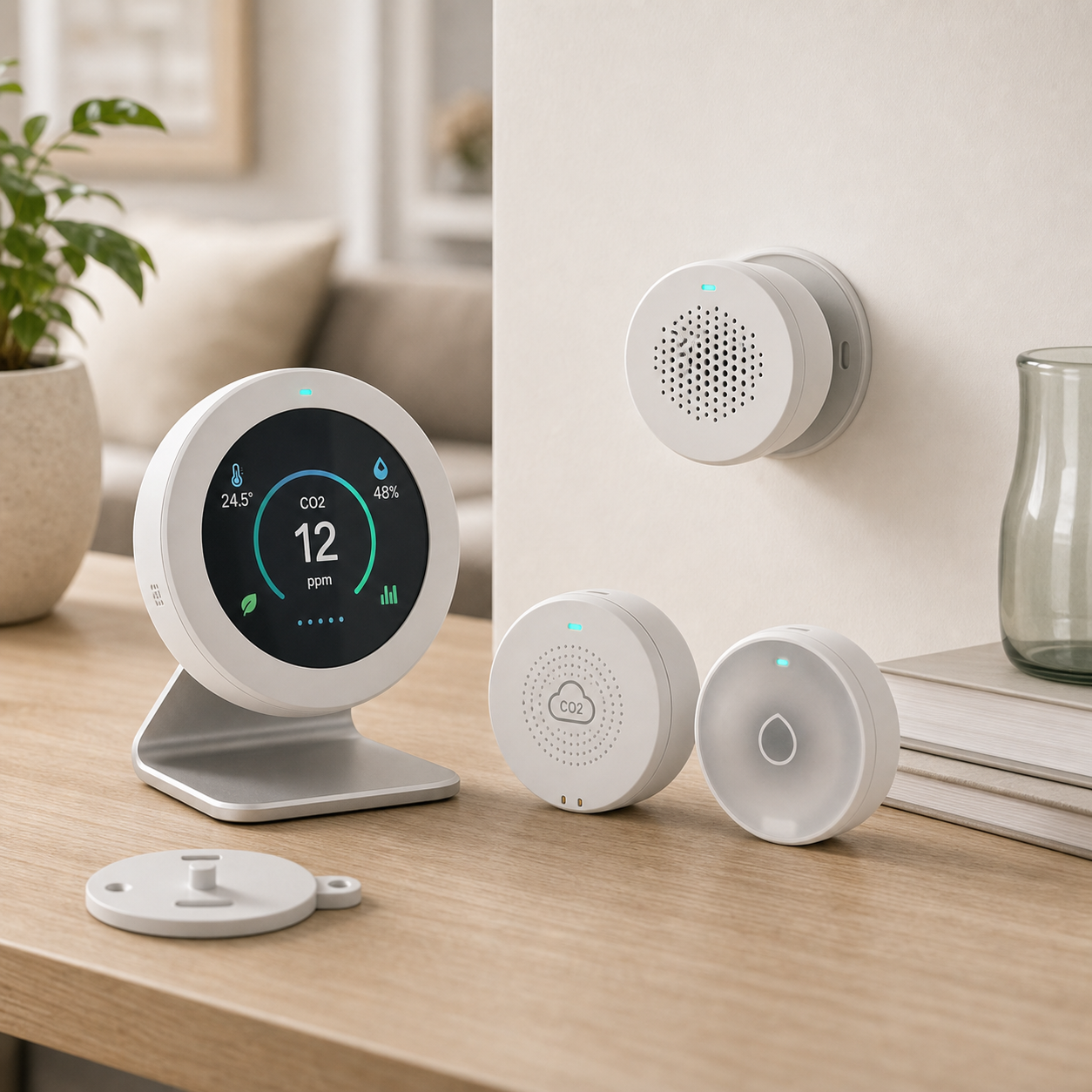
NDIR CO2 and eCO2 are not interchangeable measurements. A CO2 sensor detects carbon dioxide through its sensing principle; an eCO2 value is an estimated equivalent derived from another signal and an algorithm. Buyers should establish the sensor identity before approving display wording or comparing two indoor air monitors.
An attractive screen can show similar-looking numbers from different technologies. A parts-per-million label alone does not tell a buyer how the value was produced. For a home-awareness product, a clearly explained estimate may serve a limited purpose. For a project requiring actual CO2 measurement, substituting that estimate can undermine the application.
This NDIR CO2 vs eCO2 guide is for importers, workplace buyers and smart-home distributors assessing an air quality monitor kit. It explains questions to ask, not specifications confirmed for every catalog model. Proposed comparisons are buyer workflows, not KudBo laboratory results. These devices should not be assumed to be life-safety alarms, medical instruments or regulatory compliance tools.
Identify What the Display Actually Represents
Ask the supplier to list each displayed parameter, sensing component, measurement principle, unit and processing step. Distinguish a directly sensed quantity from a calculated index or estimate. A screen with several values may use fewer independent sensors than the customer expects. That is not automatically inappropriate, but it must be explained honestly.
Sensirion’s SGP30 description identifies a multi-gas sensor with VOC and CO2-equivalent outputs. Its technology overview separately explains sensing technologies such as infrared-based CO2 detection. These are examples of manufacturer documentation, not proof that a KudBo monitor contains those components.
An air monitor sensor identity record should include component revision where relevant and the assembled device’s firmware. A sensor data sheet describes the component under its specified conditions. It does not automatically establish the accuracy or behavior of the finished product, whose enclosure, placement and processing can influence performance.
Understand the NDIR CO2 vs eCO2 Decision
Actual CO2 sensing still has conditions
Non-dispersive infrared sensing uses infrared absorption associated with the gas to derive a concentration measurement. Other direct CO2 technologies also exist, so a procurement brief should describe the required measured quantity rather than treating one acronym as the only possible solution. Ask how the proposed technology supports the intended use.
Review measurement range, accuracy conditions, response behavior and environmental limitations for the actual component and assembled device. Do not compare a typical component value with another supplier’s guaranteed finished-device limit. Terms such as typical, maximum, repeatability and accuracy describe different evidence and should remain distinct in the comparison sheet.
eCO2 is an estimated carbon dioxide reading
An estimated carbon dioxide reading can be influenced by the underlying gas response and the algorithm’s assumptions. It is not a direct measurement of CO2 simply because its output uses ppm. Buyers should ask when the estimate is useful, what can affect it and how the limitation appears in the manual and on the display.
If the customer requirement is a CO2 concentration record, do not replace it with an eCO2 number without explicit acceptance and technical review. A lower component cost is not a valid reason to conceal the distinction. Keep the product label, website copy, quotation and application brief consistent with the actual output.
Match Measurement Scope to the Application
| Intended use | Buyer question | Evidence needed |
|---|---|---|
| General indoor awareness | What does each value mean? | Clear parameter definitions and limitations |
| Ventilation-related observations | Is CO2 directly measured? | Component identity and finished-device assessment |
| Historical records | How are values stored and time-stamped? | Export, retention and clock behavior |
| Smart-home automation | What drives the trigger? | Threshold logic and failure behavior |
| A specified building project | What requirements apply? | Project-specific specialist review |
Do not infer suitability for a building certification, occupational limit or formal report from a catalog label. The customer’s required method and evidence must be examined separately. Indoor air quality includes several different quantities; a CO2 result does not measure every pollutant or establish that a room is safe.
For a smart mirror weather panel, distinguish locally measured indoor values from weather or air-quality information obtained online. A remote data feed and a local sensor do not answer the same question. Both need accurate labels and a plan for unavailable or stale information.
Ask CO2 Monitor Calibration Questions Before Sampling
Ask whether the proposed device has factory calibration, automatic baseline correction, manual adjustment or another procedure. Clarify the conditions needed for each method. Do not assume an automatic routine is appropriate in every continuously occupied environment. The supplier should explain its assumptions and the consequences if those assumptions are not met.
Find out whether adjustment can be performed by the end user and how incorrect adjustment is prevented or reversed. A menu option called calibration is not evidence that a user has access to a traceable reference. Do not instruct customers to adjust the unit against another unverified consumer device.
For a procurement file, request the calibration record or policy appropriate to the promised performance. Identify the reference, date, method and scope where available. If the supplier provides no relevant evidence, mark the accuracy claim unresolved rather than converting a general factory statement into a verified numerical specification.
Design an Indoor Sensor Display Verification Trial
Begin with identity and labeling. Confirm that the display, manual and website call the same quantity CO2, eCO2 or a VOC index as appropriate. Check units, decimal precision and symbols. Excessive numerical precision can give a false impression even when the underlying measurement is limited.
Use an agreed reference and method for any performance comparison. Two consumer monitors placed together do not establish which one is correct. A specialist can define a suitable setup, environmental conditions, stabilization period and uncertainty treatment. Keep hazardous gases and improvised concentration generation out of an ordinary buyer demonstration.
A simple operational observation can still be useful: whether readings appear, whether the screen updates and whether the displayed data become stale after a connection interruption. Label that observation as a function check, not an accuracy test. It should not support a claim beyond what was actually observed.
Mid-Article CTA
Send Your Requirements with the quantities you need to measure, intended setting, data-recording requirement and order quantity. Email info@kudbo.com to discuss a model-specific documentation and sample request.
Review Placement and the Finished Enclosure
Air needs to reach the sensing path as intended. Ask where the monitor should be placed and what clearance its instructions require. A shelf location chosen for an attractive photograph can differ from the recommended measurement position. Do not place the device near an unusual local source and generalize the result to an entire room.
Check whether packaging, labels or decorative covers obstruct openings. For a private-label design, surface changes can affect more than appearance. Ask the supplier whether an enclosure modification needs renewed assessment. The component data sheet cannot resolve every consequence of a changed finished-device arrangement.
Document warm-up or stabilization requirements without inventing a universal time. If a supplier specifies one, tie it to the model and procedure. Explain how the user distinguishes a ready reading from an initial or unavailable value. A blank, frozen or default number should not be presented as a current measurement.
Treat Alerts and Thresholds as Separate Features
An alert function needs a defined input, threshold, delay and recovery behavior. Determine whether it is based on direct measurement, an estimate or a remote feed. Ask what happens if the sensor fails, the battery becomes low or the network disconnects. A colored indicator may be convenient, but it is not automatically a safety alarm.
Do not publish a universal healthy/unhealthy boundary without appropriate context and specialist review. Thresholds used in one application may not represent legal limits or medical advice. The product can explain an awareness feature without asserting that it protects users from all air-quality hazards.
If integration with ventilation equipment is proposed, review that system separately. A monitor’s output does not establish compatibility with every controller or guarantee that an automated response is suitable. Keep the relevant installer and project owner involved rather than turning a retail accessory into an unreviewed building-control component.
Verify Data Export and Time Behavior
For logged readings, establish timestamp source, time zone, sampling interval and missing-data handling. A chart can look continuous even when the device was offline. Ask whether gaps are identified and whether values are averaged, interpolated or replaced. The exported record should preserve those distinctions.
Review whether data remain local or are sent to a service. Identify account ownership and the process for deleting or transferring records. A buyer does not need to disclose real customer data during a sample trial; fictional room names and test accounts are sufficient. Keep data governance separate from sensor accuracy.
Test a representative export and check that the parameter name and unit survive outside the app. A CSV column labeled air quality is too vague if the procurement purpose requires a specific quantity. Documentation should allow someone who did not operate the device to understand what the record means.
Compare Quotations on Evidence and Support
Request a complete bill of functions rather than a screen photograph. Include sensor identity, firmware, power arrangement, logging, alerts and any subscription. Compare what is confirmed, what is provisional and what requires evaluation. A lower-cost estimate-based device and a directly measuring device should not be scored as identical products.
Ask how component substitutions are controlled. Replacing a sensing element or changing an algorithm can affect the meaning of the displayed value even if the housing stays unchanged. Require notification and review of the relevant claims. Retain the approved labeling and parameter definitions with the sample record.
Factory testing should distinguish basic assembly checks from calibration or performance assessment. Shipment inspection can confirm identifiers, package completeness and agreed operational checks. Do not interpret a powered screen as proof of accuracy, or a generic test statement as traceable calibration for the shipped lot.
Resolve a Procurement Mismatch Early
Imagine a hypothetical office buyer who requests actual CO2 measurements for a ventilation observation project. A supplier offers a device whose display says CO2 but whose component documentation identifies an equivalent estimate. The correct next step is to clarify the output and determine whether it meets the brief, not to assume the matching unit label settles the question.
The buyer can reject the substitution, change the application with appropriate review or request another model. Record that decision before artwork and purchasing. This example is not a KudBo customer case. It illustrates how a precise measurement requirement prevents a visually similar but functionally different product from entering an assortment.
Reconcile the Display With the Quotation
Before approval, compare the supplier quotation, manual, screen and exported file field by field. They should describe the same parameter. If one document says CO2, another says CO2 equivalent and the export uses a generic air-quality heading, ask the supplier to resolve the inconsistency rather than choosing whichever description sounds most impressive.
Review unavailable states as well as normal values. A frozen last reading can appear current unless the device clearly communicates its age. If the customer needs historical observations, timestamps and gaps should survive export. This is a data-meaning question, not only a screen-design preference.
Create a short internal explanation for the sales team that names the actual quantity and its limits. They should not call an estimate a direct measurement when answering an enquiry, or imply that one value represents every indoor hazard. Keep the explanation tied to the model revision so it is updated when the sensing or processing changes.
For a project enquiry, ask what the customer needs to decide from the reading. That answer helps separate an awareness accessory from an application requiring specialist measurement evidence. It also makes the quotation more useful: the supplier can identify a suitable configuration or flag a mismatch before the buyer orders an attractive but inappropriate display.
Related Buyer Resources
Continue with AI Meeting Recorders: Enterprise Onboarding for a complementary purchasing question. Compare the full product catalog, or browse the KudBo sourcing blog or the product sourcing topic collection for additional buyer guides. These resources provide decision context; each product still needs its own model-specific approval.
Frequently Asked Questions
Is eCO2 a direct carbon dioxide measurement?
No. It is an estimated equivalent output derived from another signal and processing method. Ask the supplier to identify the component and explain the estimate’s limitations. If the application requires actual CO2 concentration measurement, do not approve eCO2 as a substitute without explicit technical acceptance.
Does a sensor data sheet prove finished-monitor accuracy?
Not by itself. The component specification has stated conditions, while the finished enclosure, placement and processing can affect operation. Request evidence appropriate to the assembled model and proposed claim. Keep typical component performance separate from any guaranteed limit offered for the complete retail device.
Can two consumer monitors calibrate each other?
Agreement between two unverified devices does not establish accuracy. A proper assessment needs an appropriate reference, method and uncertainty treatment. Do not advise customers to adjust one device to match another merely because it appears plausible. Use the manufacturer’s reviewed procedure and competent specialist guidance where required.
Does a CO2 reading show that all indoor air is safe?
No. CO2 is one quantity and does not measure every pollutant or hazard. An awareness monitor should not be promoted as a life-safety alarm or medical instrument without appropriate evidence and assessment. Explain the device’s measurement scope, intended use and limits clearly to the buyer and end user.
What should change control cover?
Include sensor substitutions, firmware, relevant algorithms, enclosure airflow paths and displayed parameter wording. These can change measurement meaning or behavior without altering the product’s appearance. Require notification and review the affected claims, retaining the approved revision and evidence for repeat orders and customer support.
Conclusion
The NDIR CO2 vs eCO2 comparison begins with measurement identity. Define what the customer needs, verify how each value is produced and match the finished-device evidence to the claim. Clear parameter labels and honest limitations are more useful than a screen that presents different technologies as equivalent.
Final CTA
Contact Us or email info@kudbo.com with your destination, quantity, required parameters and recording needs. KudBo can discuss available catalog options and documentation requests. Confirm the actual sensor configuration and application suitability before approving the order.