Introduction
Compression can save space in a suitcase without reducing the mass of its contents. That distinction is central to an honest vacuum travel pouch listing. The KudBo vacuum compression travel pouch is described as a kit with a compact rechargeable pump. A buyer must know whether that pump fits every pouch in the retail pack, how the valve behaves during travel and what happens when the battery is empty. The price of a complete bundle should be compared with the complete ownership routine, not a before-and-after photograph alone.
Earlier guides cover vacuum pouch valve and seal checks and vacuum pouches versus compression cubes. This article focuses on pump compatibility and the baggage-weight misconception. The suggested tests are a buyer's protocol; they are not a claim that a specific KudBo sample achieved a measured reduction.
Define the Retail Bundle Precisely
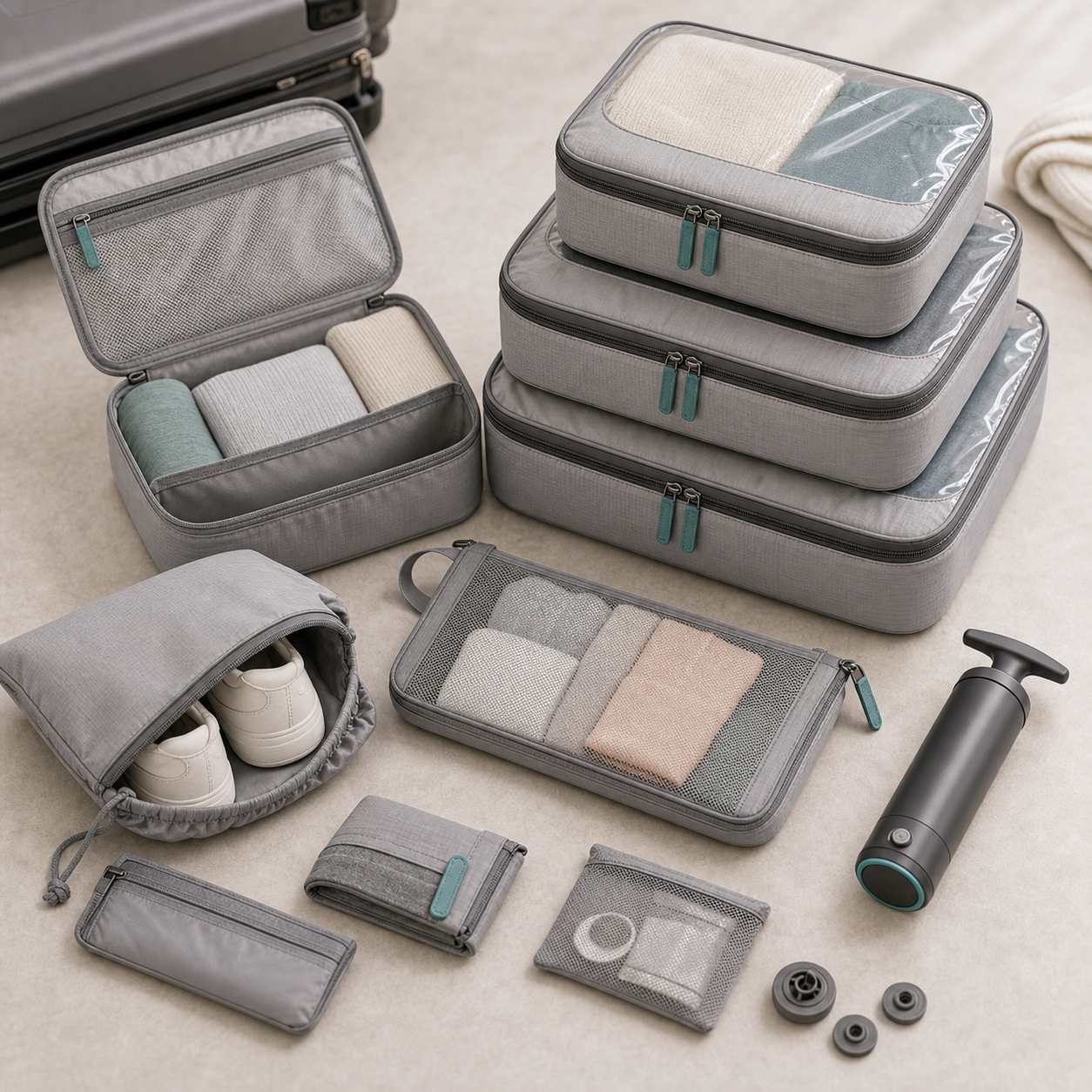
Write a bill of materials for each SKU: pouch count and sizes, valves, caps, pump, charging cable, spare seals, instruction card and storage bag. A photograph may show several pouches while the quoted pack includes only one. Ask the supplier to place every retail item on a table and label it before pricing. An import buyer should distinguish the pump's accessory count from the pouch count; two identical-looking valves may use different adapters across revisions.
Record the pump input and battery type from the actual device, not from a similar model. If the pump charges by USB-C, specify whether the cable and power source are included. Some travelers may use a separate charger; that is not necessarily a defect, but the customer needs to know. If the kit can be operated manually when the pump is unavailable, demonstrate the method and describe its effort honestly. Do not invent a manual fallback because it sounds convenient.
The pouch's usable size depends on its closure and fill instructions. Measure the loaded profile after sealing, with a reference set of garments. A flat bag dimension is not the same as the resulting stack in a suitcase. The buyer may find that several smaller pouches are easier to fit around a suitcase frame than one large slab; that is a merchandising and pack-out choice, not a universal performance rule.
Confirm Pump-to-Valve Fit Across Revisions
Test every pouch size with the exact pump and adapter supplied. The nozzle should seat without tearing the valve or requiring a hand to hold an awkward angle for the whole evacuation. Check how the pump indicates completion, whether it overheats under repeated cycles and whether users can remove it without reopening the valve. If there is a spare cap, test it as a real protective part rather than a decorative cover.
Build a small compatibility matrix by pump revision, nozzle type and pouch valve. Keep photos of the connection and part numbers in the reference file. A supplier can change a valve membrane while retaining the same pouch fabric; that may affect fit and after-sales replacements. Ask for change notice before repeat orders. If a buyer sells pouches separately later, the product page should say which pump versions work with them.
The presence of a valve does not make a pouch permanently airtight. A long-trip claim needs defined storage conditions, fill materials and a time interval. Garments, seams and user handling can all affect the result. Test a normal packed suitcase after several open-and-close cycles, not only a fresh bag laid flat on a studio table.
Explain the Weight Boundary Clearly
A vacuumed set of clothes retains essentially the same mass; the pump and pouch add their own mass. Compression can even make it easier to exceed a baggage weight limit because more items fit. A buyer should place the filled pouch, pump and final suitcase on a scale and show that full-system weight in any packing comparison. Do not say the product “reduces luggage weight” unless some material is actually removed from the packed contents.
The IATA baggage guidance describes the broader airline baggage context; it is not a universal weight or dimension allowance. Individual carriers and tickets set their own terms. A product listing should tell travelers to check current airline rules and weigh the final bag. A dramatic compressed-volume image is useful only when it does not imply the airline will accept a heavier case.
If the rechargeable pump uses a lithium battery, confirm its documentation and the current carriage rules for the target routes. The IATA traveler battery resource is a starting point, not approval for a particular pump. The buyer should provide the actual battery information and ask its logistics partner to review the packed configuration. Do not print “airline approved” on the carton from an unrelated device's test report.
Mid-Article CTA
Send Your Requirements with pouch sizes, pump version, destination markets, charging expectations and desired pack count. Email info@kudbo.com for a component-level sample and packaging review.
Review the Packing Sequence End to End
Ask a first-time user to pack a weekend clothing set with only the supplied instructions. Observe whether garments block the zipper, whether the user can find the valve, how long a normal pump cycle takes under defined conditions and whether the packed bag fits the intended luggage. Then ask them to unpack and repack without the pump. This trial reveals what a still photograph cannot: whether the product is practical during a return trip when the traveler is in a hurry or the battery is low.
Check noise and heat only with a declared measurement method if they will become marketing claims. A small electric pump may be acceptable at home but intrusive in a shared hotel room. A buyer can position the kit as pre-trip organization rather than promising effortless repacking everywhere. Keep any recorded observations tied to the exact pump and garment load; different textiles compress differently.
After repeated use, inspect zipper teeth, seam stress, valve contamination and pouch cleaning instructions. A waterproof-looking coating does not automatically mean the entire pouch can be machine washed. The pump should be stored away from moisture and loose lint according to the maker's directions. Quote spare pouches and adapters if the program is meant to support repeat retail purchases.
Treat Accessories and Returns as Part of Cost
A lost charging cable is relatively easy to replace when a standard connector is used; a proprietary nozzle may not be. Ask the supplier which parts can be ordered separately, how customers identify pump revisions and whether a return can be diagnosed without sending the entire suitcase kit back. A support guide can ask users to check a seal, valve and battery state before declaring the pump defective, but it must not instruct them to dismantle a rechargeable cell.
At shipment inspection, count pouch sizes, caps, pump and cable, confirm markings and run a defined connection check on a sample. Check that the manual includes first-use charging and safe packing instructions. An inspector can find a missing nozzle; it cannot prove a claim that the pouch will remain compressed through every climate and journey. Preserve any longer-use evidence separately.
For a private-label launch, photograph the actual complete kit against the approved bill of materials. If the hero scene includes a luggage scale or garment set, mark them as props. A clear retail pack supports informed purchases and can reduce returns better than another exaggerated percentage claim.
Compare the Bundle Price Fairly
A low pouch-only price should not be compared directly with a kit that includes a rechargeable pump, adapters and spare seals. Ask for a priced bill of materials and show the exact set in the listing. If the pump is shared across several pouches, determine whether a future pouch-only refill can use the same nozzle revision. A proprietary connector can make the initial kit inexpensive but the replacement program difficult. The buyer should calculate the cost of serving a customer who needs one more pouch, one lost cap or one failed pump.
For packaging, show the pump as carried, not only attached to a pouch on a studio table. Travelers need to know where to store its cable and how to keep lint out of the nozzle. If lithium battery documentation is required for shipping, obtain it for the exact pump revision and destination route. Do not treat “rechargeable” as enough information for freight acceptance or passenger carriage. The final instructions should separate airline policy from the product's mechanical function.
Pilot feedback should ask whether users completed the return trip with the same kit. A departure-only success can hide battery and repacking problems. Record valve compatibility, pouch expansion and final bag weight separately. That information can guide a spare-cap decision, a different pouch mix or a clearer airline disclaimer. A product that honestly organizes volume can be valuable without promising that it reduces travel weight.
Model the Airport and Return-Trip Experience
The buyer should build two packing scenarios: the departure bag packed calmly at home and the return bag packed in a small room with limited time. Use the same clothing inventory in both. At home, the traveler may have a charger, clean floor and enough time to compress several pouches. On the return trip, the pump could be low on charge and the clothing could be slightly damp. The kit's usefulness depends on whether its instructions describe a realistic response to these differences.
An airline-facing test should include the entire bag: suitcase, clothing, pouches, pump, charger if carried and any purchases added during travel. Measure the finished weight and dimensions. A volume claim about one pouch does not establish that the finished bag meets the carrier's allowance. The buyer should avoid “carry-on approved” without specifying a carrier, fare and actual bag dimensions. Pouch compression can reduce bulging, but rigid case shells and handles still determine the external size that gate staff see.
Consider airport security inspection. A tightly compressed pouch may need to be opened for inspection and repacked afterward. Do not suggest that a sealed pouch prevents inspection or guarantees that it can be reclosed instantly in a queue. Ask the sample user to repack without their preferred tabletop, and note whether the pump nozzle and cap are easy to locate. A small accessory bag can prevent loss if genuinely included. If not, the product page should not imply that the pump has a dedicated compartment.
Customer-support scripts should separate three failure reports: the pump does not start, the pump starts but does not seal to a valve, and a sealed pouch gradually expands. Those require different evidence. Request a short video showing the nozzle and valve for fit complaints, but do not ask the customer to expose personal travel details unnecessarily. The supplier should provide replacement part numbers and a warranty path for each component. A returns process that replaces the whole kit for a missing cap may be needlessly expensive, while one that refuses support for an incompatible pump revision is equally poor.
Frequently Asked Questions
Does a vacuum pouch lower checked-bag weight?
No. It changes volume, not the mass of packed clothes. The pump and pouch add weight, so customers should weigh the finished suitcase.
Will one rechargeable pump fit every pouch?
Not necessarily. Approve a pump-to-valve compatibility matrix for each quoted pouch and revision, including any separately sold refills.
Can a traveler bring the pump on a flight?
The answer depends on its actual battery, packing and current carrier rules. Provide the battery details and direct travelers to the airline rather than promising universal acceptance.
What happens if the pump battery is empty during the return trip?
Check whether the kit has a documented manual method or another supported pump option. Do not assume one; make the limitation clear before sale.
Is a compressed pouch permanently airtight?
No universal retention claim is sound. Test the selected construction under defined contents, closure method, handling and time before publishing any duration.
Conclusion
Vacuum travel pouches are most credible when the pump, valves, garment load and final baggage weight are treated as one use system. The buyer should approve every connection, explain the airline boundary and give customers an achievable return-trip routine.
Final CTA
Get a Quote for your pouch-and-pump bundle or email info@kudbo.com. Compare the current KudBo products, all buyer guides and Product Sourcing topics before finalizing the accessory specification.