Introduction
Vacuum pouches save space by removing air from a sealed bag; compression cubes organize clothing and reduce its thickness with a second zipper. Neither removes the weight of the garments. For a cabin-luggage assortment, the better choice depends on the traveler’s clothing, access needs and ability to repack during the journey, not on the most dramatic supplier photograph.
A traveler carrying bulky knitwear may value a vacuum pouch. Someone changing hotels each night may prefer accessible cubes that do not need a pump. A compact suitcase can still exceed its airline weight allowance after compression. Buyers therefore need separate answers to three questions: how much space is reduced, how easily the system can be reused, and how clearly its limitations can be explained on the package.
This guide helps importers, luggage retailers and corporate-gift buyers compare vacuum compression travel pouches with compression packing cubes. The procedures below are proposed buyer evaluations, not claims that KudBo has performed these tests or achieved a stated saving. Agree the final method, sample size and acceptance limits with the supplier before approval.
What the Two Mechanisms Actually Do
A vacuum pouch depends on a sealed air path
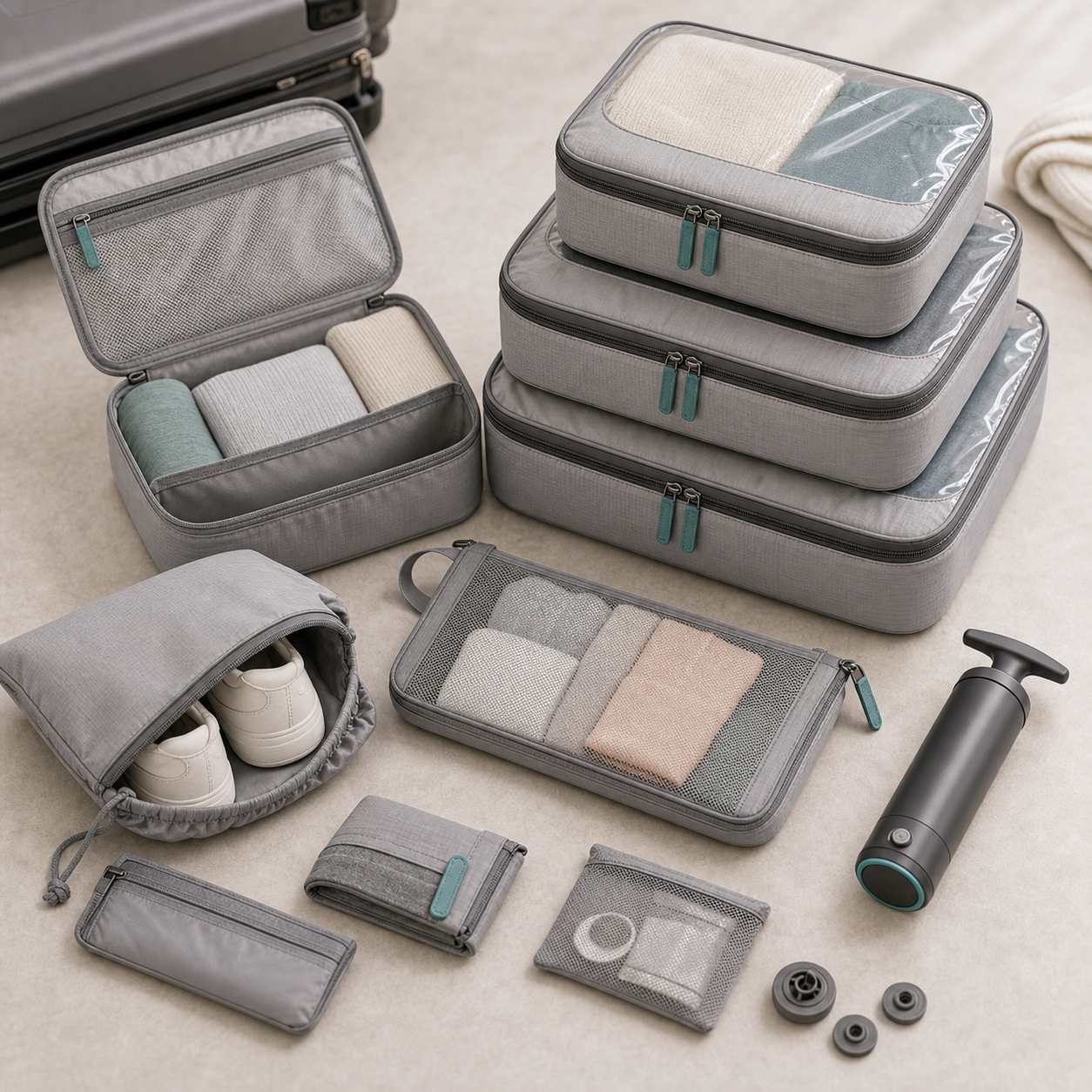
A vacuum pouch usually has a closable opening and a valve. Removing air reduces the spaces between suitable soft contents. The resulting shape depends on fabric thickness, folds, trapped air and the pressure applied during packing. A supplier may provide a hand pump, an electric pump or a roll-to-expel design. These are different user experiences and should not share one description without confirmation.
The closure and valve must remain functional after opening, repacking and normal handling. One successful compression does not establish repeat performance. Ask whether the supplied pump fits only this valve, whether it requires charging and whether a replacement is available. If the bag can be compressed without the pump, obtain the intended instructions rather than assuming every valve permits this.
A compression cube depends on controlled loading
A cube normally has a loading zipper and, on some models, a separate compression zipper. It pulls the fabric walls around the clothing rather than evacuating air through a valve. Mesh panels can make contents visible, while softer walls allow the filled cube to conform to a suitcase. These benefits do not prove that every garment becomes smaller or less creased.
An overfilled cube can transfer force to seams, zipper teeth and the slider. A more rigid construction may be easier to stack but heavier when empty. Establish which feature matters to the assortment: maximum reduction, organization, access or packing speed. A cube selected for frequent business trips should not be judged solely by the thickness of one packed demonstration.
Compare the Products Against a Travel Routine
| Buying decision | Vacuum pouch | Compression cube |
|---|---|---|
| Bulky soft clothing | Potential space reduction depends on load and sealing | Reduction depends on zipper travel and fabric construction |
| Frequent access | May require resealing and recompression | Usually accessible through the loading zipper |
| Return journey | Pump or roll method must remain available | No evacuation pump needed for a zipper design |
| Contents visibility | Depends on film and printed coverage | Depends on mesh and opening design |
| Key failure mode | Valve or closure loses the compressed condition | Overloading damages zipper or seam |
| Weight management | Packed garments retain their mass | Packed garments retain their mass |
Build a short journey description before requesting quotations. Include suitcase internal dimensions, typical garments, trip length, how often the traveler opens the bag and whether a pump is realistically carried. A cabin luggage compression bags program aimed at winter holidays can differ materially from a pump free packing cube comparison for short work trips.
Security screening is another reason to test reopening. The TSA’s complete permitted-items list says vacuum-sealed clothing bags may need opening if they alarm during inspection. This is guidance for US screening, not a worldwide rule or an airline baggage allowance. Product copy should tell customers to check their operator and destination requirements.
Measure Volume Without Creating a Misleading Claim
Define the baseline and the load
Use the same garments, folding method and suitcase for both samples. Photograph the load before packing, record its mass and identify each garment. Do not compare an untidy pile with a neatly folded compressed bag and call the entire difference a mechanism benefit. The baseline should represent a reasonable alternative packing method.
For luggage volume reduction testing, choose a repeatable measurement that fits the claim. External length, width and maximum thickness can be useful for rectangular loads, but a rounded bag is not a perfect rectangular block. A bounding-box calculation measures occupied envelope, not exact garment volume. State that distinction in the report and do not present the result with unrealistic precision.
Measure immediately after packing and after the agreed waiting period. For a vacuum pouch, that second observation helps reveal air return. For a cube, it helps reveal fabric relaxation or shifting contents. Record room conditions, sample identification and the person performing the packing. These details make a comparison reproducible instead of dependent on one especially skilled demonstrator.
Keep hypothetical arithmetic separate from evidence
Suppose a trial load has a measured envelope of 12 liters before compression and 9 liters afterward. The calculated envelope reduction would be 25 percent: the difference divided by the baseline. Those numbers are an illustration of the calculation, not a KudBo product result or an expected saving. A different load, measurement method or waiting period can produce a different answer.
Evaluate several realistic loads rather than choosing the most compressible one for all advertising. Lightweight shirts, bulky fleece and mixed garments can expose different limitations. Keep footwear, sharp objects and unsuitable items outside the trial unless the supplier expressly approves them. Do not extend a clothing-storage result to food storage, waterproof protection or delicate equipment.
Run a Travel Pouch Repacking Test
A useful travel pouch repacking test follows the journey rather than merely repeating an empty closure. Start with the approved garment load, compress it using the supplied instructions, place it in the suitcase and then reopen it. Remove one item, replace it and repeat the intended packing procedure. Record the steps that are confusing or difficult without coaching.
Include the return journey. The traveler may have laundry, a less convenient work surface and no access to a powered pump. If an electric pump is included, verify its charging connection and transport instructions independently. A product that works well at home can disappoint when its essential accessory is forgotten. This is a positioning issue as well as a mechanical test.
Do not invent a universal cycle count. Agree a screening sequence that reflects expected use, then ask whether a longer durability assessment is justified. A short buyer trial is not a lifetime guarantee. Factory testing can add controlled valve, closure and seam checks, but the supplier must describe the equipment, conditions and failure criteria behind any durability claim.
Mid-Article CTA
Planning a travel-storage range? Send Your Requirements with the intended suitcase size, garment mix, quantity and preferred packing method. Email info@kudbo.com to request a model-specific comparison and sample-review checklist.
Inspect Construction Where Failures Start
Closure and valve details on pouches
Check whether the closing guide reaches the entire seal and whether instructions show the correct sequence. Look for folds or debris in the sealing path. Examine the valve cap, its attachment and any separate seal that can be misplaced. These observations help identify service needs; they do not substitute for a controlled leakage method.
Separate damage caused by misuse from failure under the approved load. A sharp garment accessory may puncture a film that is otherwise suitable for soft clothing. That possibility should lead to clear packing instructions, not an unsupported claim that the bag is puncture-proof. Ask which film construction is quoted and how changes in film thickness or valve supplier are controlled.
Zippers and seams on cubes
Check the loading opening, compression track and zipper end stops while the cube is filled. Observe whether fabric catches near the slider. Inspect seam lines where compression force concentrates. An attractive empty sample can conceal limited compression travel or an opening that becomes difficult to use when packed.
Agree how to classify a nonfunctional closure, a detached handle, a cosmetic thread and a missing accessory. Each issue has a different consequence. Shipment inspection should compare packed production units with the approved model and include a practical functional check, not only photographs of empty cubes laid flat on a table.
Request Quotations on the Same Retail Unit
Wholesale travel storage selection often goes wrong when quotations describe different bundles. One pouch offer may include an electric pump and another only a valve adapter. One cube set may have three sizes and another four. Record the item count, usable dimensions, empty mass, materials, accessories and retail packaging before comparing prices.
Ask for carton dimensions and gross weight based on the proposed pack-out. An oversized gift box can erase the freight advantage of a compact organizer. Where cartons are provisional, mark them as estimates and obtain confirmation before transport booking. The final cost comparison should include sample work, artwork, accessories, spares and handling, rather than treating the lowest unit price as the whole decision.
For a private-label program, decide what can change without further approval. Color may be commercially important, but a replacement zipper or valve can alter function. Require written notification of changes to the parts responsible for sealing or compression. Retain the approved sample and dated specification together so a repeat order does not depend on memory.
Write Honest Instructions and Product Claims
Avoid a fixed percentage reduction unless supported by a clearly defined method and representative results. A qualification hidden in small print cannot repair a dramatic headline that suggests all travelers receive the same saving. The FTC’s advertising guidance provides the broader principle: advertising claims need appropriate support and must not mislead consumers.
Useful instructions explain suitable contents, correct closure, maximum practical loading, pump dependence and storage after use. If the model has no validated waterproof claim, do not imply that compressed clothing remains protected in water. Likewise, compression is not a substitute for checking suitcase dimensions or weighing luggage before departure.
Have a person unfamiliar with the product read the draft insert and pack a sample without verbal help. Record hesitation and incorrect steps. Change the instructions where necessary and rerun the task. This modest exercise can expose a missing diagram more efficiently than adding another paragraph of promotional language.
Build a Small Assortment With Clear Roles
A two-product range can work when each item has a distinct job. A pouch can address bulky seasonal clothing, while cubes can organize frequently accessed garments. Do not bundle both solely to increase item count. Demonstrate how they fit in the selected suitcase and confirm that the package contains every essential accessory.
For corporate gifts, test the first-use experience with the actual branded packaging. For travel retailers, consider a display that shows the closure and explains pump dependence. For online selling, include full-product photographs, usable dimensions and a realistic packed view. These choices reduce ambiguity without promising an unverified performance result.
Before approval, compare three records: the commercial quotation, the tested sample specification and the retail copy. They should describe the same mechanism, accessory set and use limitation. If they disagree, resolve the mismatch before printing. The KudBo product catalog can help frame complementary travel items, but compatibility and pack-out still need individual confirmation.
Check the Return-Journey Package
Include a brief return-journey review in sample approval. Ask whether the traveler can identify the closing method after the paper sleeve is discarded, and whether an essential pump still fits in the luggage after repacking. A compact outbound arrangement can become awkward when the contents change.
For a cube set, confirm that each size has a clear role rather than adding a small piece that customers rarely use. For a pouch, verify whether the valve cap and closing guide remain attached or require separate storage. These details belong in the retail-unit list because losing a small accessory can change the next packing task.
Related Buyer Resources
Continue with Travel Steamer vs Travel Kettle for Hospitality Gift Programs for a complementary purchasing question. Compare the full product catalog, or browse the KudBo sourcing blog or the product sourcing topic collection for additional buyer guides. These resources provide decision context; each product still needs its own model-specific approval.
Frequently Asked Questions
Do vacuum pouches make cabin luggage lighter?
No. Removing air changes packing space, not the mass of clothing. The pouch and any pump also add their own mass. Buyers should keep volume-reduction claims separate from weight-management claims and encourage customers to check baggage limits and weigh the complete suitcase before travel.
Are compression cubes better for short business trips?
They can be convenient when travelers need frequent access and do not want to carry a pump. That advantage depends on the cube’s opening, zipper design and packed fit. Validate the actual journey and garment load rather than assuming every compression cube is equally easy to reopen.
Can a vacuum pouch be repacked after security inspection?
That depends on its closure and evacuation method. Test reopening, garment removal and recompression using only the accessories a traveler will carry. Screening practices vary. US TSA guidance notes that vacuum-sealed clothing bags may need opening for inspection, so effortless repacking should not be assumed.
What is a credible compression percentage?
A credible figure identifies the sample, garment load, baseline, measurement method and observation time. It should distinguish occupied envelope from exact volume and disclose relevant conditions. A supplier photograph or one unusually compressible load is not enough to support a general percentage for every customer.
Which documents should a wholesale buyer retain?
Retain the agreed retail-unit list, dated specification, approved sample identity, test method, results, artwork and change-control record. Add inspection evidence for the shipped lot. Together these establish what was ordered, what was evaluated and whether production matched the approved configuration, without implying universal performance.
Conclusion
The vacuum pouches vs compression cubes decision is best made around a travel routine. Compare the same garments, measure space and mass separately, and repeat packing with the accessories available during the journey. A well-positioned product delivers a clear benefit within stated limits; it does not need an exaggerated savings promise.
Final CTA
Ask for Product Catalog or email info@kudbo.com with your destination market, target quantity, suitcase dimensions and desired bundle. KudBo can discuss available options and the evidence to request before a purchase decision. Confirm final specifications, pricing and sample arrangements in writing.