Introduction
Vacuum insulated bottle sourcing should start with the drink, lid and daily use pattern, then move to material records and repeatable tests. For overseas importers, private-label sellers and corporate gift buyers, the best comparison is between complete bottles under the same conditions. A steel grade or a long temperature-retention claim cannot answer whether the finished product leaks, cleans easily or fits the intended application.
A commuter bottle, a desk tumbler and an outdoor flask solve different problems. Before requesting samples, decide whether users will carry the product inside a bag, drink hot liquids through a spout, wash it in a dishwasher or replace worn seals. Those decisions determine what to ask the factory and which attractive catalog options to remove from the shortlist.
Quick Answer: What Should the RFQ Specify?
Specify nominal and usable capacity, beverage restrictions, inner and outer materials, closure design, seal identification, dimensions, empty weight, finish, cleaning method, packaging and the evidence required for every performance claim. Ask suppliers to quote against one shared brief. Keep unconfirmed features marked as pending rather than letting them become printed promises.
Use this initial decision sequence: application first, closure second, cleaning third, measurable performance fourth, decoration fifth. This order prevents a logo treatment or fashionable silhouette from locking the project into a bottle that is difficult to use. A buyer can change a color comparatively late; a change from straw lid to hot-drink closure may require a different safety and validation review.
Match the Lid to the Beverage and Carrying Method
A screw closure offers a different use experience from a push-button spout or an exposed straw. For bag transport, specify the closed position, locking mechanism where present and orientation used for leakage evaluation. For desk use, assess one-handed operation and whether a protruding handle or base interferes with storage. Avoid treating the word “travel” as a complete specification.
Hot beverage suitability needs explicit confirmation for the complete lid assembly. Do not assume every lid supplied with a steel bottle is suitable for hot liquids. Ask how the user opens it, whether liquid can collect around the drinking outlet and how the instructions communicate permitted beverages. Request the actual instruction sheet with the sample instead of writing it from a product photograph.
Compare Cleaning and Reassembly
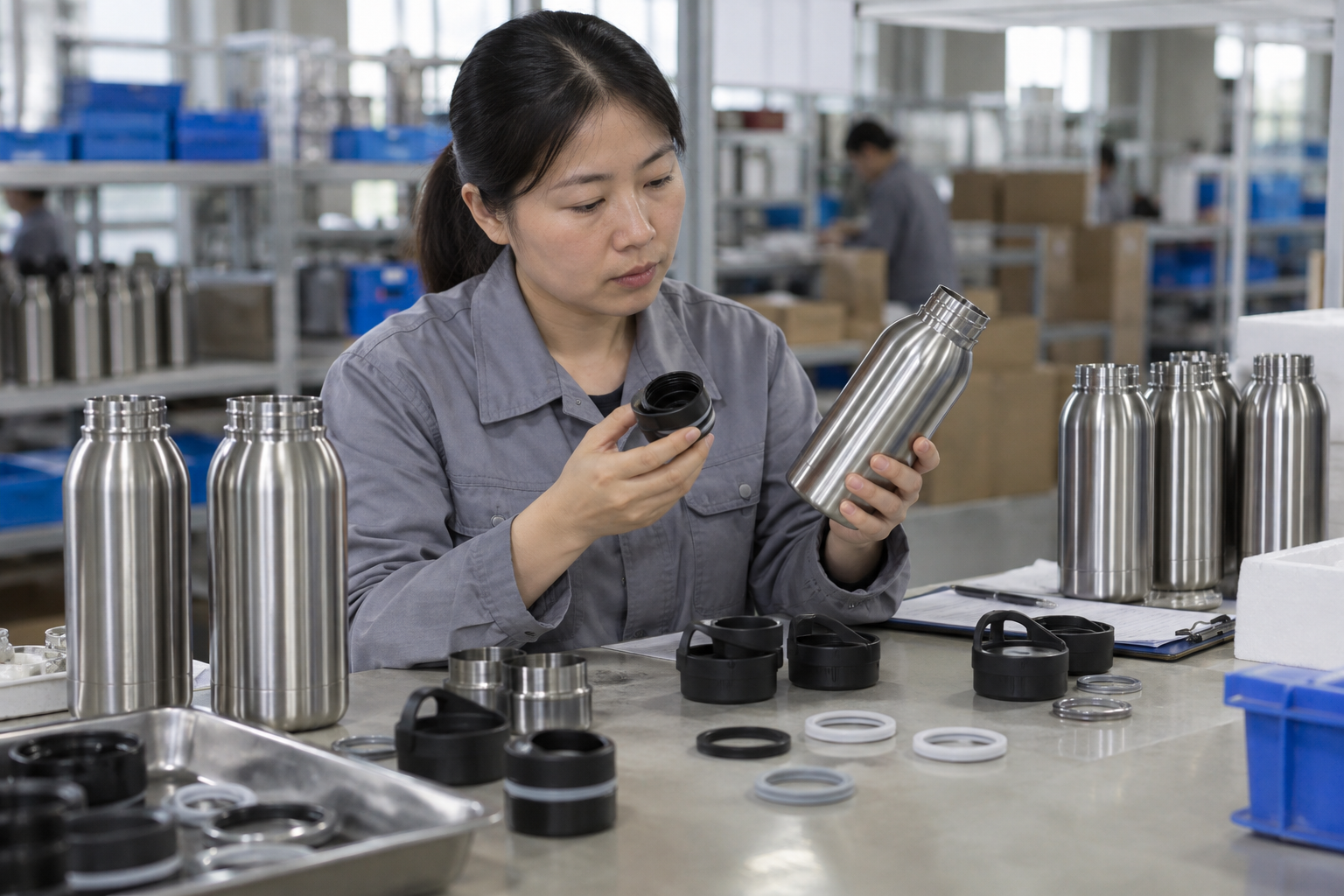
Have the supplier demonstrate how each removable seal is taken out and correctly refitted. Record the orientation, whether different seals look similar and whether the assembly can appear closed when a gasket is misplaced. Small components should have identifiable service part references. A lid that needs careful reassembly may be acceptable, but that burden belongs in the selection decision.
An illustrative sample review can involve one buyer following only the draft instructions while another records uncertainty. This is a proposed usability exercise, not a reported KudBo test. If the user has to guess where a seal belongs, revise the drawings or change the design before approving packaging. A short cleaning demonstration often reveals more than an additional beauty photograph.
Read Material Evidence at Component Level
Request the inner vessel material, outer shell material, lid polymer, gasket material and any coatings or adhesives relevant to the intended contact conditions. Connect each declaration or report to a component code and supplier revision. A generic “stainless steel” statement does not identify the complete product, and a report on one polymer does not describe every lid or color.
For food-contact documentation, review the destination market and intended beverage, temperature and contact duration with the appropriate laboratory or specialist. The European Commission food-contact materials overview explains the EU framework; it is not a certificate for a particular bottle. Use its scope to organize questions, then obtain evidence covering the actual supplied materials.
Ask whether a new color, seal compound or interior process changes the evidence package. Put that question into the purchase specification. Suppliers should identify substitutions before using them, including changes that are invisible in a finished-product photograph. The purpose is to keep the physical item connected to the reviewed information throughout production.
Make Temperature-Retention Claims Comparable
A useful comparison protocol records starting liquid temperature, fill quantity, room conditions, lid configuration, preconditioning, measurement times and the temperature criterion behind the claim. Ask whether the lid remains closed between readings. Repeated opening can change the result, while different fill levels can make two apparently similar marketing statements impossible to compare fairly.
As a clearly illustrative discussion draft, buyers might ask a laboratory to propose measurements at 0, 2, 6 and 12 hours in a controlled 20–25°C room. These values are not a required standard or a performance promise. The final conditions, instruments, uncertainty and acceptance limits need agreement before testing. Choose intervals that match the intended use rather than the largest number that fits a carton.
THERMOS care guidance links performance and cleaning advice to product-specific instructions and discusses preheating for retention. That manufacturer example supports asking about preparation conditions; its products and results should not be used as evidence for an unrelated private-label bottle. Request the supplier’s complete method and results for your model.
Keep Raw Records With the Summary
A one-page pass sheet is easier to read, but retain the underlying measurements and sample identifiers. Record whether each sample came from tooling trials, a sales sample shelf or the actual production lot. When the lid or body changes, decide which evaluations must be repeated. A revised model should not silently inherit the best result from an earlier configuration.
Separate Leakage, Retention and Handling
Leak resistance and insulation are different questions. A bottle may preserve temperature while losing liquid through a poorly fitted gasket. Ask for leakage checks that represent the intended closed condition and carrying orientations, followed by inspection of the thread, gasket seat and drinking outlet. Do not invent a universal test duration that ignores the application.
Handling evaluations should consider whether the product can be gripped, opened and carried with the expected contents. Review a full sample as well as an empty one. A narrow handle that feels comfortable on the bench may be less useful when filled. Check that decorative sleeves, straps and accessories do not obstruct closure or conceal parts that require cleaning.
If impact or drop testing is needed, define height, surface, orientation, conditioning and post-test evaluation with a competent provider. A cosmetic dent and a loss of vacuum are different outcomes and should be recorded separately. Keep factory testing for process control distinct from an independent qualification exercise. Both can be useful, but neither should be described as the other.

Mid-Article CTA
Send Your Requirements. Explore KudBo’s product catalog and email info@kudbo.com with your target capacity, beverage use, lid preference, destination and order quantity. Ask for a comparison brief covering samples, decoration, documentation and inspection rather than an unsupported retention headline.
Compare Capacity, Dimensions and Decoration
Define whether capacity means brimful volume or a recommended working fill. State the measurement method and the headspace needed for the lid. For a gift set, compare packed dimensions as well as bottle dimensions. A wider silhouette may alter the insert, master carton and shipping volume even when nominal capacity stays the same.
If cup-holder fit matters, name the reference opening or provide a dimensional drawing. “Fits most vehicles” is difficult to verify without a defined basis. Measure the base, widest body section, handle projection and total height with the lid installed. Include tolerances on the drawing rather than asking an inspector to judge a fit claim from appearance.
Decoration needs its own approved sample. Review print placement, color under agreed lighting, surface preparation and resistance to the cleaning routine you intend to recommend. Laser decoration and printed graphics create different visual effects; neither should be selected only from a digital mockup. Ask the factory which processes are available for the exact finish and how they control repeat orders.
Build a Practical Comparison Table
Use a weighted decision sheet, but make mandatory requirements pass-or-hold gates before scoring appearance or unit cost. A low price should not compensate for missing material identity or an unsuitable lid. The table below is a procurement template; it contains questions rather than assumed results.
| Decision area | Evidence to request | Hold the decision when |
|---|---|---|
| Beverage use | Model-specific instructions | Hot-liquid compatibility is unclear |
| Seal system | Exploded drawing and spare code | Gaskets cannot be reliably identified |
| Retention | Method and sample-linked readings | Only a headline duration is supplied |
| Bag transport | Defined closed-condition leakage review | Closure configuration differs from sample |
| Cleaning | Complete assembly care guidance | Body and lid instructions conflict |
| Decoration | Approved finished sample | Production process remains unspecified |
| Packaging | Insert and carton prototype | Lid or body can strike adjacent units |
Keep comments beside each score. “Easy cleaning” should refer to observable features such as access to a recess or clear gasket orientation. A second buyer should be able to understand why one sample was preferred without repeating the entire review. This makes approval more durable when purchasing, quality and marketing teams change.
Prepare Packaging for the Actual Sales Channel
For retail shelves, ensure the carton explains capacity, beverage limitations and cleaning without exaggeration. For ecommerce, consider how the decorated surface is protected during handling and how the buyer removes packaging without scratching it. For corporate programs, confirm how individually personalized bottles are identified without confusing recipients or mixing artwork versions.
An approved packaging sample should contain the production-equivalent bottle and lid. Empty-box photographs cannot reveal movement, rubbing or pressure on a button. Check the instruction leaflet, any spare seals and the order of assembly in the pack. If the bottle is shipped with its lid partly loosened, record that choice and validate the receiving and leakage expectations.
Avoid adding unrelated environmental claims to compensate for a simple product proposition. State material and packaging facts only when verified. If the project includes a reusable gift presentation box, discuss whether its added size supports the program objective. Procurement should compare the entire delivered set, not just the attractive bottle on the quotation page.
Control Production and Shipment Inspection
Retain a sealed approved sample and a revision-controlled specification accessible to the factory and inspector. Identify the body, closure, seal set, finish and packaging separately. Use written change approval for substitute components. Record whether a difference requires only an artwork review or a new technical evaluation.
During shipment inspection, reconcile the lot against purchase order versions before performing agreed checks. Count lid styles and colors, examine decoration, verify accessory inclusion and review the defined functional sample. The sampling plan and defect classifications should be agreed in advance. A shipment inspection is a sample-based release activity, not a guarantee that every unit is defect-free.
Review test records for anomalies instead of only the final pass column. If one production group has a different closure supplier or finish date, preserve that traceability. A targeted hold on an affected group may be more appropriate than treating every carton as indistinguishable. Clear records also help investigate later customer requirements and feedback.
Plan Replacement Seals Before the First Order
A replacement gasket can be inexpensive yet difficult to support if no one knows which revision fits. Ask the supplier to identify replaceable parts, minimum replenishment quantities and expected availability. Compare the cost of a small service inventory with sending a whole replacement bottle. Do not assume a seal that looks similar provides the same fit.
For example, a gift-program buyer could assign a bottle family code and a separate lid revision on internal records. That is an illustrative control method, not a customer story. The service team can then request a photograph and purchase reference before selecting parts. Include simple reassembly instructions with any user-replaceable component.
A THERMOS bottle product page presents capacity, closure and care details for one identified model. Use that level of specificity as an editorial benchmark. Do not copy its temperature claims, warranty or component promises into a different product listing.
Frequently Asked Questions
Is 304 stainless steel enough to approve a bottle?
No. Material identity is one part of the review. You also need the complete contact-material evidence, lid suitability, seal design, cleaning instructions, performance method and production controls. The same general steel description can appear on bottles with different closures, finishes and use limitations.
Should all bottles advertise a heat-retention duration?
Only publish a duration when model-specific evidence supports the stated conditions and consumer meaning. A comparison may still be useful without a headline duration if it clearly identifies the application and measured behavior. Marketing should review the actual report rather than selecting the most impressive number from a supplier message.
Can every stainless steel bottle go in a dishwasher?
Do not assume so. Confirm care for the complete body, finish, lid and removable components. Product instructions may differ even within one brand. If dishwasher suitability matters to the customer, include the intended cleaning routine in qualification and ensure packaging and online copy communicate the same guidance.
How many samples should an importer request?
There is no universal quantity. Request enough to separate destructive evaluation, usability, packaging and retained references, considering variants and test needs. Agree the sample allocation with the factory and laboratory. A single showroom sample is usually insufficient to support every decision in a multi-color, multi-lid project.
What information makes an initial inquiry useful?
Provide destination market, beverage use, working capacity, transport method, lid preference, cleaning expectation, decoration, quantities and launch timing. Identify mandatory requirements and flexible preferences separately. Include existing drawings or claims that need evidence so the supplier can propose a relevant sample and documentation package.
Related KudBo Resources
Browse the KudBo product catalog, explore the buyer guide library, read more Wholesale Buying sourcing guides, or send your product requirements for a focused sourcing discussion.
Conclusion
Vacuum insulated bottle sourcing works best when the buyer evaluates a complete product under defined conditions. Lock the application, lid and cleaning requirements first, then compare material records, retention evidence, leakage checks and packaging. Clear specifications help procurement select a product that can be described accurately and supported after delivery.
For adjacent drinkware and kitchen projects, review the food-contact sourcing document guide. The portable espresso press is an adjacent catalog reference for discussing a coordinated beverage assortment; it is not evidence that any bottle option is already qualified.
Final CTA
Get a Quote. Send your bottle brief to info@kudbo.com or use KudBo’s contact section. Include capacity, lid type, market, quantity, decoration and the performance statements you want to substantiate. Request a documented sample comparison before committing to printed claims.