
Introduction
“Food grade” is not a complete purchasing specification. A buyer should define every food-contact component, its material and supplier, the foods it will touch, temperature, contact time and repeated-use conditions. Then review whether each substance is authorized for that intended use in the destination market and whether the proposed production sample matches the documented construction.
For US sales, the FDA explains that the regulatory status of a food-contact material depends on the status of each substance that may migrate to food and on its conditions of use. Its guide to determining the status of food-contact components is a useful starting point. Final assessments should be made by qualified specialists for the exact article.
Start With Intended Use, Not a Material Buzzword
The same material may be suitable under one use condition and unsuitable under another. Define whether the product contacts dry, aqueous, acidic, fatty or alcoholic food; whether contact is brief or extended; whether the product is used at room, refrigerated, freezing, boiling or reheating temperatures; and whether it is single-use or repeated-use.
A modular lunch box set has a different exposure profile from a collapsible travel kettle or countertop sous-vide box. The specification should distinguish body, liner, lid, gasket, valve, coating, adhesive, ink and any accessory that can reasonably contact food.
Create a Component Material Schedule
For every component, record part name, material grade or formulation identifier, color, supplier, production process, food-contact status, intended use limits and supporting document. Link the schedule to drawings and sample photographs. Vague entries such as “silicone,” “stainless steel” or “PP” are insufficient when grades, additives, pigments and surface treatments can differ.
Require advance approval for changes in resin supplier, color masterbatch, coating, adhesive, gasket compound, lubricant or recycled content. A price-driven substitution after sample approval can invalidate the review basis.
What Supplier Documents Can and Cannot Prove
A declaration, test report or letter of guaranty can support due diligence only when it identifies the relevant material, supplier and conditions. The FDA notes that customers may ask a manufacturer for a letter of guaranty regarding acceptability for intended food-contact use. It also notes that an effective Food Contact Substance Notification is specific to the manufacturer identified in the notification.
Review document issuer, material trade name and grade, production site where relevant, sample description, test or authorization basis, date, conditions of use and limitations. Compare those details with the bill of materials. A report for clear resin does not automatically cover a colored part with a different additive package.
Avoid Overreading Migration Reports
A passing migration result for one sample is evidence about that sample under the stated test conditions. It does not independently prove all future production, every food type or every temperature. Use it alongside material identity, supplier control, representative sampling and change management.
Sample Review for Kitchenware Buyers
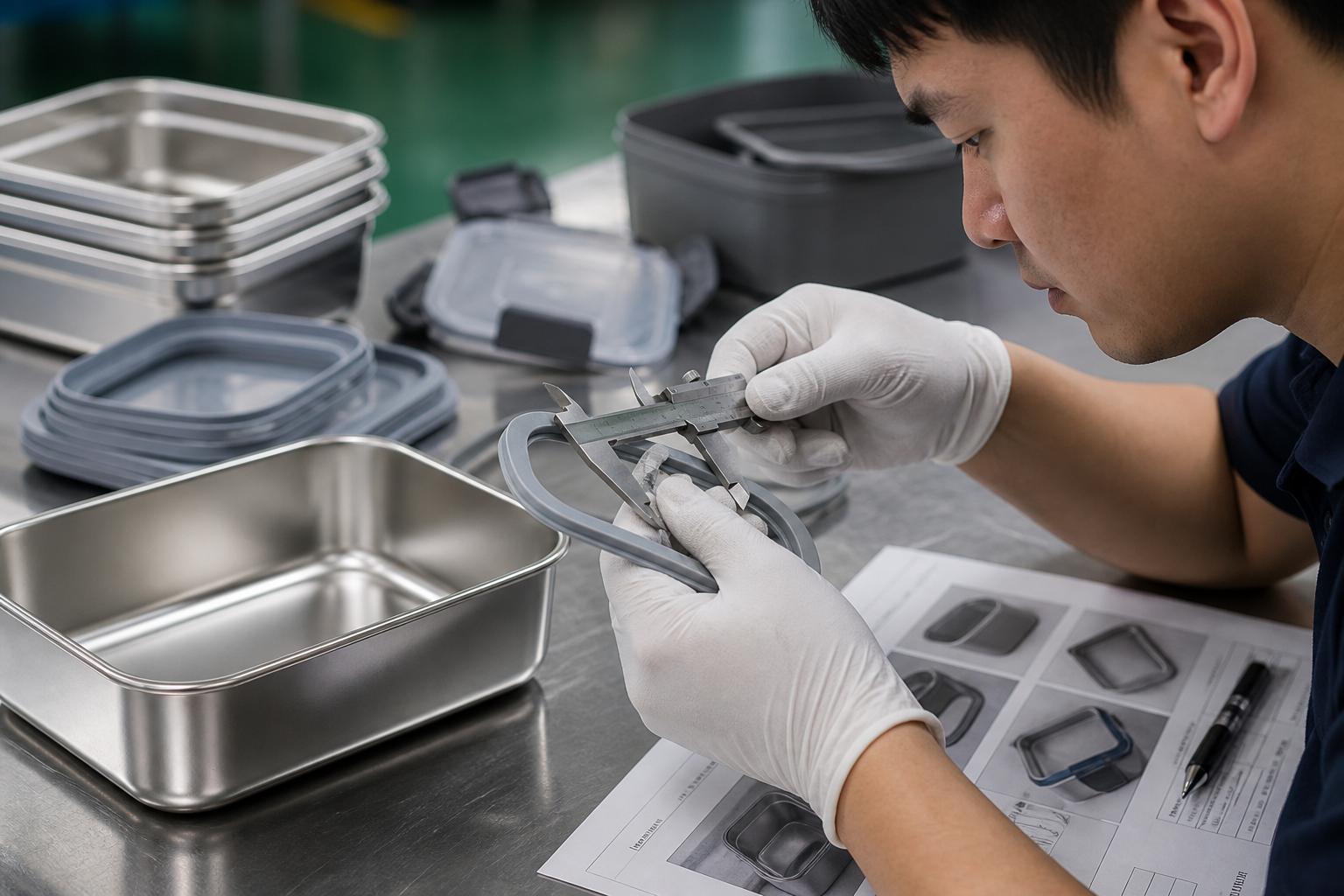
Check dimensions, capacity, mass, fit, surface finish, burrs, odor, color, sealing interfaces, latch operation, cleaning access and assembly. For repeated-use products, agree on practical cycle checks appropriate to the mechanism. Record the method and acceptance limits rather than stating a vague “durability test.”
For heated products, electrical safety and food-contact review are separate workstreams. The food-contact file does not establish electrical compliance. Likewise, a stainless-steel body does not answer questions about its coating, gasket, handle, adhesive or lid.
Mid-Article CTA
Need a specification-led kitchenware sample? Browse KudBo kitchen and travel products and email info@kudbo.com with destination market, food type, temperature, contact time, materials, capacity and packaging needs. We can coordinate the supplier document list and physical sample for your technical reviewer.
Factory Controls That Preserve the Reviewed Design
Translate the approved component schedule into purchasing and production records. Incoming material checks should verify supplier, grade, lot, color and accompanying documents. Production teams should use controlled work instructions for mixing, molding, forming, coating, curing, assembly and cleaning.
Keep retain samples from meaningful production lots where practical. If a defect or customer question occurs, the buyer can compare the shipped batch with the approved reference. Batch codes on unit or packaging should connect to production records without exposing confidential formulas.
Shipment Inspection Preparation
The inspector needs the approved sample, product specification, packaging artwork, component list and objective checks. Inspection can verify appearance, dimensions, component count, lid fit, gasket seating, latch movement, leakage under an agreed non-regulatory method, odor observations, markings, instructions and pack-out.
Do not ask an inspector to declare a product “FDA approved.” FDA does not provide a simple blanket approval for finished kitchenware. Report observable results and let the responsible technical team assess document compliance.
Compare Suppliers on Material Control
Issue one component schedule to all candidate suppliers. Ask each to identify the actual material grade, manufacturer and intended-use support for every food-contact part. Compare gaps explicitly. One supplier may offer strong stainless traceability but vague silicone information; another may document resin well but outsource coatings without change control.
Normalize quotes for the same materials, thicknesses, finishes, colors and packaging. A cheaper gasket made from an unspecified compound is not equivalent to an approved formulation. Request the cost and lead-time effect of locking sources, arranging representative testing and retaining production samples so the commercial decision includes the real control plan.
Review Cleanability and Foreseeable Use
Food-contact compliance and usable design overlap but are not identical. Examine seams, undercuts, hollow handles, removable valves and gasket channels for trapped residue. Confirm whether components can be removed and reinstalled without damage. Instructions should explain cleaning, temperature limits and uses that were actually reviewed.
Avoid creating unsupported dishwasher, microwave, freezer or oven claims from informal sample use. Define the appliance conditions, cycle, detergent and acceptance criteria, then obtain appropriate technical evidence. A product that survives one household trial has not established a broad durability claim.
Packaging, Storage and Traceability
Food-contact surfaces should arrive clean and protected from dust, odor, abrasion and contamination. Specify bag or tissue materials, protective films, carton cleanliness and storage conditions. Confirm that packaging inks, adhesives or anti-mold treatments cannot transfer under the planned configuration. Strong fragrance in printed packaging can create customer complaints even when the article itself is acceptable.
Use lot or batch identification that links finished units to component and production records. During shipment inspection, note abnormal odor, residue, rust, coating damage or gasket deformation and photograph affected samples. Do not “clean away” evidence before the buyer evaluates the cause.
For reorders, re-confirm suppliers, grades, colorants and intended-use documents. Review customer feedback by component and condition: leakage when hot, staining with acidic food, odor after storage, latch fatigue or cleaning difficulty. Translate valid findings into controlled specifications and verification methods rather than relying on informal factory promises.
RFQ Template for Food-Contact Articles
Begin the RFQ with the use scenario: food categories, maximum temperature, contact duration, repeated-use expectation, cleaning method and destination market. List every food-contact component, including seals, valves, coatings, adhesives and printing that may contact food through normal or foreseeable use. State capacity, dimensions, color and packaging, and distinguish mandatory requirements from preferences.
Require suppliers to complete the material schedule with trade name or grade, manufacturer, colorant, production process and supporting-document reference. Ask them to mark information that is confidential and propose a route for qualified third-party review. Do not accept “same as sample” as the material identity; samples can be reproduced with different upstream inputs unless sources are controlled.
Compare the returned schedules line by line. If one supplier identifies stainless grade and silicone compound while another lists only generic materials, record the second quote as technically incomplete. Ask whether coatings or seals are produced in-house, which incoming checks are performed, how lots are identified and how changes are approved. Include these controls in commercial evaluation because they affect repeat-order consistency.
Before artwork, finalize intended-use statements and exclusions. Instructions should not promise microwave, dishwasher, freezer, boiling or long-term storage suitability beyond the technical review. Marketing copy, icons and lifestyle photographs must agree with the assessed conditions. A photograph showing a use can create an implied claim even when the text is cautious.
At production release, connect the approved material schedule to the purchase order, inspection file and retain sample. Require final documents before shipment inspection. If a supplier requests an alternate resin, pigment, coating or gasket, pause the affected component until the technical reviewer determines what new evidence is required. This discipline is more reliable than repeating a broad migration test after every undocumented change.
Frequently Asked Questions
Is a “BPA-free” statement enough?
No. It addresses one claim, not the complete material system or intended conditions of use. Claims also require substantiation.
Does FDA approve finished lunch boxes?
The relevant question is whether each food-contact substance is lawfully used under the applicable authorization and conditions. Avoid presenting a finished article as “FDA approved” without a precise legal basis.
Should buyers request a full formulation?
Suppliers may protect confidential formulations. A qualified compliance route can use grade identity, applicable authorizations, declarations and appropriate testing without disclosing unnecessary trade secrets to every party.
When should documents be updated?
Review them when material, supplier, colorant, coating, process, production site or intended use changes, and when legal requirements or authorizations change.
What belongs in the purchase order?
Reference the approved sample, drawing revision, component material schedule, permitted suppliers, packaging version, change-approval requirement and agreed inspection plan.
Related KudBo Resources
Browse the KudBo product catalog, explore the buyer guide library, read more Kitchenware sourcing guides, or send your product requirements for a focused sourcing discussion.
Official Reference Links
Conclusion
Credible food-contact sourcing connects intended use to exact component identity. Buyers reduce uncertainty by replacing “food grade” with a controlled material schedule, relevant documentation, representative samples and factory change control.
Final CTA
Compare KudBo kitchen products, read our multi-category sourcing guide, or email info@kudbo.com with your intended use and supplier-document checklist.