Introduction
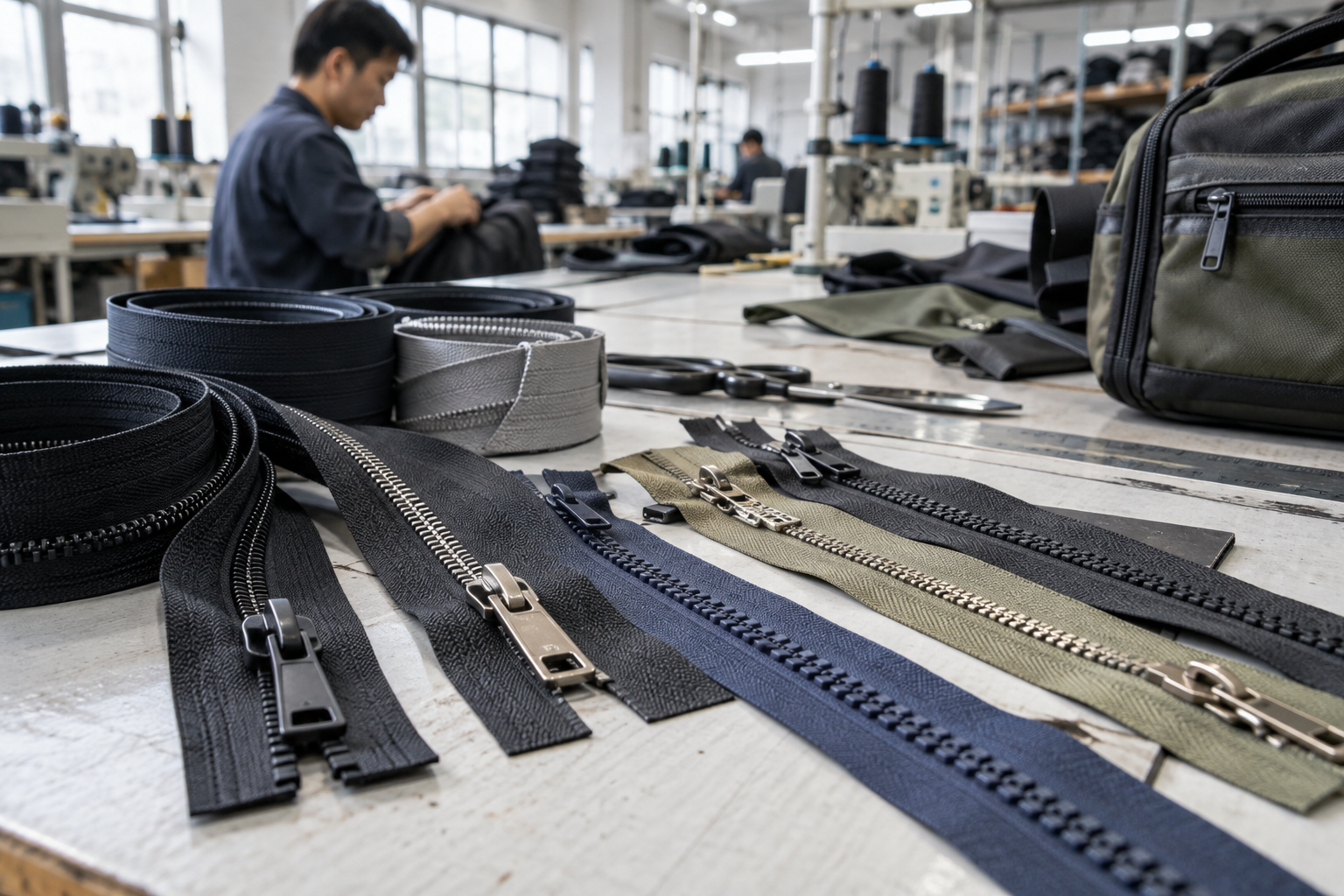
Travel bag zipper selection should evaluate the chain, slider, stops, tape and sewn installation as one assembly. Coil, molded plastic and metal constructions can each be suitable in different applications, but the material name alone does not establish durability. Private-label luggage sellers and packing-cube buyers need a repeatable specification tied to the bag’s shape, loading and care requirements.
Start with the opening geometry and expected use. A curved packing cube, a straight accessory pocket and a heavily loaded travel bag impose different demands. Compare finished samples rather than loose zipper strips alone. This guide explains what to request from a supplier, how to review alternatives and how to prevent a successful sample from turning into an uncontrolled bulk substitution.
Quick Answer: Specify the Complete Assembly
An RFQ should identify zipper family and size designation, chain material, tape, length and measurement convention, slider type, pull design, end configuration, color, finish and installation drawing. Add the intended bag load, closure path, cleaning conditions and required evidence. Use the manufacturer’s own part reference when available.
Do not ask only for a “heavy-duty zipper.” That phrase leaves the factory to choose details that may matter more than appearance. Require the quote to list substitutions or unresolved choices. The YKK product search illustrates how zipper products are differentiated by construction and components; a similar level of identification is useful even when selecting another supplier.
Compare Coil, Molded Plastic and Metal in Context
Coil constructions are often considered for flexible travel products, molded elements for particular handling and appearance requirements, and metal for a distinct visual and tactile finish. Treat these as starting points for samples, not universal rankings. Weight, bend geometry, slider match and tape integration can change which option works best.
Ask each supplier to explain the proposed assembly in relation to your actual pattern. If a zipper must curve around a tight corner, request a sewn prototype at that radius. If the opening is usually straight and highly visible, assess the finish and alignment across the entire run. Component selection should follow the installed geometry.
Avoid a Material-Only Strength Decision
A heavier-feeling chain can still be poorly installed or paired with the wrong slider. Conversely, a lighter assembly may be appropriate for a small organizer if it meets the actual use brief. Compare evidence using the same methods and units, and keep the complete assembly identity attached to each result.
A useful shortlist has two or three technically credible constructions rather than many cosmetic variants. Ask what changes in price, weight, sourcing lead time and installation when moving between options. This reveals whether a supplier is recommending a solution or simply offering whatever stock is available.
Lock Slider Compatibility and Operating Behavior
A slider is not interchangeable merely because it fits over the chain. Ask the component supplier to confirm the correct combination, including chain size and construction. Record the slider reference separately from the decorative pull. If a custom pull is used, confirm how it attaches and whether it changes handling or mechanical evaluation.
Choose operating behavior deliberately. A pocket closure, a two-way luggage opening and an application that needs a locking function do not require identical sliders. Have the supplier demonstrate the proposed feature and provide the part specification. Avoid calling every slider “self-locking” unless that function is actually present and verified.
Assess pull accessibility with representative users and packing conditions. A small decorative tab may look clean but be difficult to grip. A long cord may be convenient but can catch on adjacent hardware. Review the entire product application, including how the bag is opened when full and whether pull tabs strike delicate contents.
Define Length and End Configuration Clearly
Specify how zipper length is measured and show the start and end points on the drawing. Include allowances needed for sewing and stops. A quotation that uses a different measurement convention can produce an assembly that looks close but does not fit the pattern.
For two-way openings, record slider orientation and the intended closed position. Show whether the pullers meet at the top or move in another arrangement. Confirm what the user sees when the bag is fully open. A prototype review should catch these decisions before bulk chain is cut.
The YKK PROSEAL technical guidance explicitly discusses measurement conventions for its specialized products. That example reinforces a general procurement habit: use the selected manufacturer’s drawing and terminology instead of assuming that every supplier measures the same way. Its detailed dimensions do not apply automatically to ordinary travel zippers.
Review the Sewn Bag, Not Only the Loose Component
A straight loose strip cannot demonstrate performance around a finished corner. Ask for samples sewn with the proposed fabric, lining, reinforcement and seam allowances. Fill the bag with representative contents and observe whether closing requires squeezing the panels together or pulling at an angle.
Inspect lining clearance along the complete opening. A neatly installed zipper can still catch fabric if the lining moves into the slider path when the bag is loaded. Check near corners, handles and internal pockets. Photograph the location of interference and describe the packing condition that produced it.
Make the Sample Exercise Repeatable
Use the same packing set and closure sequence for each sample. Record approximate contents and whether the reviewer needed to reposition them. This is a proposed comparison method, not a standardized durability result. Its purpose is to separate a design issue from differences in how samples were handled.
Ask the factory to explain corrections on the pattern rather than merely sending a better hand-finished sample. If seam allowance, lining attachment or corner geometry changes, update the drawing and retain both revision identities. Otherwise the bulk line may continue following the older pattern.
Distinguish Water Resistance From Watertightness
A film-coated zipper can reduce exposure without being a watertight closure. Water may enter through the chain, end region or adjacent seams. If a bag will be marketed for water protection, identify exactly what the finished assembly is expected to resist and obtain evidence for that claim.
The YKK zipper usage manual distinguishes water-repellent AquaGuard products from waterproof or watertight constructions. Use this distinction to challenge vague supplier wording. Do not apply the AquaGuard name to an unverified component, or assume an unbranded coated zipper has the same characteristics.
For ordinary travel organization, a clear water-resistant description may suit the intended use better than an unsupported waterproof claim. If immersion protection is necessary, choose the complete bag and closure around that requirement from the beginning. Adding coated tape late in development is not a substitute for that design review.

Mid-Article CTA
Send Your Requirements. Browse KudBo’s product catalog and email info@kudbo.com with bag drawings, opening shape, intended contents, zipper preferences and order quantity. Request a sewn-sample comparison with component references and a clear substitution policy.
Ask for Test Evidence That Answers the Actual Question
Separate chain strength, slider retention, pull attachment, end-stop behavior and repeated operation. A result in one area does not prove every other function. Ask the component supplier or laboratory which methods suit the assembly and how results map to your use requirements. Do not create a universal pass value from a competitor’s catalog.
For repeated operation, specify whether samples are straight or installed, loaded or unloaded, and clean or conditioned. A test that repeatedly opens an empty flat specimen may not represent a curved, overfilled bag. Both component and finished-product evaluations can be useful if their limitations remain explicit.
A test brief should record method, sample count, conditioning, equipment, rate, load where applicable and failure definition. Keep raw observations available. If a sample becomes harder to operate before it breaks, that change may matter to product selection even when the final report emphasizes only complete failure.
Treat Numeric Claims as Evidence Questions
If a supplier proposes a cycle count, ask what counted as a cycle and which sample configuration achieved it. Do not multiply a laboratory cycle count into a number of years of consumer use. Real handling varies, and the conversion would need its own defensible basis.
Control Color, Finish and Care Compatibility
Review zipper color beside the final fabric under agreed lighting. A tape and panel can match in one setting yet look different in another. Approve physical references and define acceptable variation. Digital renderings and screen photographs are useful for communication but are poor substitutes for a retained color sample.
Ask how slider coatings and pull finishes behave under the intended cleaning routine and storage conditions. If a product is intended for damp travel use, include that context in supplier discussions. Avoid broad corrosion-proof statements without specific evidence. Record whether a changed finish requires additional evaluation.
Care instructions should address the finished bag and its weakest relevant component. A fabric that tolerates one treatment does not establish that the zipper film, slider finish or decorative pull tolerates it. Marketing, product development and the sewing factory should approve one consistent instruction set.
Build a Component-Control Table
Use a bill of materials that identifies what may change and who must approve it. A supplier should not replace a slider or chain because the new part looks similar in a carton photograph. Critical compatibility questions need written resolution before production.
| Specification field | Record | Why it matters |
|---|---|---|
| Chain | Supplier, family and size reference | Prevents a vague material substitution |
| Slider | Exact compatible reference and function | Controls fit and operating behavior |
| Pull | Material, dimensions and attachment | Preserves grip and attachment design |
| Tape | Material, width, color and finish | Connects component to sewing process |
| Length | Drawing and measurement convention | Keeps cut components aligned to pattern |
| Ends | Stops and opening configuration | Prevents incorrect assembly |
| Installation | Stitching, clearance and corner geometry | Makes loose-component approval meaningful |
| Care | Finished-product instructions | Avoids conflicting cleaning claims |
Add revision dates and approval references without overcrowding the operator’s worksheet. Purchasing needs the full record; a sewing station may need a focused diagram showing the approved orientation and allowances. Good documentation is specific enough to prevent mistakes and simple enough to be used.
Evaluate Quotes Beyond the Zipper Unit Price
Ask whether the quoted component is stocked or made to order, and how color minimums interact with bag quantities. Identify tooling or setup charges for a custom pull. Compare the complete assembly and installation cost rather than a chain price per unit length.
Discuss lead time for approved replacements before approving a unique finish. A component that is easy to obtain for development may be difficult to replenish at a small quantity. For gift programs or limited editions, decide whether a stock assembly with a custom pull gives a better balance than a fully custom chain and tape.
Keep evidence of authentic branded supply when a brand name is part of the purchase requirement. Do not assume a stamped pull alone proves provenance. Ask the supplier how component purchasing records will be connected to production lots and how substitutions will be disclosed.
Organize Shipment Inspection Around Failure Modes
Before inspection, provide approved samples, component references, artwork and the installed pattern revision. Check the visible identity and construction, then apply agreed functional sampling. Use representative loading where required by the plan. A quick slide on an empty bag should not be reported as a complete durability assessment.
Record snagging, uneven engagement, loose stops, damaged elements, sharp edges and incorrect pull orientation separately. Include the exact sample and location. If several bags show the same problem, investigate whether it follows a sewing station, component batch or pattern revision. Avoid closing the issue with a generic promise to “improve quality.”
The AQL shipment inspection guide can help structure sampling discussions. Sampling does not replace component qualification or ongoing process control. Release decisions should use the agreed inspection scope and documented disposition of any failures.
Plan Repair and Customer Instructions
Decide whether a failed pull can be replaced separately or whether repair requires opening a seam. Keep compatible part references for the service team. A visually similar replacement slider should not be shipped without confirmation that it matches the chain and intended function.
Customer guidance can explain how to avoid forcing an obstructed closure and how to identify the product for assistance. Do not use care advice to excuse a design that regularly traps its own lining. Feedback about snagging, separation or difficult operation should feed back into component and pattern review.
For compression packing cubes, distinguish the main access zipper from any separate compression mechanism when discussing requirements. These functions may have different loads and handling patterns. The catalog reference is a starting point for a sourcing conversation, not proof of a particular component specification.
Frequently Asked Questions
Is a larger zipper always stronger?
Not as a complete buying decision. Size designation, construction, slider compatibility, installation and test method all matter. Compare suitable assemblies under the same relevant conditions. A larger component can add bulk or reduce flexibility without solving the failure mode that matters in the finished travel bag.
Can I replace a slider with one that looks identical?
Only after confirming compatibility with the exact chain and required function. Similar appearance does not establish fit, locking behavior or performance. Keep supplier part references and revision records. For customer repairs, obtain an approved replacement procedure instead of asking users to trial unrelated sliders.
Are metal zippers the best choice for premium luggage?
They can support a particular appearance, but premium positioning does not determine technical suitability. Evaluate weight, finish, opening geometry, handling and care alongside appearance. A carefully specified alternative may better suit a flexible bag. The final choice should follow the application and evidence, not a material hierarchy.
What sample should a packing-cube buyer request?
Request the zipper installed in the proposed fabric and lining, using the production pattern and intended corner geometry. Include representative contents during review. Retain the component specification and approved sewn sample so the factory can reproduce the same construction rather than only matching a photograph.
What should be frozen before bulk production?
Freeze chain, slider, pull, tape, length convention, end configuration, color, finish and installation drawing. Also approve care instructions and the evidence behind any performance claims. Define written change approval so a component shortage does not lead to an unreviewed substitute late in production.
Related KudBo Resources
Browse the KudBo product catalog, explore the buyer guide library, read more Travel Accessories sourcing guides, or send your product requirements for a focused sourcing discussion.
Conclusion
Travel bag zipper selection is an assembly and installation decision. Match the component to the opening shape, confirm slider compatibility, evaluate a loaded sewn sample and keep claims connected to relevant evidence. A controlled specification gives purchasing, sewing and shipment inspection teams the same definition of the approved product.
Final CTA
Get a Quote. Contact KudBo or email info@kudbo.com with your bag application, drawing, quantities and target zipper behavior. Ask for component alternatives, sewn samples and production controls before approving a private-label travel collection.