Introduction
A portable tire inflator that handles a pressure top-up is not automatically suitable for a much larger from-low-pressure task or repeated continuous use. Tire volume, starting pressure, power condition and the permitted duty cycle determine the workload. Maximum pressure alone cannot answer how long the task takes or whether pauses are required.
This distinction is important for automotive retailers. Customers may expect a compact device to restore any flat tire at the roadside, while the intended application is narrower. A damaged tire also requires appropriate assessment; adding air does not repair the cause or establish that driving is safe.
This tire inflator top up vs flat tire guide helps buyers evaluate a cordless tire inflator. It proposes controlled review questions, not completed KudBo tests. Follow the vehicle and inflator manuals, and use qualified personnel for performance or safety assessment. Do not conduct a procurement trial beside moving traffic or deliberately damage a tire.
Define the Task Before Requesting a Time Claim
Identify the tire type, size, starting condition and target pressure. A small pressure correction and filling from a substantially lower starting pressure involve different quantities of air. Do not compare supplier time claims unless the workload and stopping point are equivalent.
The NHTSA tire-safety guidance directs users to the vehicle’s recommended pressure information and explains cold-tire checking. The maximum pressure printed on a tire sidewall is not the vehicle’s routine inflation target. Keep vehicle guidance separate from the inflator’s maximum capability.
For a cordless pump tire volume test, state the exact reference and method. A buyer should not invent a standard tire that represents all cars, bicycles and recreational equipment. Different valves and supported applications also need confirmation. A supplied adapter is not proof that the device is appropriate for every object it fits.
Review the Portable Inflator Duty Cycle
Ask the manufacturer to define permitted run and pause conditions for the quoted model. Some instructions specify a maximum continuous period or cooling requirement. Do not substitute another model’s guidance or remove a pause from the demonstration to create a faster advertised result.
Distinguish the planned task from endurance validation. A short trial can observe whether the sample completes the approved workload, but it cannot establish a lifetime or continuous-duty rating. If repeated use is central to the assortment, request suitable evidence for that duty rather than assuming a handheld consumer device is a workshop tool.
Record power state, operating mode and ambient conditions in any controlled comparison. Battery condition or input supply can affect behavior. Keep provisional observations qualified and do not transfer a result from a fresh sample to every aging battery or climate.
Compare Top-Up and From-Low-Pressure Scenarios
| Scenario | What to specify | Claim boundary |
|---|---|---|
| Small top-up | Reference tire and pressure change | Not evidence for a much larger fill |
| Lower starting pressure | Exact starting and target conditions | Does not repair tire damage |
| Repeated tires | Sequence and required pauses | No continuous-duty inference |
| Different valve | Approved adapter and connection | Physical fit does not prove suitability |
| Cordless operation | Battery state and stopping rule | No universal runtime claim |
Portable inflator duty cycle and tire pump sustained run comparison should be evaluated under an agreed safe method. Use the same reference setup for different samples and retain the actual sequence, including pauses. A time claim that excludes setup and mandatory cooling may not describe the customer’s complete task.
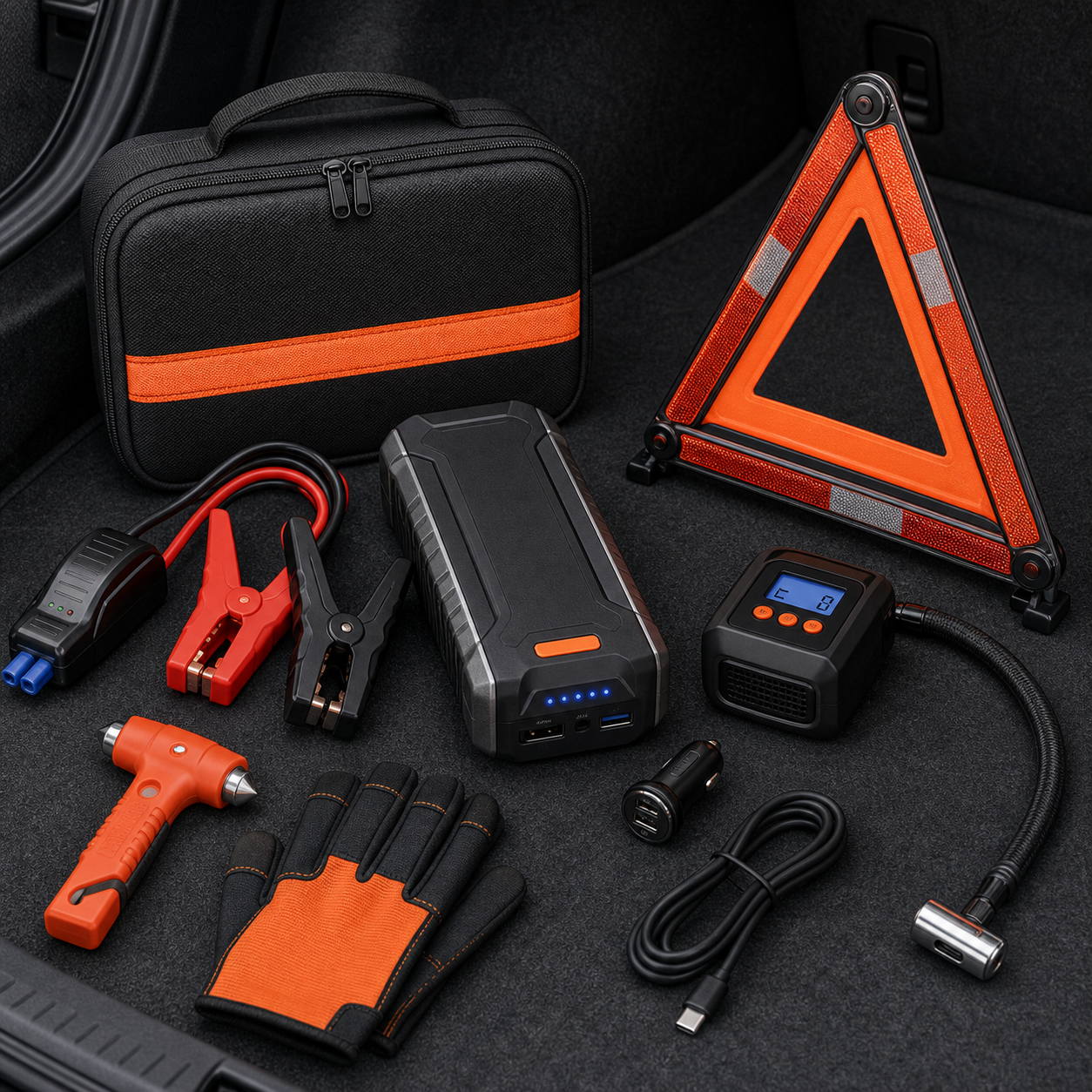
If a buyer wants a simple roadside accessory, compare it with the broader car emergency kit application. The kit may support preparedness, but neither it nor an inflator guarantees that every roadside incident can be resolved without professional assistance.
Assess Connection and Inflator Hose Heat Handling
Check the approved connection sequence, hose reach and valve access on a safe stationary reference. The device should not require an awkward position that places it under the vehicle or against an unsuitable surface. Observe whether the connector can be attached and removed using the manual without excessive twisting.
Ask which parts may become hot and what handling precautions apply. Do not touch or move a recently operated hose or connector in ways the instructions prohibit. If temperature characterization is required, use suitable instruments and a qualified method rather than subjective hand contact.
Record any pressure loss associated with normal connection or removal if it is relevant to the buying requirement, using an agreed measurement procedure. Do not invent a universal loss figure. The final customer instructions should explain the approved sequence and how to recheck pressure where appropriate.
Make Auto-Stop a Separate Evidence Question
Ask what triggers the stop function, how the target is entered and which units are available. A screen can display a plausible value while the user selects the wrong unit or target. Instruction comprehension is part of the task, but gauge accuracy and stopping performance need their own assessment.
Do not assume that an automatic stop eliminates all supervision. Preserve the manufacturer’s operating precautions and vehicle guidance. A retailer should not promote the device as safe to leave unattended without explicit support. Unexpected behavior, damage or conditions outside the manual require stopping and appropriate escalation.
The buyer record should distinguish display operation, measurement evidence and control behavior. A powered screen proves only that the screen powered on. It does not establish pressure accuracy, correct stopping under every workload or fitness for a damaged tire.
Mid-Article CTA
Send Your Requirements with the reference tires, intended task, destination and quantity. Email info@kudbo.com to discuss a sample request that separates top-up performance from larger inflation workloads.
Plan the Trial With Safe Conditions
Use competent personnel, suitable equipment and an approved location away from traffic. Establish stop conditions and follow both device and vehicle instructions. Do not deliberately overinflate, defeat protection or create a flat tire to make a sales demonstration more dramatic.
For each run, record the sample identity, reference setup, power condition, operating sequence and elapsed time. Include mandatory pauses and note whether the quoted task was completed. Keep failed or interrupted runs in the record. Selective reporting can make a weak result look stronger without improving the product.
If two quotations describe different supplies, compare those differences openly. A mains-powered tool, a vehicle-powered accessory and a cordless unit may have distinct use constraints. Choosing the smallest case is not a meaningful performance comparison unless the target task remains the same.
Explain Roadside Inflator Application Limits
An inflator does not identify every cause of pressure loss or repair structural damage. Customer copy should avoid implying that a flat tire is always a simple air deficit. Vehicle-specific advice and appropriate roadside assistance remain relevant, particularly when damage or unsafe conditions are suspected.
NHTSA’s winter-driving guidance places tires and emergency preparation within a broader safe-driving context. It is not approval of a particular inflator. Keep the product’s useful role clear while avoiding a promise that it eliminates the need for inspection, maintenance or assistance.
Photographs should show a stationary vehicle in a safe setting, complete hose routing and an appropriate operator arrangement. Do not normalize kneeling in a live traffic lane or placing cords across moving vehicles. A realistic application image can communicate a useful task without depicting an unsafe roadside trial.
Compare Complete Retail Units and Support Costs
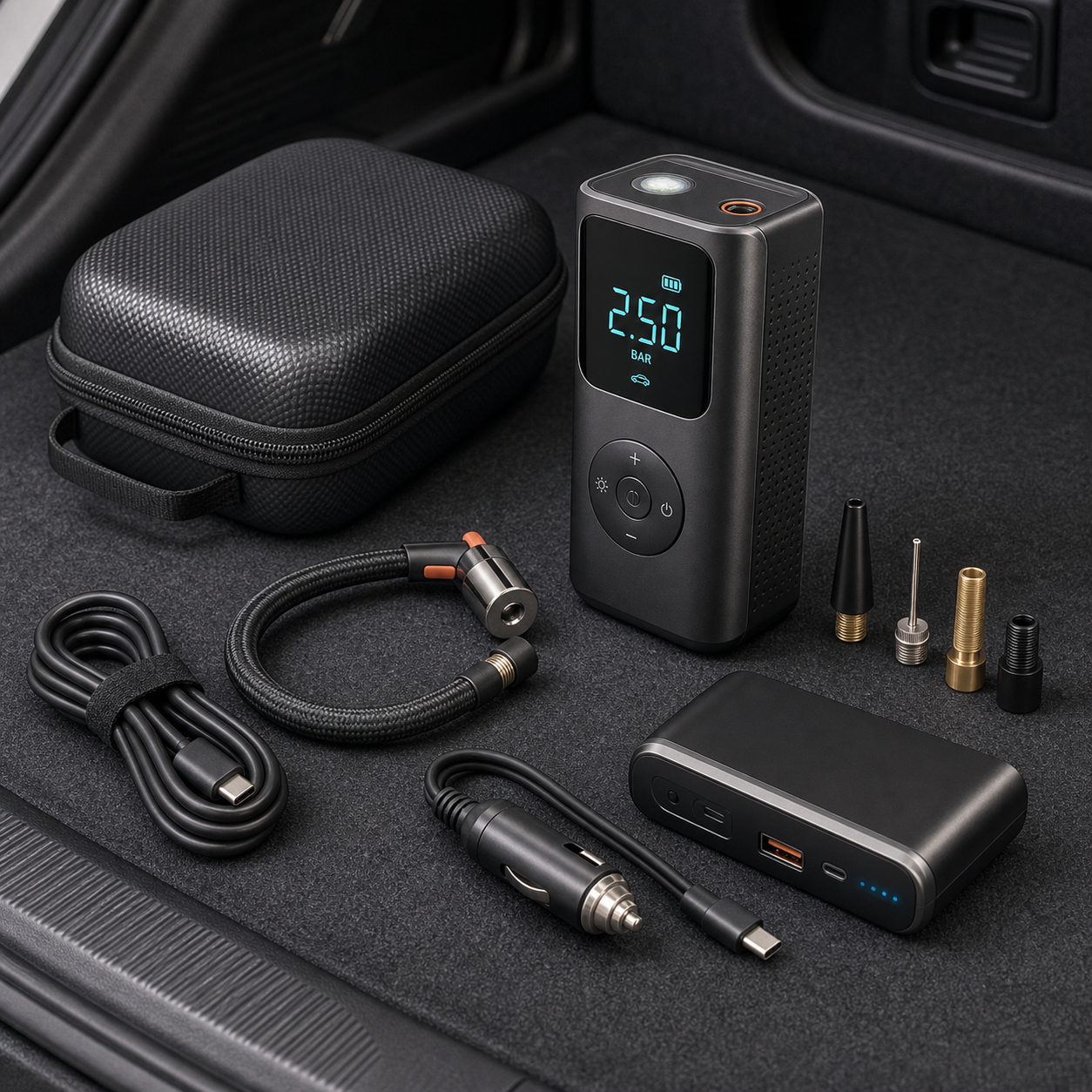
Record the inflator, hose, approved adapters, charging accessories, case and instructions. Identify separately required supplies. An adapter set shown in the photo should match the actual pack-out. Different accessory counts can explain a price difference without indicating a difference in core performance.
Ask which parts are replaceable and how customers identify them. Hose and connector wear can affect the task, but a generic replacement is not automatically appropriate. Confirm model compatibility and commercial terms. Do not promise indefinite battery or hose support without a written basis.
Review the return and service process for a suspected defect. Support should ask for the model, workload and symptom without advising further operation under abnormal conditions. A device that did not complete an unsupported large task is a different issue from one that failed under the agreed approved workload.
Preserve the Approved Workload Through Production
Changes to the compressor, battery, hose, pressure sensing or control firmware can affect the reviewed task. Require notification and review of affected evidence. A familiar housing and identical maximum-pressure label do not establish unchanged top-up time or duty behavior.
Factory testing should state its actual operational checks and acceptance limits. Shipment inspection can verify identifiers, completeness and agreed screening of selected units. It cannot reproduce every customer tire and environment or convert a basic run check into a continuous-duty guarantee.
Before a repeat order, reconcile the quotation, technical specification, manual and retail claim. They should identify the same supported workload and pause requirements. The KudBo catalog offers selection context; the approved model-specific file governs the final purchasing decision.
An Example Performance Decision
Imagine a hypothetical buyer whose target is routine household pressure correction. A compact sample completes the agreed top-up task but is not supported for repeated workshop filling. That can be an acceptable product when the retail claim preserves the boundary. It becomes a poor choice if the marketing promises unlimited roadside recovery.
Another buyer needing frequent sustained operation should request a differently supported tool or additional evidence. This scenario is not a KudBo project or measured comparison. It demonstrates how defining duty and workload prevents a maximum-pressure number from driving an unsuitable purchase.
Request a Complete Workload Statement
A useful supplier response describes the workload in one record: reference tire, starting state, target, power configuration, running sequence and required pauses. If those facts are scattered across messages, consolidate them before comparing offers. A headline time without the workload remains provisional.
Keep setup and operating time distinguishable. A customer may spend time attaching the hose, selecting the unit and preparing the device before pumping begins. The supplier can report pumping time, but the copy should not imply that the entire task takes that interval if necessary steps are excluded.
Request the stopping rule behind the measurement. Reaching the screen target, reaching an independently assessed pressure and stopping at a protective limit are different outcomes. Appropriate reviewers should define what the method establishes. Do not convert a display observation into an accuracy claim without relevant assessment.
Review adapters individually. A set can contain several fittings while the inflator supports different precautions for each application. Their presence should not produce a suitable-for-everything statement. Keep the object, valve and instruction boundary in the specification.
For a roadside offer, ensure images show a safe stationary setting and do not imply that damaged tires are repaired by adding air. A staged scene is not evidence of a real breakdown resolved. Avoid a narrative promising more than the model supports.
Ask support to collect the workload before deciding whether a complaint indicates a defect or an application mismatch. A device stopping under an unsupported task needs a different investigation from one failing the agreed top-up. Both deserve a clear response, not the same assumed diagnosis.
Keep the Approval Evidence Retrievable
Record the model, revision, method, conditions, observations and reviewer in the purchase file. A later reader should distinguish a supplier statement, a buyer observation and an unresolved requirement. Do not describe an illustrative photograph as a completed factory test or a real customer project. If a revised sample is proposed, identify what changed and review the affected requirement before carrying the earlier conclusion forward. This record should support the decision, not create certainty that the evaluation never established. Keep the final claim within the observed or appropriately documented scope, and make remaining limitations visible to the person approving artwork and the order.
Related Buyer Resources
Continue with Car Gap Organizers: Control Clearance and Setup for a complementary purchasing question. Compare the full product catalog, or browse the KudBo sourcing blog or the product sourcing topic collection for additional buyer guides. These resources provide decision context; each product still needs its own model-specific approval.
Frequently Asked Questions
Does maximum pressure tell buyers inflation time?
No. Time depends on the reference tire, starting and target pressure, power condition and operating constraints. Compare claims using equivalent workloads and include required pauses. A maximum-pressure rating alone does not establish speed, continuous duty or suitability for every tire and valve application.
Can a top-up result be used for a flat-tire claim?
Not without appropriate evidence and a defined supported task. The air requirement can be much larger, and a damaged tire needs assessment beyond adding air. Keep top-up and from-low-pressure observations separate. Do not imply that an inflator repairs damage or makes every flat tire safe to drive.
Should buyers use the pressure on the tire sidewall?
Use the vehicle manufacturer’s recommended pressure information and checking procedure for the actual application. NHTSA explains this distinction. A tire’s maximum sidewall pressure is not the routine target for every vehicle. The inflator’s own capability and instructions are separate from the vehicle’s required pressure.
What should a duty-cycle review include?
Identify allowed running, pauses, reference workload, power configuration and conditions. Follow the exact model’s manual and use a competent method. A short buyer trial can reveal task suitability, but it is not a lifetime test or proof that a portable unit supports continuous professional operation.
Does automatic stop remove the need for supervision?
Do not assume so. Follow the manufacturer’s precautions and review the actual control function separately. An automatic feature does not justify unattended operation or unsupported workloads. Keep display, measurement and stop behavior as distinct evidence questions and provide clear escalation for abnormal conditions.
Conclusion
The tire inflator top up vs flat tire decision is about workload and supported duty. Define the reference task, preserve pause and handling requirements, and keep inflation separate from tire repair. A transparent performance claim serves customers better than a maximum-pressure number presented as a universal solution.
Final CTA
Get a Quote or email info@kudbo.com with your destination, quantity and reference workload. KudBo can discuss available automotive options and evidence requests. Confirm the final power arrangement, adapters and supported duty before approving production.