Introduction
A car seat-gap organizer should fit without obstructing seat movement, belt buckles or vehicle controls. That assessment begins while the vehicle is safely stationary, using the relevant vehicle and accessory instructions. A product fitting into an empty gap is not enough to support a universal vehicle-compatibility claim.
The organizer can offer a convenient place for small items, but convenience should not encourage adjustment or retrieval while driving. Optional charging functions introduce additional cable-routing and electrical questions. Buyers need a complete installation brief rather than a photograph that conceals the surrounding controls.
This car gap organizer control clearance guide helps automotive buyers review car seat-gap organizers. It provides proposed fit and instruction checks, not completed KudBo vehicle tests. Vehicle safety systems and installation suitability require model-specific guidance and competent review. Do not improvise modifications or remove vehicle components to make an accessory fit.
Define the Supported Vehicle Configuration
Ask which vehicles and seat arrangements the supplier has reviewed. Record the vehicle model, relevant version and installation side. Similar model names can have different consoles, seats and controls. A generic dimension range may help screen possibilities, but it does not establish compatibility with every arrangement inside that range.
Identify the actual gap and adjacent functions before selecting a sample. Look at buckle position, seat adjustment path and any controls nearby. Do not assume that a soft-looking organizer cannot interfere with movement. The assessment should consider its filled shape and the approved contents as well as the empty housing.
If the supplier cannot provide a supported list, treat the application as requiring review rather than advertising universal fit. A retail description can offer a measurement and compatibility-check process without guaranteeing every vehicle. Keep the limitation prominent enough to inform the buying decision.
Conduct Stationary Car Fit Verification
Use a safely parked vehicle and follow its manual. Confirm the accessory’s installation sequence and permitted location. A new user should be able to understand the orientation without forcing the organizer into place. If fitting requires bending, trimming or attaching to an unsupported component, stop and clarify the application.
Document the organizer, vehicle and instruction revisions. Photograph the complete area rather than a close crop that hides the buckle or controls. Record whether the approved contents change its position. An empty demonstration may conceal interference that appears only after the customer loads the product.
Do not perform a road test merely to observe an unapproved sample. Stationary fit checks and specialist safety review should come first. A successful static observation is still limited evidence; it does not establish crash behavior, restraint-system compatibility or universal suitability.
Check Car Organizer Buckle Access
Access should remain understandable
The user should be able to locate and operate the buckle according to vehicle guidance. An organizer that visually resembles a buckle cover or moves into its path can create confusion. Record the relevant geometry and have a competent reviewer evaluate concerns rather than assuming a small obstruction is harmless.
Do not attach to, cover or modify safety-system components without explicit support. A storage benefit does not justify changing how a belt or seat system operates. The NHTSA seat-belt guidance explains the importance of correct restraint use; it does not approve a specific accessory installation.
Test the complete permitted setup
Review the organizer in its intended filled configuration. Small items can shift the shape or create a protrusion. Ask the supplier to define suitable contents and loading limits where relevant. Do not infer that any object fitting inside the opening is safe to carry in that location.
Keep observations descriptive and configuration-specific. “The buckle remained accessible in this reviewed setup” is different from “never interferes with seat belts.” The second statement is an absolute claim that one fit check cannot establish.
Review Seat Movement Organizer Interference
Identify the seat adjustment range and procedure relevant to the vehicle, using approved guidance. Check whether the organizer or its contents enter a moving interface or change position. Do not force the seat through resistance or bypass a control to complete a trial.
Keep hands and objects away from moving mechanisms according to the vehicle instructions. If a potential interference is observed, stop and escalate. The supplier may need to revise the design or exclude that application. A tighter fit is not automatically a better fit if it affects movement.
For a car backseat organizer, the mounting and load path are different. Do not transfer compatibility evidence between front-gap and backseat accessories. Related catalog links should help compare use cases, not imply that every organizer shares a universal installation method.
Create a Seat Gap Accessory Installation Check
| Check | Record | Do not infer |
|---|---|---|
| Vehicle identity | Exact relevant configuration | All versions of the model are equivalent |
| Orientation | Approved side and position | A reversed installation is acceptable |
| Buckle | Access in the filled setup | Universal restraint compatibility |
| Seat movement | Reviewed path and condition | Crash or safety-system performance |
| Controls | Visibility and operation | Any nearby control can be covered |
| Cable | Approved routing and clearance | A loose lead is harmless because it is thin |
Retain both accepted and rejected configurations. A compatibility list is more useful when it explains exclusions rather than quietly deleting failed observations. If a revised sample is offered, repeat the affected checks and identify the new revision.

Mid-Article CTA
Send Your Requirements with your target vehicles, installation side, intended contents and quantity. Email info@kudbo.com to discuss a model-specific fit record and sample request.
Plan Vehicle Accessory Cable Routing
If charging is offered, establish the power source, input rating, supplied cable and actual output capabilities. A socket’s shape does not prove its charging performance. Request appropriate evidence for the final electrical configuration and destination rather than assuming an added charging module is interchangeable.
Route the cable only as permitted by the vehicle and accessory instructions. Review seat movement, controls and access without running a loose lead through an unapproved mechanism. Do not invent attachment points or recommend placing a cable where it can be pinched. Potential interference requires review before installation approval.
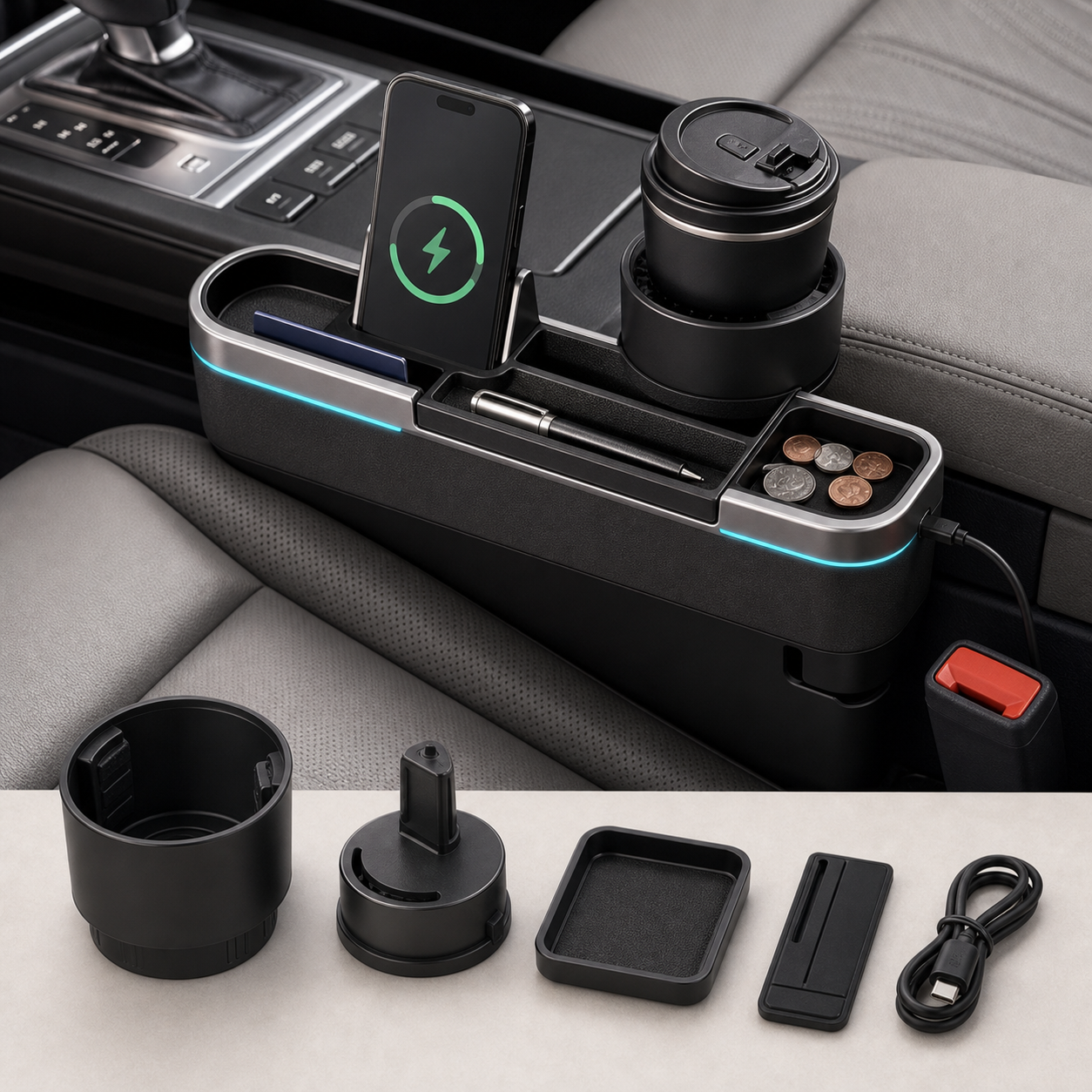
Check whether the retail pack provides all essential accessories and clear setup guidance. A lifestyle photograph may hide a cable or power adapter that the customer must supply. Identify these dependencies so the product does not appear wireless or self-powered when it is not.
Preserve Driver Attention in the Retail Story
Product copy should describe organization before or after a journey, not encourage active searching or adjustment while driving. NHTSA’s distracted-driving guidance explains that non-driving activities can divert attention from safe driving. Do not show a driver reaching into the organizer while the vehicle moves.
A useful application image can show a parked vehicle and unobstructed surrounding functions. Full context is more informative than a tightly cropped glamour image. If controls, buckles or cables are absent from the photograph, buyers cannot assess the practical installation.
Avoid safety guarantees such as prevents accidents or makes driving safer without suitable support. An organizer can have a defined storage role without claiming a reduction in crash risk. Keep convenience, installation compatibility and safety outcomes as separate evidence questions.
Assess Contents and Surface Care
Ask what objects and loading conditions are permitted. Sharp, heavy or heat-sensitive items can raise questions beyond ordinary storage. Do not create a universal contents claim because the cavity is large enough. The actual application and vehicle conditions matter.
Review the approved cleaning method and contact surfaces. A material description does not establish that every cleaner or vehicle finish is compatible. If a scratch-free or stain-free claim is proposed, request relevant evidence rather than relying on a soft appearance.
Observe removal and reinstallation according to instructions. A product that leaves residue, changes shape or becomes difficult to locate correctly can create support issues. Record those observations on the intended vehicle setup and keep the method consistent for comparison.
Compare Quotations Against the Approved Configuration
List dimensions, materials, inserts, charging components where offered and the retail instructions. Compare equivalent sets rather than a basic organizer with an electrically equipped version. Identify provisional measurements and the actual sample revision.
For private labeling, make sure marking does not cover essential instructions or change the relevant fit surface. Approve the decorated sample in the supported installation, not only an artwork rendering. A label or added trim can affect an interface even if the underlying product remains unchanged.
Require notification of changes to shape, mounting, material stiffness or electrical components. A familiar product name does not guarantee continued fit. Keep the approved compatibility record, photographs and retail copy together so repeat orders preserve the same boundaries.
Use Shipment Inspection for the Right Questions
Factory testing should identify checks for dimensions, component fit and offered functions. Shipment inspection can confirm the retail-unit list, identifiers, visible condition and agreed screening. It cannot assess every vehicle or establish restraint-system compatibility for an unreviewed installation.
Define how to classify a functional fit mismatch, a missing cable and a cosmetic mark. Their consequences differ. An inspection report should identify the sample and method rather than presenting a general quality label as proof of every application claim.
The KudBo product catalog offers automotive selection context. Final purchasing should rely on the approved model and installation evidence. If the target vehicle range cannot be supported, narrow the offer or choose another accessory rather than adding a universal-fit headline.
An Example Compatibility Decision
Imagine a hypothetical retailer whose sample fits the first target vehicle but obstructs a control on the second. The correct response is to record an exclusion or request a suitable revision, not to approve both because the organizer fits into each gap. Functional clearance matters more than insertion alone.
This is not a KudBo customer case or a measured compatibility rate. It illustrates how a stationary fit observation can prevent an ambiguous retail promise. A revised sample should be evaluated on the same configuration before the excluded vehicle is added to a supported list.
Retain the Vehicle Configuration Photographs
Photograph the stationary setup from angles showing the organizer and surrounding functions. Include the relevant buckle, controls and cable path. A close crop should not be the sole compatibility record. A reviewer needs to understand the area outside the accessory.
Identify the vehicle configuration and whether the organizer was empty or filled. Preserve the instruction sequence used. If a later photograph shows a different trim or seat arrangement, do not silently add it to the supported list. Presentation and technical approval are separate changes.
Record exclusions with a reason, such as an unresolved control-clearance concern. A list containing only successful fits can leave staff guessing about similar vehicles. Clear exclusions help them request further information instead of approving an unfamiliar setup from appearance.
Explain the measurement process without promising every gap of a certain width is suitable. Geometry is one input. Filled shape and surrounding functions may determine the decision. A precise dimension can support screening without becoming a universal safety statement.
If a customer sends an installation photograph, support should not infer safety from the image. They can identify visible mismatches, but interference or safety-system concerns need competent review. Do not recommend trimming or forcing a seat to accommodate the accessory.
Keep photographs linked to the quotation and retail-unit list. A charging-equipped version can have a different installation burden from a basic organizer. The same image should not imply identical dependencies. This record helps preserve a supported application while offering a concise product page.
Keep the Approval Evidence Retrievable
Record the model, revision, method, conditions, observations and reviewer in the purchase file. A later reader should distinguish a supplier statement, a buyer observation and an unresolved requirement. Do not describe an illustrative photograph as a completed factory test or a real customer project. If a revised sample is proposed, identify what changed and review the affected requirement before carrying the earlier conclusion forward. This record should support the decision, not create certainty that the evaluation never established. Keep the final claim within the observed or appropriately documented scope, and make remaining limitations visible to the person approving artwork and the order.
Related Buyer Resources
Continue with Tire Inflators: Top-Up vs Flat-Tire Duty for a complementary purchasing question. Compare the full product catalog, or browse the KudBo sourcing blog or the product sourcing topic collection for additional buyer guides. These resources provide decision context; each product still needs its own model-specific approval.
Frequently Asked Questions
Does physical insertion prove vehicle compatibility?
No. Review buckle access, seat movement, controls, filled shape and any cable routing in the actual vehicle configuration. A product entering the gap does not establish that surrounding functions remain unaffected. Keep observations model-specific and do not infer crash or restraint-system performance from a fit check.
Should fit checks be performed while driving?
No. Begin with a safely stationary vehicle and the relevant manuals. Do not encourage adjustment or retrieval while driving. Unapproved samples should not be road-tested merely to observe interference. Potential safety concerns require competent review and a clear stop-and-escalate process.
Can one vehicle version represent the whole model range?
Do not assume so. Seats, consoles and controls can vary between relevant configurations. Record the exact setup reviewed and preserve exclusions. A broad dimension range may screen candidates, but it does not prove universal compatibility across all versions sharing a vehicle model name.
What changes require another fit review?
Changes to shape, stiffness, mounting, trim or relevant electrical components can affect the approved installation. Require notification and reassess the affected checks. A color match or unchanged product name does not prove that a repeat order preserves control clearance and seat movement.
What should the application photograph show?
Show the complete organizer in a parked vehicle with relevant buckles, controls and cable paths visible. Label separately required accessories. Avoid a moving-driver scene or a crop that hides installation dependencies. A photograph provides context, not proof of universal fit or a safety outcome.
Conclusion
Car gap organizer control clearance is the starting point for a credible installation claim. Review the stationary, filled setup and preserve vehicle functions and driver attention. A bounded compatibility record and clear instructions are more useful than universal-fit language unsupported by the actual sample.
Final CTA
Contact Us or email info@kudbo.com with your destination, quantity and target vehicle configurations. KudBo can discuss catalog options and sample arrangements. Confirm installation clearance, electrical details where relevant and supported applications before production approval.