Introduction
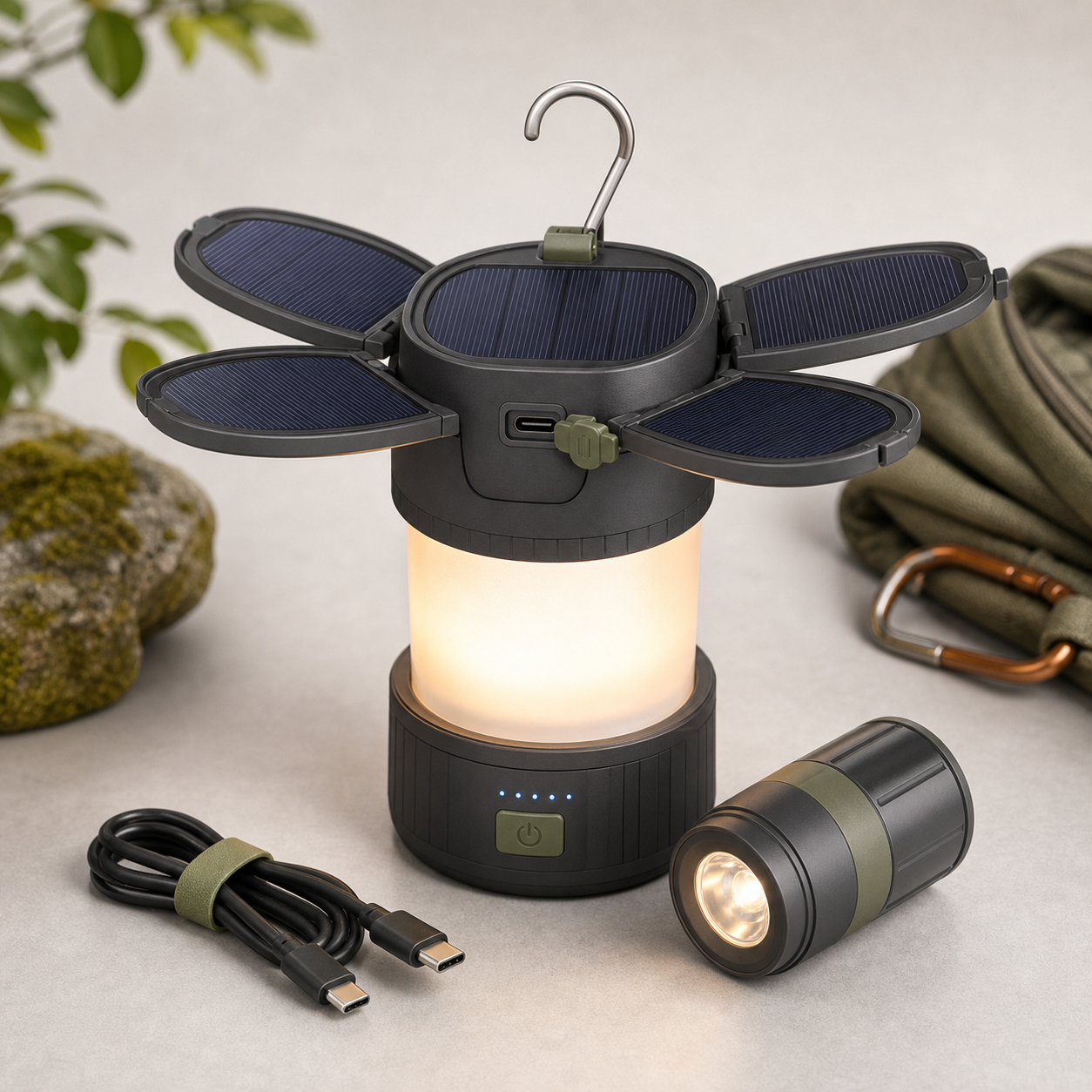
Peak brightness is not the first question a customer asks after taking a lantern out of a cupboard. They need to know whether it turns on, how to charge it, and how long to prepare before an evening outdoors. A folding solar product can be useful while still requiring a deliberate pre-trip charge. The KudBo solar folding lantern includes fold-out solar petals, a diffuser, USB-C charging and a hanging hook in its catalog description. None of those features alone establishes how much energy remains after storage.
An earlier guide explores lantern runtime claims, while another discusses lumens, lux and energy budget. Here the distinct purchasing question is readiness: what happens between factory pack-out, warehouse storage, retail shelf time and first use? The checks below are proposed acceptance methods, not reported KudBo shelf-life measurements.
Trace the Storage Journey
Write a plausible timeline for the sales channel. A unit may spend weeks in a shipping carton, additional time in a distribution center, and a season on a store shelf. A buyer should ask for the cell type, shipping state of charge, protection circuit behavior and maker-recommended storage and top-up procedure. Avoid promising that a lantern is “always ready” unless the exact configuration has been evaluated over the intended interval and temperature range.
Check for shipping isolation tabs or switches. A tiny standby current can matter over long storage; so can an indicator that leaves a light on inside the carton. The supplier should explain what the user sees on first opening and whether a charge is recommended before use. A clear printed instruction such as “charge before the first trip” can prevent a negative review that no amount of brighter packaging will fix.
For an emergency-kit program, decide who maintains the battery. A household that stores a lantern for power outages may not inspect it until needed. The Ready.gov preparedness resources encourage planning for alternate power and lighting, but do not certify a particular lantern or charge interval. The buyer should supply a model-specific reminder schedule based on the maker's instructions rather than inventing a universal annual check.
Separate Solar Input from Stored Energy
The U.S. Department of Energy's photovoltaic efficiency explanation describes why light conditions and temperature affect output. That is a general technology principle, not a performance result for KudBo's lantern. A panel rating under a defined laboratory light source should not be presented as guaranteed charge input in a shaded campsite. Ask for measurement conditions behind any solar recharge statement.
In sample review, use separate tests for USB charging, solar charging and light output after each. State the light level, panel orientation, duration and battery starting state. Do not compare a freshly USB-charged lantern with one exposed to weak winter sun and conclude that the solar panel is defective. The result should help write honest consumer instructions: when solar can supplement use, when USB is the reliable preparation method, and how the indicator communicates both.
If the product can power another device through USB, treat that as a separate function with an energy budget. A small lantern battery can support light and phone charging only within its actual capacity and operating conditions. Ask whether using the output disables the lantern or reduces available lighting time. Product photography should not show multiple devices charging simultaneously if the quoted ports or output cannot support it.
Make the Indicator Legible
A customer often judges readiness by one LED or bar display. Ask what each state means: charging, nearly full, full, low battery and fault. Test the indication in bright daylight and a dark tent. A blinking lamp can be difficult to interpret if the same pattern means two different conditions. Write a simple table in the manual using the actual firmware behavior. Do not reuse a battery graphic from another model.
Check whether the lantern can be turned on while charging and whether that is recommended by the maker. A user may connect a power bank during a campsite meal. The manual should distinguish safe supported behavior from a marketing photo. If the lantern is not meant to operate while wet or covered, show that boundary. The fold-out petals and hook create several physical positions; each should be stable and should keep cables away from walking paths.
Mid-Article CTA
Send Your Requirements with your sales channel, expected storage interval, charging method and desired brightness modes. Email info@kudbo.com for a sample-review and first-use handover checklist.
Design a Reproducible Storage Trial
Choose production-intent samples from one documented lot. Record initial charge state by the maker's approved method, store units at the intended temperature range for a stated interval and then perform the same start-up and lighting sequence. If you need a claim for unusually long storage, extend the trial or use validated data from the exact cell and device configuration. A short overnight check cannot establish multi-month readiness.
The test should note whether the unit starts immediately, how its indicator behaves and whether a recommended USB top-up restores normal use. Record unit and firmware revision, pack state and any changes in battery supplier. Do not convert a small sample into a failure-rate percentage for every shipment. Use the findings to improve the pack insert and to decide what checks are needed at shipment inspection.
For retail returns, give support a diagnostic path: charge using the approved cable and source, wait for the stated indicator, try the switch sequence and record the result. The user should not be asked to open the battery housing. A defective unit and a neglected stored unit need different remedies, but both deserve a clear support response.
Consider the Outdoor Setup and After-Sales Parts
The hook, hinges and panel supports are part of the product. Open and close them through a defined sample cycle, then check that the lantern still stands or hangs as pictured. A damaged hinge may leave the panel at the wrong angle for charging even when the LEDs work. If the diffuser is removable, determine how it is cleaned and replaced. A lantern that packs small but breaks when unfolded is not ready for repeated camping use.
Ask for the exact included cable, charging input and weather-exposure limits. If a rain-resistance claim is proposed, require a model-specific method and explain whether exposed USB ports must be closed. Do not treat a campsite lifestyle image as an ingress-protection test. Carton photography should show the real charging connector and included accessories.
Shipment inspection can check start-up, indicator behavior, hinge action, cable inclusion and visual condition of sampled units. It cannot verify a six-month storage claim on a shipping dock. Keep longer-term evidence separately and update it when cells, firmware or solar panels change.
Translate Test Results Into Retail Copy
The retailer can state supported lighting modes, charging input and a recommended first-use charge routine when those are documented on the final unit. A runtime number should identify the mode, start condition, test endpoint and environment. A solar recharge claim should also state the sunlight conditions. If these variables are omitted, customers may assume the lantern charges fully through a car window or under weak winter light, which a product image cannot establish.
Packaging can help set the correct expectation. Show both the folded storage state and the deployed hanging state, with the full hook or stand visible. If the lantern is shown outdoors in rain, verify that the assembled unit's ingress rating supports that situation. A “camping” category label is not a water-resistance claim. The instructions should say whether the lantern should be dried before folding and how to protect its charging connector.
For a pilot order, collect support questions by cause: stored battery depleted, charge indicator unclear, solar input slower than expected, or hook damage. Each points to different action: better first-use wording, indicator design, narrower solar copy or a stronger accessory. Ask the supplier for part-level replacement and warranty handling before promising that the unit can be kept in service for many seasons. A test protocol makes these discussions concrete without inventing a heroic runtime.
Build a Shelf-to-Trip Readiness Protocol
Retailers should test the journey customers actually face: a lantern leaves the factory, spends time in a carton, sits on a shelf and is then taken on a trip. Establish a safe storage state and charging instruction from the actual battery supplier. Do not assume that fully charging every unit before storage is optimal for every battery chemistry. Identify whether the retail carton lets an inspector check the unit without damaging seals or whether a sampled carton must be opened and repacked.
Define a shelf-to-trip check that a first-time buyer can perform: inspect the charging port and folding petals, read the indicator, select a lighting mode and confirm the hanging point is intact. If the indicator uses a small number of lights, explain what they mean and what they do not. An indicator that says “charged” may still be too coarse to guarantee an advertised runtime. A clear instruction to charge before first use is more defensible than implying the product is guaranteed ready after months in distribution.
For a storage trial, log sample identity, ambient temperature range, start charge condition, duration, test mode and end behavior. Compare at least a small number of units rather than one prototype, and separate normal battery self-discharge from a malfunction. If a solar recharge is part of the claim, document panel angle, unobstructed sun hours and weather. A cloudy windowsill is not the same as a sunny campsite. Do not transform one ideal-sun observation into a universal recharge time.
Plan customer support around the likely questions: why did the unit not turn on after storage, why was solar charging slower than expected, and can the USB-C input be used instead? The answer should follow the exact circuit and battery configuration. A retailer can provide a simple troubleshooting sequence without encouraging customers to open a sealed battery pack. Replacement hooks or charging covers are only meaningful if parts can be supplied by revision; obtain those part numbers before claiming long service life.
Frequently Asked Questions
Can a solar lantern arrive fully charged?
It depends on shipping and storage policy. Ask the supplier to state the intended shipping condition and tell customers whether a first-use charge is recommended.
Will a sunny afternoon fully recharge any folding lantern?
No universal answer is credible. Panel area, orientation, sunlight, temperature, battery size and starting charge all matter. Request a model-specific method and conditions.
Is USB-C charging a substitute for the solar feature?
USB-C may be the more predictable preparation route, while solar can supplement energy outdoors. The exact roles should be explained by the maker for the quoted version.
How should retailers check shelf-aged stock?
Follow the supplier's storage and top-up instructions, sample stock at planned intervals and record the lot and result. Do not apply a made-up universal replacement date.
Does a lantern's light output prove its battery is healthy?
One short illumination check shows the lamp can turn on at that moment. It does not establish remaining capacity, solar recharge rate or performance after long storage.
Conclusion
A useful solar lantern program plans for the quiet time between manufacture and first use. Approve charge indicators, USB and solar preparation, realistic storage instructions and a service path alongside brightness and runtime. Those details make an outdoor product more dependable than an unsupported “always ready” badge.
Final CTA
Ask for Product Catalog or email info@kudbo.com with your storage and charging requirements. Compare the current KudBo catalog, buyer guide library and Product Sourcing collection for related outdoor products.