
Introduction
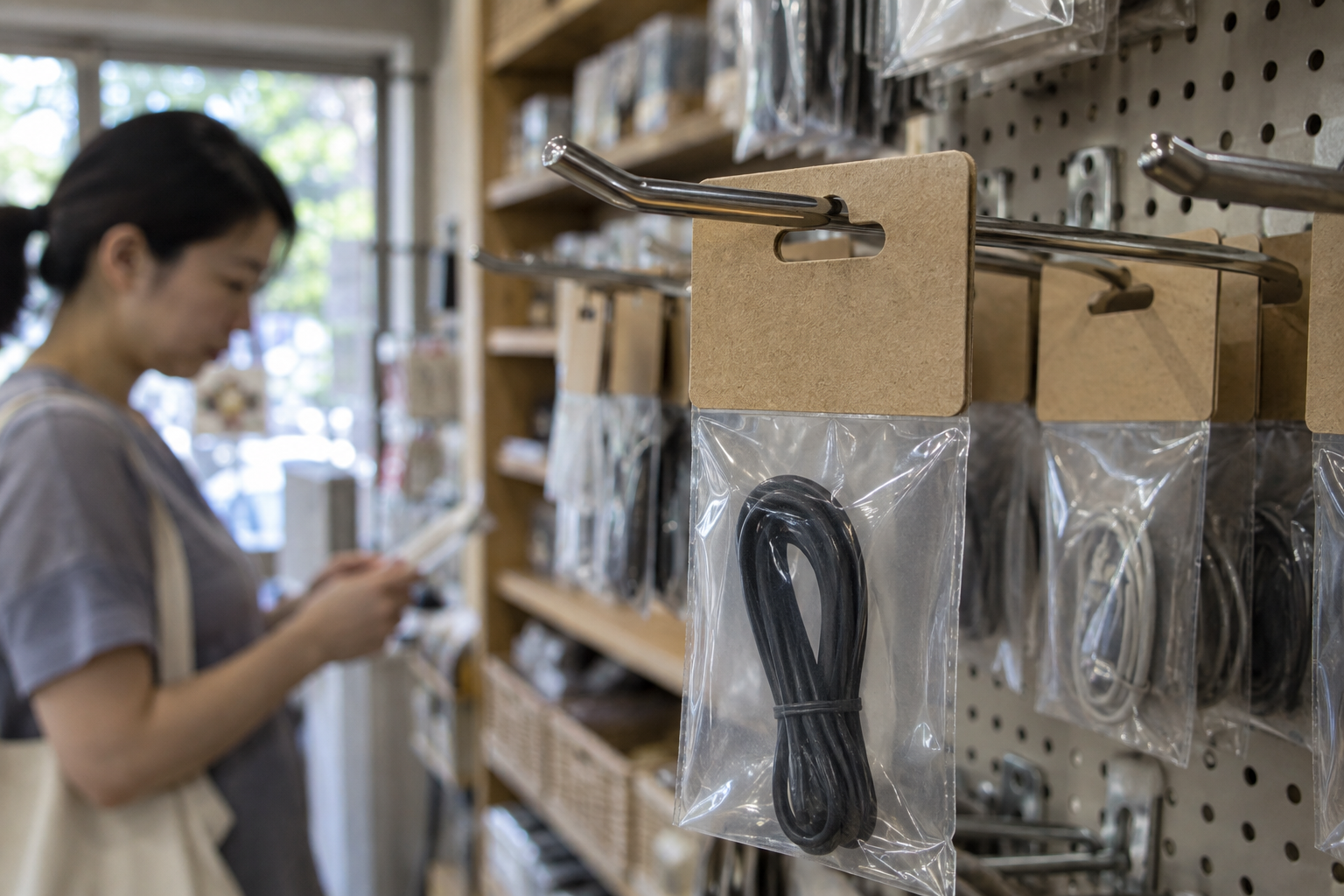
Approve retail peg-hook packaging on the actual fixture with the complete packed product. Check the hole geometry, hanging balance, usable peg capacity, removal clearance, label visibility and durability during the intended display period. A familiar slot shape does not guarantee compatibility with every retailer's hook. Buyers should obtain fixture details early and test stocking, shopping and replenishment before printing the production run.
For small desk, travel and home accessories, a hanging pack can make a product easy to display while creating problems that a flat artwork proof will never reveal. The header may bend, the pack may tilt, or customers may need to remove several items to reach one. This guide turns those risks into a practical sourcing brief, without asserting test results or universal fixture dimensions.
Get the Retailer's Fixture Specification First
Ask for the hook type, usable length, relevant diameter, end shape, price-label holder and spacing between adjacent pegs. A physical sample or a verified drawing is more useful than a photograph alone. Confirm whether the same fixture is used across every store or whether several variants need consideration. Identify who can approve a packaging exception if the range is not uniform.
For a magnetic cable dock, the package may be small enough to appear simple, but its depth and weight distribution still affect how it hangs. Request the actual packed sample, including the product and internal restraint. An empty header card can fit a hook perfectly while the filled pack rotates or leans into a neighboring facing.
Distinguish a Hole Name From a Fit Requirement
Terms such as Euro slot are shorthand, not a complete interface specification. Record the approved opening dimensions, position and tolerances in the packaging drawing. Check that the hook passes through without excessive force and that its tip or label holder does not interfere with loading or removal.
Do not solve an uncertain fit by simply enlarging the hole. That may weaken the surrounding material or change the hanging position. Evaluate the complete tab and pack geometry with the packaging designer. The correct balance depends on the product weight, card construction and intended fixture, rather than a generic template copied from another item.
Measure the Package as It Will Be Supplied
Use an agreed measurement method and identify the package's normal orientation. The GS1 package and product measurement standard provides rules for trade-item dimensions, including distinctions between rigid and flexible hanging packaging. Follow the applicable rule for product data rather than improvising a convenient measurement that excludes an inconvenient tab.
Catalog dimensions and fixture fit are related but separate tasks. A correctly recorded package height does not establish removal clearance or the number of packs that fit on a peg. Keep measured trade-item data in one record and the fixture evaluation in another, linked to the same packaging revision.
Account for Bulging and Flexible Parts
Flexible pouches and loosely restrained products can occupy more space when filled than the artwork suggests. Measure representative packed samples and observe how they settle when hung. A flat development sample may not show the shape created by a zipper, product corner or folded instruction leaflet in normal production.
If the pack changes shape during stocking or customer handling, identify the acceptable range and its implications for display. Avoid compressing the sample by hand to obtain a favorable capacity estimate. The buyer needs a realistic shelf presentation, not a measurement that can only be reproduced with special handling.
Work Out Peg Capacity From Usable Space
The nominal hook length is not necessarily all available for product. The tip, label holder, rear clearance and shopping access can reduce usable space. Obtain the retailer's requirements and test with the complete pack. Count how many units can be stocked without forcing them together or making the front item difficult to remove.
As a planning calculation, capacity is constrained by usable length divided by the space each hanging pack actually occupies. This is only an estimate. Friction, angled packs, product thickness and the removal path can reduce the practical count. Confirm the result with a fixture trial rather than presenting a calculated maximum as a guaranteed store capacity.
| Check | Buyer question | Evidence to retain |
|---|---|---|
| Hook interface | Can staff load the pack without damage? | Fixture identity and fit photographs |
| Display capacity | How many units remain easy to shop? | Observed count and pack revision |
| Neighbor clearance | Do adjacent products interfere? | Loaded display arrangement |
| Removal path | Can a customer take one unit naturally? | Observations from representative handling |
| Header condition | Does the tab remain usable? | Defined evaluation and post-check images |
Include the expected store replenishment quantity. A case pack that exceeds a facing's capacity may require backroom storage, which can be acceptable if planned. It becomes a problem when the buyer assumes every carton empties directly onto one peg and the store discovers otherwise during launch.
Evaluate Balance, Readability and Access Together
Hang the complete package at the intended display height and observe its normal resting position. Check whether the product weight causes rotation, forward tilt or a folded header. Positioning the hole near the visual center of the artwork does not necessarily place it correctly for the loaded center of mass. Let the physical trial inform the drawing.
Review the product name, variant identification, barcode and important consumer information in the displayed state. A perfectly printed label is less useful if the hook, adjacent pack or natural fold hides it. Check both a fully stocked facing and a nearly empty one, because the presentation can change as products are removed.
Test the Shopping Motion
Ask a representative user to take one pack and replace it without coaching. Observe whether fingers catch the hook, the tab tears or the product swings into adjacent merchandise. This is a proposed usability check, not a formal safety certification. Any potentially hazardous fixture or package behavior should be escalated to the appropriate specialist and retailer.
Test staff replenishment as well. Staff may need to load many packs quickly, identify variants and keep the display aligned. A package that works only when carefully positioned by its designer may create avoidable handling effort in a busy store. Include the actual inner carton and replenishment sequence where possible.
Mid-Article CTA
Preparing accessories for pegboard retail? Send Your Requirements with the product, retailer fixture details, target units per facing and packaging format. KudBo can discuss representative samples and packaging coordination before the artwork and production quantities are finalized.
Assess the Header as Part of the Complete Package
The tab material, hole location, cut quality, folds and attachment method all deserve review. If a separate adhesive hanger is proposed, ask how its material and application process are controlled. A strong-looking tab does not establish that its attachment to the pack will remain suitable. Evaluate the weakest part of the assembly rather than only the visible card.
Define the intended display conditions and duration with the retailer. Ask the packaging provider to propose relevant conditioning and handling checks. Avoid inventing a universal load or hanging time that supposedly certifies every retail pack. Acceptance should reflect the actual application and any retailer protocol that applies.
Include Transport Before Display
Packaging may reach the store with folds, abrasion or tab damage caused during transit. The ISTA design and testing guidance is a primary reference for selecting distribution evaluations and tracking package changes. Discuss how the display feature is protected within the shipping carton and how it will be examined after the selected evaluation.
Check the pack after realistic unpacking. If staff must unfold a tab, remove a temporary restraint or add a hanger, make the operation clear and repeatable. Loose tabs or mixed accessory bags can create errors during replenishment. Prefer a defined process that the receiving store can follow without searching for an explanation.
Compare Hanging Cards, Cartons and Pouches
A carded pack can offer clear product presentation but may need careful control of product restraint and header strength. A hanging carton can provide more printable area and protection while increasing depth. A pouch may accommodate soft or irregular items but can change shape when loaded. These are design considerations, not a ranking that applies to every product.
Compare the formats against the same fixture and customer requirements. Request material, assembly labor, shipping volume and sampling costs separately. Include any tooling or retailer review needed before release. A cheaper format can become more expensive if it requires store assembly or uses more space per facing than the buyer planned.
Use the retail-ready packaging guide for the broader receiving and replenishment workflow. The peg-hook trial should fit into that workflow, with clear relationships between retail unit, inner pack and master carton. Treating the hanging pack as an isolated design can hide problems elsewhere in the supply chain.
Run a Small Fixture Trial Before Artwork Approval
Prepare production-intent samples with the correct product weight, material and closure. Label each candidate with its revision and intended fixture. Load the proposed facing, then check capacity, neighboring clearance, removal and replenishment. Photograph the same views for every candidate so the comparison is useful to people who were not present.
Separate observed findings from predictions. For example, record that a tab bent during the defined handling exercise rather than claiming it will always fail in stores. If a sample performs well, record the conditions and limits of that observation. This language supports a sound decision without overstating what a small development trial proves.
A Hypothetical Tradeoff
Suppose a slimmer pack allows more units on a peg but makes the product harder to identify. A wider pack presents the product clearly but reduces facing capacity. The retail buyer can compare replenishment frequency, category presentation and commercial goals before choosing. The appropriate answer depends on the retailer's priorities rather than a universal preference for the smallest pack.
If a new artwork layout resolves visibility, repeat the relevant review with the finished design. If a structural change moves the hole or changes the closure, repeat fit and handling checks. Do not assume that a late visual change leaves every physical interaction untouched.
Control Production and Reorders
The shipment inspection brief should include the approved drawing, fixture reference, sample pack and critical fit checks. Verify that the actual product and insert match the approved packed configuration. Inspect hole cutting, tab alignment, material condition and assembly as applicable. A pack count and print-color check alone can miss the feature that determines whether the item can be displayed.
Keep product-data dimensions synchronized with the final packaging revision. Notify the retailer through the agreed process when a change affects its display or data. A small increase in depth may matter across a fully stocked peg even if it appears minor on a drawing. Reorder approval should consider fixture compatibility as well as the product itself.
Browse the KudBo product catalog to plan which accessories can share a display family. Common packaging can simplify a retail range, but each loaded product still needs a fit review. Similar outer dimensions do not guarantee similar balance, weight or shopper handling.
Include Store Operations in the Approval Meeting
Invite the person responsible for replenishment or category execution to review the fixture trial. They can identify whether the proposed case quantity, package opening and variant labels fit the store's actual routine. A designer may optimize the display photograph while an operations reviewer notices that staff must sort several indistinguishable variants before stocking.
Record how a partially emptied facing should look. If the remaining packs slide backward or rotate, ask whether the fixture or package needs a change. Check whether the price label remains clearly associated with the product when neighboring facings are full. These observations help the buyer discuss practical merchandising rather than relying on an idealized launch display.
Where the retailer uses security accessories, include the relevant approved fixture configuration in the trial. Do not assume a package that works on a plain hook will behave identically once another element is added. Obtain the retailer's input and avoid improvising modifications that could interfere with safe customer access or store procedures.
Finish with a one-page approval record: fixture identity, packaging revision, observed capacity, accepted arrangement and open issues. Attach photographs that show both the complete display and the critical tab detail. Share the record with production and inspection so the reason for each dimension remains visible. This prevents later attempts to save a small amount of card from unintentionally changing the fit that the retailer already approved.
Frequently Asked Questions
Does a Euro slot fit every retail hook?
No. The name does not define every relevant dimension or fixture feature. Obtain the retailer's hook specification and approve a complete packed sample on that fixture. Include the tip, label holder and loading path in the check, not only whether a metal rod passes through the opening.
How should buyers calculate units per peg?
Use usable fixture length and the space occupied by the packed product as an initial estimate. Then confirm with a loaded display trial. Leave the required removal and label clearance. Nominal hook length divided by a flat artwork dimension can overstate practical capacity and complicate store replenishment.
Should a hanger tab be included in product dimensions?
Apply the relevant GS1 measurement rule for the packaging type. Rigid and flexible hanging items are treated differently in the standard. Record the method and final package revision. Separately verify fixture fit, because correct trade-item dimensions do not establish shopping clearance or display capacity.
Can a separate adhesive hanger solve an unsuitable package?
It may be an option, but its attachment, material compatibility, placement and application process need evaluation. Check the complete assembly under the intended conditions. Adding a hanger without a defined procedure can move the problem from the original hole to the adhesive bond or pack surface.
What should a retailer sample trial include?
Use the final product weight, intended package, relevant fixture and neighboring packs. Check stocking, normal hanging, visibility, removal, replacement and replenishment. Identify the duration and conditions of any durability exercise. Retain observations and photographs so approval remains linked to the actual tested configuration.
Conclusion
Retail peg-hook packaging succeeds when the package, fixture and handling process are developed together. Obtain the fixture specification, measure correctly and validate the loaded display. Record practical capacity and shopping behavior, then carry the approved details into production inspection. A small physical trial can answer questions that artwork alone cannot resolve.
Related Buyer Resources
Continue with the KudBo buyer blog and product sourcing collection, or use the sourcing enquiry section to describe the application and approval evidence you need.
Final CTA
Get a Quote or contact KudBo with your accessory range, retailer requirements and launch quantity. Include fixture drawings or sample details if available. A focused packaging discussion can establish the sample work, structural decisions and approval evidence needed before the retail order is released.