Introduction
Source replacement lunch box gaskets as controlled components of a specific lid and container system. Matching the apparent length or color is not enough. The seal profile, groove geometry, material, hardness, manufacturing tolerance and assembly direction can all affect fit and closure. Approve replacement parts against the exact product revision and intended cleaning conditions before offering them to customers.
For kitchenware retailers and private-label importers, a removable seal can support cleaning and after-sales service. It also creates a compatibility responsibility: customers need to identify, obtain and install the correct replacement. This guide explains what to request from suppliers, how to evaluate a sample and how to maintain a service kit without making unsupported leakproof or food-contact claims.
Treat the Gasket and Lid as a System
A gasket works with the groove, lid stiffness, latch geometry and container rim. A soft ring that fits loosely into a groove may not compress correctly when the lid closes. A thicker replacement may make closure difficult or distort the lid. Review the complete assembly rather than buying an isolated ring from a photograph.
For a modular lunch box set, identify which compartments have their own seals and which rely on a shared lid. Internal separation and external leakage are different performance questions. A container that resists liquid escaping outside may still allow liquid to move between compartments if the design does not seal each section independently.
Record the Functional Interfaces
Request a component drawing or sufficiently detailed specification showing the cross-section, overall path, corner shape and relevant tolerances. Identify orientation features, pull tabs and any joint. Connect the gasket drawing to the lid and container revision. A service part should have its own identifier even when it is supplied in the original product box.
Ask which dimensions are measured in the relaxed state and how the supplier avoids stretching the seal during measurement. A flexible component can be distorted by the measuring method. The inspection approach should be repeatable enough to distinguish an actual dimensional change from handling variation.
Compare Seal Designs for the Intended User
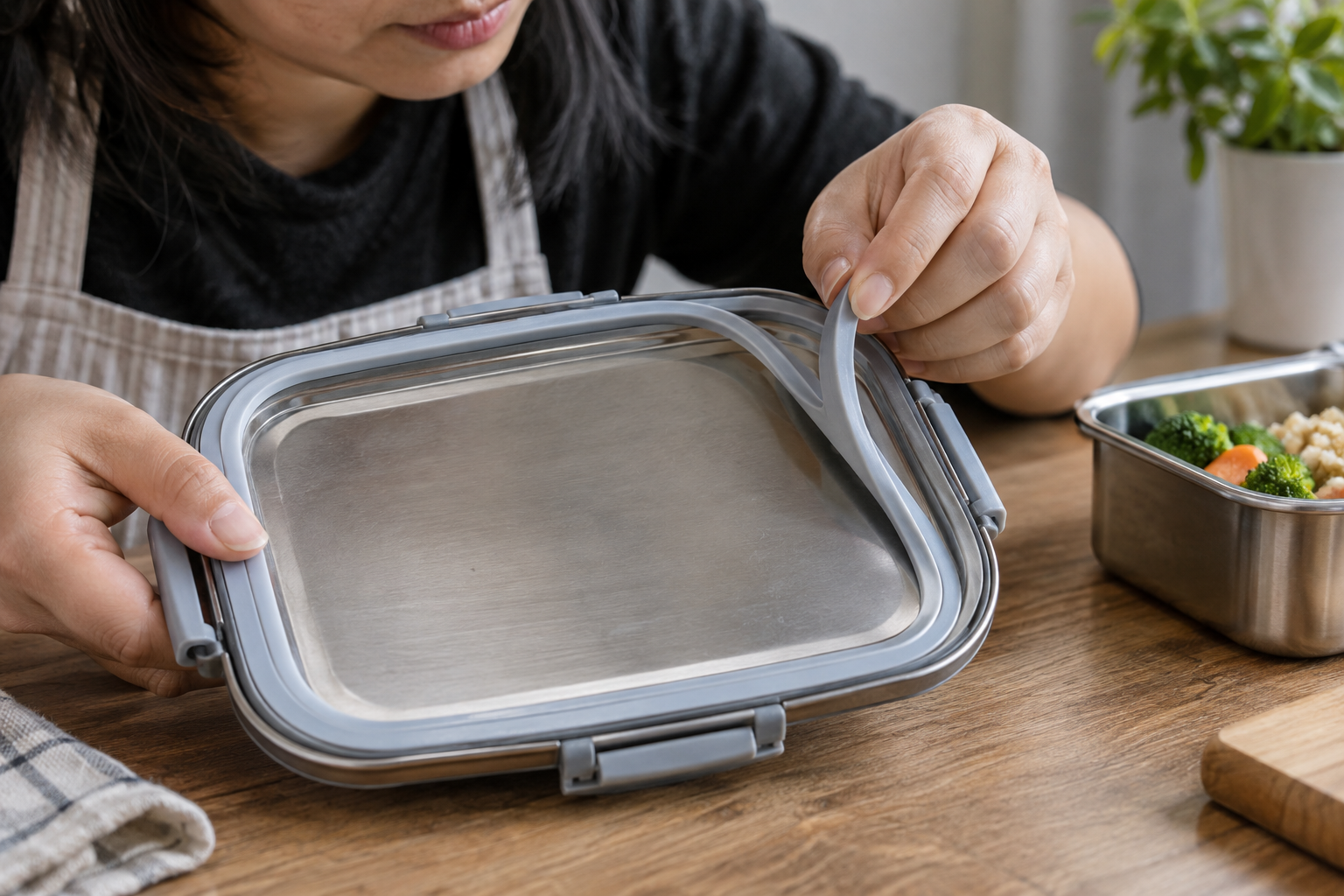
Some designs prioritize easy removal, while others use a more retained fit. A pull tab can help cleaning but must not become trapped across a sealing surface. A symmetrical profile may simplify installation; an asymmetric one may require clearer instructions. Evaluate the design with someone who has not watched the factory assemble it.
The useful question is whether an ordinary customer can remove, clean, dry and reinstall the seal correctly using the supplied instructions. Do not rely on an experienced technician's speed. Record points where the customer needs a tool, stretches the gasket excessively or cannot tell whether a corner is seated.
Avoid a Universal Hardness Recommendation
Material hardness is one input, not a complete design specification. A suitable value depends on geometry, compression and the rest of the assembly. Ask for the specified material and hardness range, the measurement method and the design basis. Do not assume that softer always seals better or harder always lasts longer.
Discuss production variation with the supplier. If a replacement uses a different formulation or process, identical nominal hardness does not establish equivalence. Review fit, recovery and the intended use evidence together. Any change that affects the customer experience should be approved against the complete lid system.
Define Food and Cleaning Conditions Before Requesting Evidence
Describe the expected foods, contact duration, temperatures and cleaning method. Cold packed lunches, warm food storage and reheating involve different conditions. State whether the gasket remains installed during any claimed heating or washing operation. The conditions in the product instructions should agree with the supplier's material evidence.
The FDA consumer explanation of food-contact materials makes clear that intended use matters in evaluating substances that contact food. For sourcing, request evidence tied to the proposed material and conditions. A generic food-grade description does not identify the formulation, applicable basis or limitations.
Keep Market Review Specific
Ask the supplier to identify the basis supporting the proposed food-contact use and provide documentation that can be reviewed by qualified personnel. FDA guidance on determining component status explains that more than one route may be relevant. Do not assume every component needs the same document or that a report for a different material applies.
For other destinations, review the applicable requirements separately. A document prepared for one market does not automatically settle another market's questions. The buyer's file should connect the exact gasket, colorant where relevant, manufacturer, intended conditions and supporting records without claiming a certification that has not been established.
Build a Sample Review Around Real Use
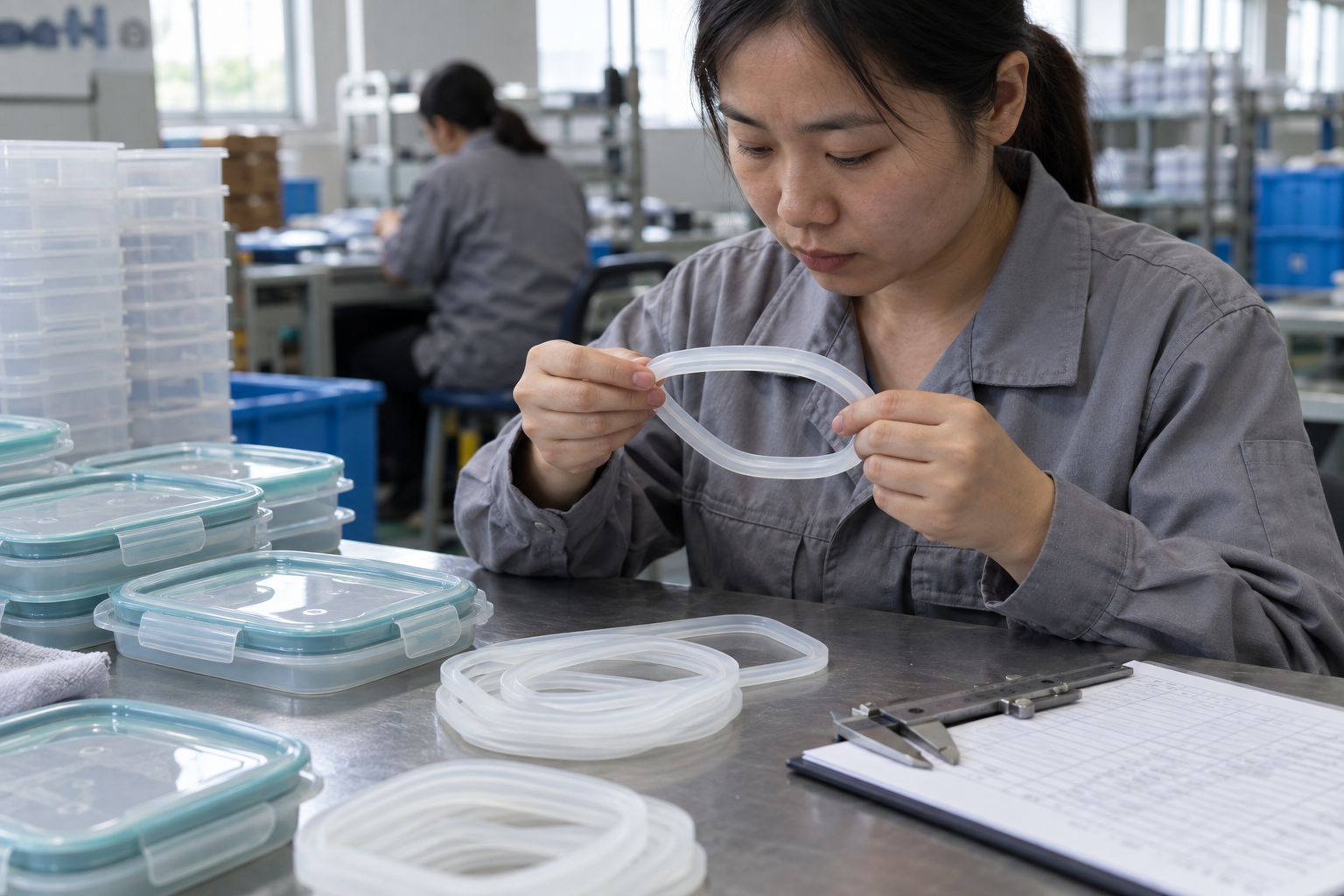
Start with a complete production-relevant lunch box and the proposed replacement seals. Photograph identifiers and record the sample revision. Inspect molding quality, flash, tears, uneven sections and contamination. Then install the gasket according to the proposed instructions and close the lid using the normal latch sequence.
Check whether the seal stays seated at corners, whether the lid closes evenly and whether the user can see an incorrect installation. Repeat removal and installation under a documented sample plan. This is a proposed evaluation workflow, not a claim that KudBo has already tested the product or that a specific service life has been demonstrated.
Separate Leakage Questions
Define the intended liquid and orientation, fill condition, duration and handling before a leakage check. Use safe, appropriate procedures and distinguish routine screening from formal claim substantiation. Do not extrapolate a short upright check into a promise that the container will remain sealed in every bag, temperature or pressure condition.
Where compartments are marketed as separated, evaluate movement between compartments independently. If the product is intended only for solid foods or upright transport, make that limitation clear. Precise instructions can prevent a product from being sold for an application the design does not support.
| Review area | Sample question | Record to retain |
|---|---|---|
| Fit | Does the seal seat without excessive stretch? | Drawing, revision and observations |
| Closure | Do latches close in the intended sequence? | Complete assembly reference |
| Removal | Can a new user remove the seal as instructed? | Instruction review notes |
| Cleaning | Can surfaces be accessed and dried? | Agreed care procedure |
| Leakage | Does the assembly meet the defined condition? | Method, sample scope and result |
| Replacement | Is the service part clearly identifiable? | Compatibility matrix and package proof |
Mid-Article CTA
Send Your Seal Compatibility Requirements. Email info@kudbo.com with the lunch box model, lid photographs, target market, intended use and replacement-kit quantity. Include available drawings or sample references so KudBo can help clarify component identity and the sample questions for the supplier.
Evaluate Cleaning Access Without Making Hygiene Promises
Inspect the groove with the gasket removed. Look for inaccessible corners, sharp edges or features that make drying difficult. Ask whether the instructions clearly explain which parts detach and how they should be cleaned. Do not claim that a removable seal prevents all odor, staining or microbial growth; those outcomes depend on materials and user behavior.
Review reassembly after the parts are clean and dry. A seal may become twisted or installed upside down if its orientation is unclear. A simple illustration can be more useful than a long warning paragraph. Test the instruction sequence with the actual part and revise ambiguous steps before the packaging artwork is finalized.
Keep Care Claims Within Evidence
If dishwasher suitability is proposed, identify the relevant components and conditions. Do not extend a container-body claim to its gasket or lid without review. Similarly, a temperature statement for a raw material does not automatically establish the performance of a complete latched assembly.
Ask how the supplier evaluates changes after cleaning, including appearance, fit and closure. Retain observed results and limitations rather than a vague pass label. The customer-facing instructions should describe only the care conditions supported for the supplied product version.
Design the Replacement Kit as a Sellable Item
Decide whether the kit includes one gasket, several compartment seals or another combination. State the contents by part identifier and quantity. If two rings look similar but fit different lids, separate and identify them clearly. A bag containing assorted seals can create more service enquiries than it resolves.
Provide a simple compatibility statement using the product model and revision information customers can locate. Avoid universal-fit wording unless the exact range has been evaluated. Include installation guidance and a clear instruction to use the correct part rather than stretching or cutting an incompatible seal to fit.
Plan Small-Quantity Logistics
Replacement parts can be light but awkward to manage. Consider how they will be stored without deformation, picked accurately and protected from contamination. The lowest-cost loose bulk pack may create extra work for a retailer that needs individual service units. Ask for both bulk and retail-ready kit options if the business will use both.
Set an initial spare quantity from the service plan and available evidence. Do not invent a standard failure rate. Forecast uncertainty should remain visible, and replenishment should be possible without forcing the buyer to place another full lunch box order merely to obtain a small component.
Maintain Compatibility Across Reorders
Create a matrix linking each lunch box revision to its lid, container and gasket identifiers. Record whether older and newer parts are interchangeable and what evidence supports that decision. A supplier statement that the change is minor should not replace a compatibility review when customers depend on replacement parts.
Ask for advance notice of tool changes, formulation changes, color changes or new component sources. Retain samples of superseded parts where practical so service teams can identify older stock. If a new gasket is not compatible, keep the service listing and warehouse location separate from the previous revision.
Resolve Discontinued Parts Before Selling the Last Units
Ask how long the supplier expects to offer the replacement and what minimums apply. A verbal long-term availability promise is less useful than a defined process for discontinuation notice and a final-order opportunity. Keep the commitment proportionate to the product's commercial program and avoid advertising a support period that has not been agreed.
When a part is discontinued, assess remaining product inventory, existing service demand and the cost of a controlled last buy. Do not substitute a visually similar ring without testing fit and reviewing material suitability. The service decision should protect product identity as carefully as the original purchase.
Inspect Incoming Parts and Shipment Pack-Out
Shipment inspection should verify part identity, quantity, appearance, packaging and a documented fit sample using the matching lid system. Sampling only the bag label will not reveal a wrong profile inside. Where several revisions are packed together, use a method that checks segregation and avoids accidental mixing during rework.
Retain lot information so a complaint can be traced to the replacement shipment. If a fit problem appears, compare the customer's product revision, supplied gasket and installation method before concluding that all parts are defective. Keep the evidence index with the food-contact supplier documentation checklist for the wider product file.
Turn Service Feedback Into a Compatibility Check
Prepare a short support checklist before the replacement kit launches. Ask for the product model, visible revision identifier, a photograph of the lid and a description of the difficulty. The aim is to determine whether the customer has the correct part and understands installation. Avoid requesting unrelated personal information merely to diagnose a component mismatch.
Distinguish a missing gasket, a damaged gasket, an installation issue and a container or latch problem. Replacing the seal will not correct every closure failure. Give support staff a route to escalate unclear cases rather than encouraging them to promise that a new ring will solve the problem automatically.
Make Replacement Instructions Testable
Use a sequence that can be followed from the package alone: identify the compatible lid, remove the old seal as instructed, clean and dry the relevant parts, orient the new seal and check its seating before use. The exact steps should come from the approved design. Do not add a tool or lubricant recommendation without the supplier's product-specific review.
Ask a reviewer unfamiliar with the product to follow the instructions using a sample. Observe whether they can identify the correct side and seat the corners without stretching the seal excessively. If they pause or improvise, improve the wording or illustration. This is an instruction-usability check, not a substitute for performance or material evaluation.
Feed verified service findings back into the supplier review. Repeated reports involving one revision may justify a focused investigation, while isolated incorrect installations may call for clearer guidance. Keep conclusions tied to the evidence received. Related sample and change-control resources are available in the product sourcing archive.
Frequently Asked Questions
Are lunch box gaskets with the same overall size interchangeable?
Not necessarily. Cross-section, corner geometry, material and compression can differ even when the outline looks similar. Match the replacement to the approved lid and container revision. Confirm compatibility through drawings and sample evaluation rather than stretching a near-match into place.
Is silicone automatically suitable for every food-contact use?
No. The exact material, formulation and intended conditions need appropriate review. Request supporting records tied to the supplied component and target market. A generic material name or food-grade statement does not establish every temperature, cleaning or contact application.
Should every lunch box include spare gaskets?
That depends on the service model, customer expectations and commercial plan. Including spares can be convenient, but they need clear identification and storage. Another option is a separately available replacement kit with a reliable replenishment arrangement. Do not assume one approach is best for every channel.
How should buyers assess cleaning access?
Remove the seal, inspect the groove and follow the proposed cleaning and drying instructions. Ask a new user to reinstall it and observe whether orientation is clear. Record practical difficulties and improve the instructions without making unsupported hygiene or odor-prevention claims.
What changes require a replacement-part review?
Review changes to the gasket profile, material, hardness, lid groove, container rim, latch geometry or relevant manufacturing process. A component can remain visually similar while behaving differently. Update the compatibility matrix and service instructions whenever the approved relationship changes.
Related KudBo Resources
Browse the KudBo product catalog, explore the buyer guide library, read more Kitchenware sourcing guides, or send your product requirements for a focused sourcing discussion.
Conclusion
Replacement gaskets are a product-platform decision, not an interchangeable accessory purchase. Specify the complete sealing system, evaluate cleaning and installation, retain use-specific material evidence and control revisions. A clear compatibility record makes after-sales support more dependable and helps buyers avoid selling a replacement that only appears to fit.
Final CTA
Ask for a Lunch Box Service-Kit Plan. Browse the KudBo catalog and buyer resource library, then use the contact form or email info@kudbo.com. Share the product revision, destination and replacement strategy to begin a component-specific sourcing discussion.