Introduction
A pet visibility light helps someone see an animal nearby; GPS tracking provides location information through a different technical system. A light should not be sold as a remote locator merely because a product name includes tracker. Bluetooth finding, satellite positioning and cellular reporting also need separate explanations.
This distinction affects both customer expectations and ownership cost. An inexpensive light can be useful for a defined walking routine without a subscription. A location service can offer different capabilities but may depend on connectivity, an account and continuing service. Neither category should promise that a pet can always be found.
This pet tracker light vs GPS collar guide helps accessory retailers assess a pet tracker light. It does not confirm that the catalog light contains GPS, Bluetooth or cellular functions. The buying workflow is proposed, not a report of KudBo field trials. Animal fit and use should follow the exact instructions and appropriate professional guidance.
Classify the Function Before Choosing a Name
Ask the supplier what the device actually does: emits light, helps nearby finding, obtains position, reports location or combines several features. List the hardware, service and connection required for each function. Do not treat one small icon on the package as sufficient evidence.
A pet visibility light positioning statement can describe making a collar easier to notice in the stated conditions. It should not imply remote tracking or collision prevention. Appearance and brightness can vary with orientation, distance and surroundings, so an absolute visible-everywhere claim needs to be rejected unless appropriately supported.
Tractive’s official light instructions distinguish a light feature within its tracker’s broader functions. They are an example of feature separation, not evidence that another device provides the same location service or app controls.
Separate Nearby Finding From Remote Location
Bluetooth is a connection, not unlimited range
Bluetooth pet finder limitations depend on the actual system. Ask whether the device connects directly to the owner’s phone, relies on a wider finding network or provides another arrangement. A nearby signal-strength feature is not automatically a precise map location or a remote service.
Do not claim a fixed usable range without the method and environment behind it. Walls, orientation and system behavior can affect results. A demonstration in an open room does not establish outdoor coverage or operation through every building. Keep the feature description consistent with the manufacturer’s supported application.
GPS positioning and reporting are separate
GPS pet accessory connectivity should identify how location information reaches the customer. Obtaining a position and transmitting it are different tasks. A product may require a cellular service or another reporting path. Ask which regions, networks and account conditions the supplier supports.
Tractive’s status-light documentation separately identifies network and GPS status for its models. The example shows why these states should not be collapsed into one working indicator. Do not copy its behavior or coverage into another product’s specification.
Build a Function Comparison for the Retail Range
| Product role | Main customer benefit | Questions to disclose |
|---|---|---|
| Visibility light | Nearby visual awareness | Mode, orientation, runtime and fitting |
| Direct nearby finder | Finding within the supported arrangement | Phone support, connection and practical limits |
| Network-assisted finder | Location through a stated ecosystem | Participation, access and service limitations |
| GPS reporting device | Position reporting through a supported path | Coverage, account, subscription and power |
Keep comparison language neutral. A light is not an inferior GPS unit; it performs a different task. A GPS product is not simply a brighter light with more features. Buyers can build a range with clear roles instead of adding ambiguous tracking language to every accessory.
For a smart pet doorbell, the customer task is communication or a learned routine, not location tracking. Related products can complement an assortment without sharing functions. The retail page should explain the actual use rather than relying on the common word smart.
Review an LED Collar Location Claim
Search the draft website, package and marketplace listing for terms such as locate, track, find and never lose. Ask what a reasonable customer might infer. If a plain light has no location capability, remove wording that suggests remote reporting. A small disclaimer may not repair a misleading headline.
Avoid security or safety guarantees that exceed the evidence. Visibility is not a guarantee that drivers or other people will notice an animal, and location information is not a guarantee of recovery. Explain the product’s supported contribution without implying that supervision or appropriate care is unnecessary.
The FTC’s advertising guidance establishes the general need for truthful, supported claims. Use that principle to review feature naming. Do not turn a supplier’s informal phrase into a verified technical claim without identifying the actual capability.
Evaluate Night Walking Accessory Selection
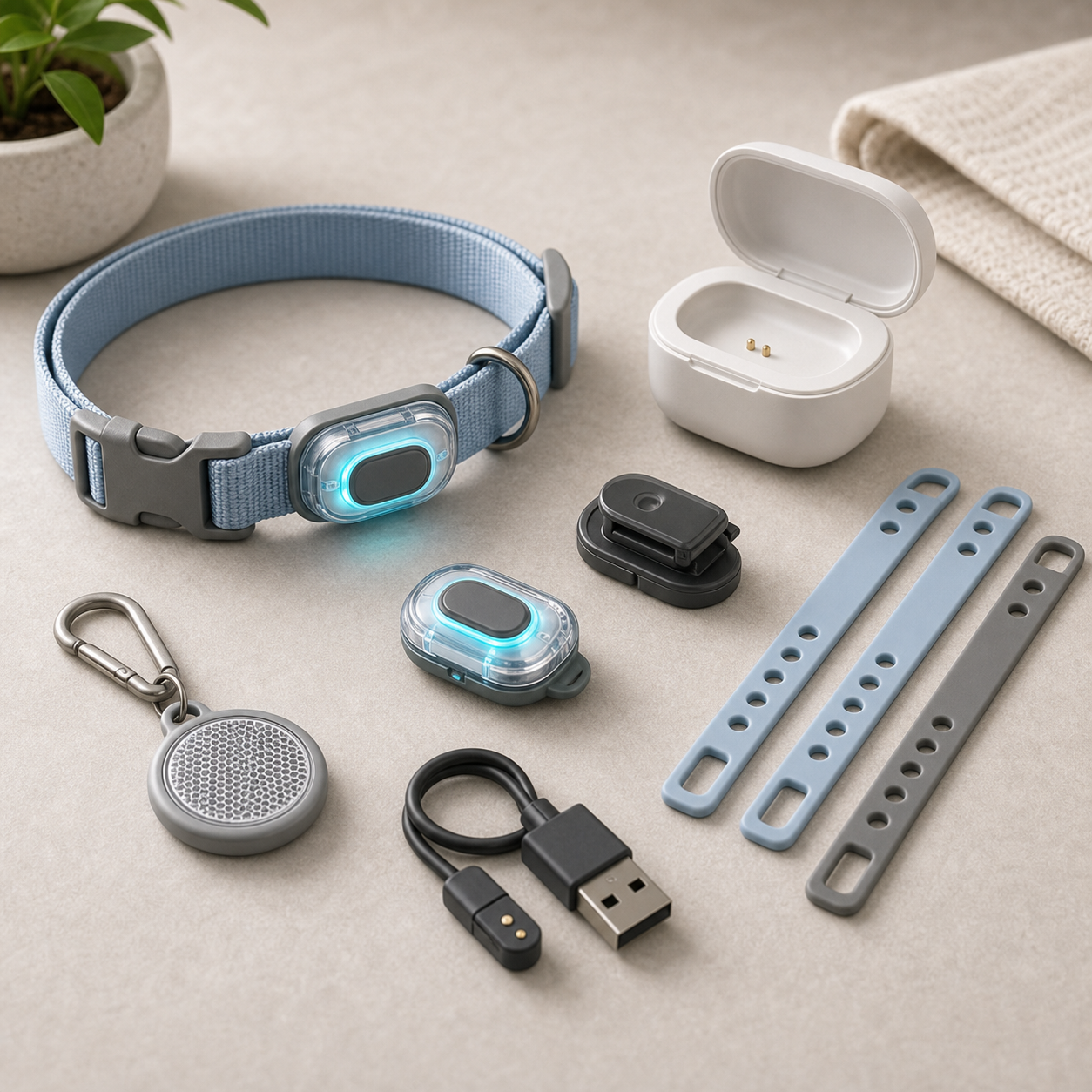
Define the intended collar, attachment method and use conditions. Check the complete device rather than a loose light on a table. Orientation and fur can affect whether the light remains visible in the intended arrangement. Animal suitability and secure fit need appropriate review; do not use an unapproved sample on an animal for a procurement photograph.
For a controlled light demonstration, use a fixture or permitted reference arrangement and record distance, ambient condition and mode. Do not invent a visibility range from a photograph whose exposure exaggerates the glow. A camera can make a modest light appear much brighter than a person would perceive.
If a numerical light-output or runtime claim is required, request a defined method and appropriate evidence. Keep each operating mode separate. A flashing-mode runtime is not necessarily the continuous-mode runtime, and a freshly charged sample does not describe performance under every temperature or aging condition.
Mid-Article CTA
Send Your Requirements with the intended function, collar arrangement, customer market and quantity. Email info@kudbo.com to discuss a clearly classified accessory range and model-specific documentation.
Compare Power and Service Burdens
A simple light may need charging or battery replacement. A connected tracker may have additional demands from positioning and communication. Ask for the exact charging method, operating modes and runtime conditions. Do not infer a longer life from the battery capacity alone or transfer a competitor’s result.
Where a subscription or account is required, identify price basis, regional support, cancellation and ownership transfer. These are part of the customer decision, not secondary details to reveal after purchase. Availability today does not establish that a service will continue indefinitely.
Check how users identify a low-power or unavailable state. A light that still illuminates may not prove that a location service is functioning. The instructions should distinguish relevant indicators and explain the next approved action. Avoid a single green icon that is promoted as assurance of all functions without support.
Use Test Accounts and Fictional Locations
For connected samples, use test accounts and avoid real customer or home information. Review what data are collected, stored and shared. A pet device can still reveal personal location or household patterns, so do not dismiss privacy concerns because the intended wearer is an animal.
The ICO’s data-minimisation guidance provides a relevant framework where applicable. It is not approval of the device or a complete assessment for every market. Identify the buyer’s responsibilities and obtain appropriate specialist review for the deployment.
Review account deletion, device reset and ownership transfer. A returned product should not remain linked to a previous customer’s location account. The support procedure should explain what the retailer can verify and what depends on a service provider. Do not claim complete deletion without evidence covering the relevant systems.
Freeze the Feature Set and Retail Contents
Record device functions, attachment, power accessories, app requirements and service terms in the quotation. A light-only offer and a connected location offer are not comparable products merely because both attach to a collar. Compare them within their intended roles.
Ask which accessories are included and which collar dimensions or fitting conditions are supported. A lifestyle photograph showing a complete collar can imply inclusion even when the quotation covers only the light. Label context items clearly and use a full-product photograph for inspection.
Require notification of changes to firmware, radio hardware, attachment, battery or relevant service arrangements. Keep revisions identifiable. A color match does not prove that the next shipment retains the same functionality, account behavior or accessory fit.
Verify Production Without Overstating the Evidence
Factory testing can check assembly and defined operating functions, but the supplier should state its methods. Shipment inspection can verify identifiers, contents, attachment condition and agreed screening. It cannot establish global network coverage or guarantee that customers will recover a missing animal.
For a location-enabled model, preserve the separate technical and service evidence. A powered light is not proof of successful positioning or reporting. A sample map screenshot is not a coverage guarantee. The KudBo catalog supports assortment planning, while the approved configuration and claim record should control the order.
Imagine a hypothetical buyer wanting a low-cost night-walking accessory without account setup. A clearly described light may meet that task better than a connected tracker. Another buyer needing remote location should request a different system. This is an illustrative decision, not a KudBo sales case or a claim that either model suits all animals.
Approve the Feature Labels Before Artwork
Create one row for each function proposed on the package. Identify the hardware or service responsible, the evidence available and the limitation customers need to understand. For a light-only model, the location-reporting row should remain absent rather than being populated with a vague tracker description.
Review icons as well as words. A map pin, satellite or phone graphic can imply a capability even when the written description is cautious. The artwork should match the actual function set. A decorative icon is not harmless if it changes what a reasonable customer expects the accessory to do.
Ask the sales team to explain the product without using the word smart. A light can be described through its supported visibility routine. A location device can be described through its actual positioning and reporting path. Both explanations should preserve relevant power and connection requirements.
For connected models, add the service dependency to the same sheet. Identify what happens without an account, supported network or subscription. Do not bury a required ongoing service beneath a one-time product price. A buyer needs the complete ownership arrangement before selecting a range.
Before release, reconcile the sheet with the manual, quotation and sample. If one says Bluetooth and another says GPS, resolve the discrepancy rather than combining both terms to attract searches. Keyword coverage is not a reason to add an unsupported capability.
A night-walking image can communicate context, but it should not be represented as a measured range or a real recovery event. Preserve the approved labels for repeat orders. A radio or service change may require revised wording even if the physical accessory is unchanged.
Keep the Approval Evidence Retrievable
Record the model, revision, method, conditions, observations and reviewer in the purchase file. A later reader should distinguish a supplier statement, a buyer observation and an unresolved requirement. Do not describe an illustrative photograph as a completed factory test or a real customer project. If a revised sample is proposed, identify what changed and review the affected requirement before carrying the earlier conclusion forward. This record should support the decision, not create certainty that the evaluation never established. Keep the final claim within the observed or appropriately documented scope, and make remaining limitations visible to the person approving artwork and the order.
Confirm the Customer's Required Function
When an enquiry asks for a tracker, clarify the intended result before quoting. A nearby visibility accessory and a remotely reported location address different needs. Record the required function in the comparison so a lower-cost light is not offered as an equivalent substitute for a location service. This clarification also keeps the retail name aligned with the actual device rather than an ambiguous category term.
Related Buyer Resources
Continue with Pet Feeder Kibble Jams and Offline Schedules for a complementary purchasing question. Compare the full product catalog, or browse the KudBo sourcing blog or the product sourcing topic collection for additional buyer guides. These resources provide decision context; each product still needs its own model-specific approval.
Frequently Asked Questions
Does a pet tracker light automatically include GPS?
No. The name is not evidence of a positioning component or reporting service. Ask what the device actually does and which connections it requires. A simple light should be described as a visibility accessory, not a remote locator, unless model-specific evidence supports additional functions.
Can a Bluetooth finder provide unlimited remote tracking?
Do not assume so. Its capability depends on the connection or finding ecosystem actually implemented. Request supported conditions and limitations. A nearby demonstration does not establish remote coverage, a precise map position or operation in every building and outdoor environment.
Does GPS positioning mean the owner receives a location?
Not automatically. Positioning and reporting require separate review. Identify the transmission path, network or service, account and regional support. Confirm how unavailable states are shown. A light turning on or a device obtaining a position alone does not establish delivery of current location information to the owner.
How should a visibility demonstration be recorded?
Use an approved reference arrangement and document orientation, mode, distance and ambient conditions. Avoid camera exposure that implies unsupported brightness. A photograph illustrates a scene; it does not by itself establish a numerical visibility range or guarantee that others will notice the animal.
What belongs in the ownership-cost comparison?
Include the retail unit, charging or batteries, relevant accessories and any account or subscription. State service and regional limitations clearly. Compare products within their actual roles, and do not treat missing service information as zero ongoing cost or promise perpetual availability without an agreement.
Conclusion
The pet tracker light vs GPS collar distinction protects both the buyer and the customer from an ambiguous promise. Classify visibility, nearby finding, positioning and reporting separately. Then evaluate fitting, power, connectivity and support within the actual model’s scope rather than its marketing name.
Final CTA
Ask for Product Catalog or email info@kudbo.com with your destination, quantity and required function. KudBo can discuss available accessory options and documentation requests. Confirm the feature set and service conditions before approving a tracking or visibility claim.