Introduction
A modular lunch box organizes a meal; it does not become a refrigerator because it has compartments. Buyers need to distinguish food-contact, leakage and temperature questions before approving an “all-day fresh” claim. A secure lid can contain a sauce yet do nothing to slow warming when a perishable lunch sits in a hot vehicle.
The KudBo modular lunch box set should be specified for its actual intended meals and use setting. Earlier guides cover food-contact documentation and dishwasher and gasket care. This article follows the packed meal through transport and asks what the box itself does, what a cold source must do and what the seller should tell customers. It is not an assertion of a safe-duration test for a specific KudBo SKU.
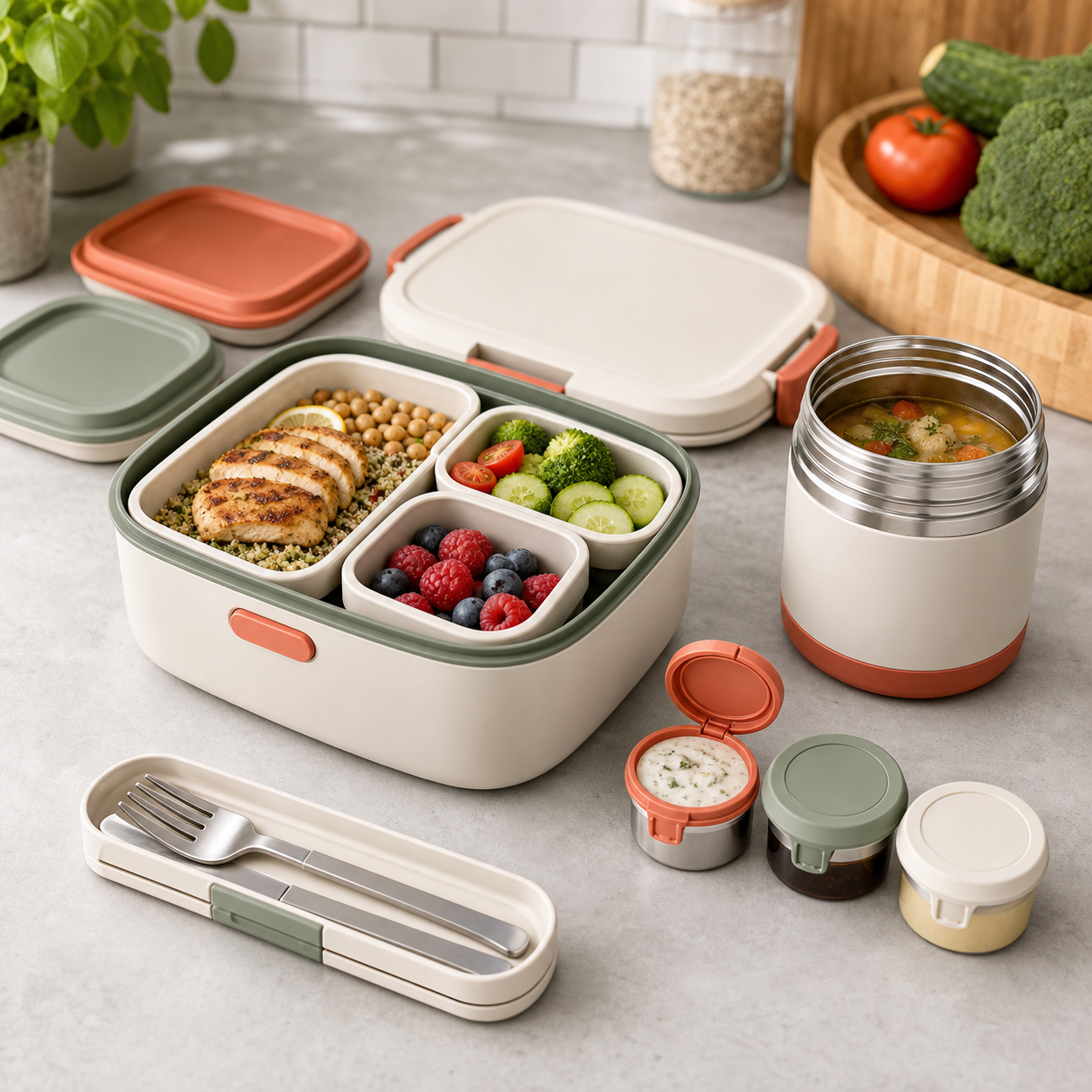
An importer can make a strong product page without exaggeration: show the number of compartments, their usable volumes, how they separate foods and which accessories are included. If the target shopper packs perishable foods, offer responsible cold-source guidance and validate any claim about thermal retention separately.
Define the Meal and Transport Scenario
Ask what the customer will pack: dry snacks, cut fruit, dairy, cooked leftovers, raw ingredients or a mixture. These foods do not have the same temperature or cross-contact concerns. Define the travel route from refrigerator to bag, vehicle, desk or classroom, including time without access to refrigeration. A generic “meal prep” image leaves those conditions invisible.
The USDA's guidance for packed outdoor food explains the importance of appropriate cold sources and keeping perishable foods cold. It does not certify a lunch box. A buyer should not promise that a compartment box holds food at a safe temperature by itself. Retail copy should distinguish the container from an insulated carrier, ice or a refrigerated destination.
If the lunch set includes a cold pack, document its dimensions, fill or freeze instructions, position and compatibility with the compartments. If it is optional, do not place it invisibly behind food in every hero image. Price a complete first-use bundle separately if the channel expects one.
Measure Usable Volume, Not Just Outer Size
Compartment depth, rounded corners and insert walls reduce usable capacity. Use defined sample foods or inert blocks to check whether a sandwich, salad dressing cup and utensils fit without bending the seal. Photograph the packed arrangement and note whether components can be rearranged. If “modular” means only one fixed layout plus a removable divider, describe that accurately.
Test the box in a realistic tote and alongside a gel pack if cold transport is central to the claim. A unit may fit the box alone but not the box plus cold source and cutlery. Check upright and sideways carrying under permitted conditions. Distinguish leakage of one compartment into another from leakage out of the whole box.
Ask for the volume measured to a practical fill line rather than maximum brim volume. A full sauce container can press a lid seal differently than a dry snack. Match the use of each compartment to the approved material and seal arrangement. Do not imply that a box is suitable for hot soup if its gasket, lid and instructions have only been reviewed for cool foods.
Separate Food Contact from Meal Safety
Map every surface that touches food: base, inserts, seals, lids, coatings and printed decorations. Request material declarations and relevant evidence for the intended food types, temperatures and duration in the target market. A statement about one plastic resin does not automatically cover the complete multi-material box. Qualified regulatory review is needed for actual compliance claims.
Food safety also depends on preparation and transport. The FDA food-storage guidance is a useful reminder that perishable foods need appropriate temperature control; it is not a product approval. A sealed compartment can slow contamination from spills but cannot make a warm perishable meal safe after an undefined period.
Keep cleaning claims separate. If inserts are dishwasher-safe but the insulated outer shell or gasket is not, the pack must say so clearly. Test the authorized care method and reassemble the box. A lunch product is used repeatedly, so support for replacement gaskets and dividers matters more than a one-time demonstration.
Build a Thermal Claim Around a Defined Method
If the buyer wants an “insulated” or “keeps cold” claim, specify what is being measured: food-simulant temperature, air in the box or cold-pack temperature. Record starting conditions, ambient environment, load, pack location, lid openings and duration. A pre-chilled empty box with a frozen pack is not the same as a meal packed warm at breakfast.
Use suitable thermometers and expert advice for food-safety interpretation. A single favorable result should not become a universal duration guarantee. Separate a relative comparison, such as one design warming more slowly under a specified trial, from an absolute statement that food remains safe for everyone. The listing must communicate any necessary cold-source and pre-chilling conditions clearly.
If the box is not insulated, say so. It may still excel at organization and cleanability. Retail buyers often prefer a precise product promise to a broad but indefensible one, especially when support teams will handle customer questions about food after transport.
Mid-Article CTA
Send Your Requirements with meal type, destination market, compartment layout, cold-pack plan and order quantity. Email info@kudbo.com for a model-specific food-contact and pack-out review. Include any thermal wording you hope to use so its evidence needs can be assessed early.
Review Handling and Cleanup
Ask a new user to pack a meal, open each section, close it and clean it using only the draft instructions. Note whether sauce reaches the divider edge, whether a child can remove a small insert safely and whether the assembled box fits a standard lunch bag. These are observed usability questions, not scientific food-safety tests.
Look for pooled wash water beneath gaskets or in hinge pockets. If the seal can be removed, show how it is reinstalled in the right orientation. A poorly refitted gasket can leak even when the material passed a lab test. Keep replacement seals keyed to the exact box revision.
Pack-out inspection should confirm every compartment, utensil, cold pack if included, gasket and printed care item. Factory tests may verify a defined closure and leak sequence. Shipment inspection can compare production units with a signed sample. Neither replaces food-contact documentation or a validated temperature profile.
Write a Useful Customer Message
Use plain wording: what the box holds, which parts can be heated or washed if supported, how to use a cold source and what is not included. Do not place an image of steaming food in a box whose instructions do not approve hot filling. Distinguish appliance use, such as microwave heating of a removable insert, from heating the fully assembled unit.
Give a first-use example grounded in a safe plan: pre-chill appropriate perishable food, use an adequate cold source where needed, and refrigerate on arrival if available. Exact handling must follow authoritative local food-safety guidance. The lunch box can help organize the meal without becoming the sole safety control.
| Buyer claim | Evidence needed | Scope limit |
|---|---|---|
| “Four compartments” | Complete pack-out and usable layout | Count actual sellable parts |
| “Leak resistant” | Defined filled-box orientation test | State conditions |
| “Keeps lunch cold” | Temperature profile with cold source | Do not infer food safety broadly |
| “Dishwasher safe” | Part-by-part care validation | Do not apply to whole set blindly |
Build a Meal-Specific Buyer Matrix
List common packed meals by the conditions they require. A dry snack asks different things of a container than dairy, cooked rice, cut fruit or warm soup. For each, note portion size, leak risk, need for temperature control and likely handling time. The box geometry can solve separation and spill problems; it cannot replace refrigeration when the food requires it. Show this distinction plainly in customer instructions.
Test the packed configuration a real user will carry. Add a cold pack only if the retail program includes or specifies one. Fill the compartments with safe test materials, close the lid, place the box in a bag and simulate a commute. Check whether a gasket is pinched, whether the cold pack steals usable meal volume and whether moisture collects at the interface. A photograph of an empty box cannot reveal those constraints. If a time claim is proposed, test the exact load, cold source and ambient conditions and preserve the temperature log.
For repeat orders, identify which parts customers can replace: gasket, latch, divider and outer shell. Confirm cleaning and drying of every contact surface. A buyer should also inspect how the retail pack communicates food-contact evidence for the destination market. Avoid treating a material name alone as proof that the complete product is suitable for every food, temperature and cleaning procedure.
Clarify Cold-Source Pack-Out
A photograph of a lunch box beside an ice pack does not tell buyers whether the pack is included. Put included contents and the compatible pack dimensions on the product page. If the cold source is optional, explain how it fits without crushing food or preventing a latch from closing. The user should be able to arrange a meal and cold source in the same configuration used for any thermal claim.
Test gasket closure after the box has been filled to a realistic level. Some compartments can overfill before a user notices, leaving the lid apparently shut while a corner gap remains. Inspect dividers and the seal path for food residue traps. Ask the supplier which parts can be separated for washing and which must dry fully before storage. A convenient modular design is not convenient if the parts can only be cleaned with specialized tools.
For school or office channels, consider labeling and ownership. A removable module can be misplaced in a shared kitchen or swapped with another user's box. If spare modules are sold, record which mold and gasket revision fit. A buyer should not assume that two similarly shaped units are interchangeable across production generations.
Translate the Test into Consumer Instructions
The final instructions should say how to pre-chill a meal where appropriate, where to place a cold source, how to close the lid and when to refrigerate the food on arrival. Avoid a simple “keeps lunch fresh all day” line unless a defined food, ambient condition and time have been established. A container can organize a meal and prevent some leaks without controlling bacterial growth. This distinction is particularly important for school and workplace listings.
Test the carrying orientation shown in lifestyle images. A lunch box photographed flat on a table may be carried upright in a backpack. If the seal is designed only for upright transport, state that and show the compatible bag placement. Evaluate the latch after repeated opening by users of the intended age group. A difficult latch may encourage incomplete closure; an easy latch may open accidentally under load. Balance both in sample approval.
For a buyer's total cost, quote extra dividers and gaskets if available. When customers lose one module, they should know whether they can replace it without purchasing an entire set. This matters for a product marketed as modular rather than disposable.
Frequently Asked Questions
Does a leak-resistant lunch box keep food safe without ice?
No. A seal addresses liquid movement, not temperature control. Perishable foods may need pre-chilling, an adequate cold source and refrigeration according to food-safety guidance. The required arrangement depends on the meal and trip, so avoid an unconditional all-day claim.
Is the outside volume the usable food capacity?
No. Walls, rounded corners, inserts and fill limits reduce usable volume. Measure the finished compartments with the lid and seals fitted. A buyer should test representative meals, not rely on outside dimensions or a styled photograph.
Can all pieces be microwaved or washed together?
Only if the exact components' documented instructions permit it. Base, lids, gaskets and inserts may have different limits. Do not copy a care icon from one removable tray onto the whole assembled box.
Is a frozen gel pack part of every modular lunch set?
Not necessarily. Confirm the quote and pack-out. If a pack is optional, show it as optional and explain what the customer should prepare for perishable food. A product image can easily imply inclusion when the bill of materials says otherwise.
What can a factory leak test establish?
It can demonstrate behavior for a specified liquid, volume, closure and orientation under stated conditions. It does not prove unlimited leakproof performance or food safety. Keep the method and result tied to the exact gasket and box revision.
Conclusion
Buyers should sell a modular lunch box for the organization and care it genuinely provides, while handling cold transport as a distinct planning requirement. Define the meal, cold source and complete pack-out before approving temperature or convenience claims.
Final CTA
For related sourcing questions, browse all buyer guides or the Product Sourcing collection.
Explore the current KudBo product catalog when comparing this guide with available SKUs.
Contact KudBo or email info@kudbo.com with market, quantity and intended meal setting. KudBo can coordinate a model-specific sample, component map and review of the claims on your proposed retail packaging.