Introduction
A folding crate’s useful life depends on its hinges, latches and repeated setup as well as its load capacity. A successful static stacking check does not establish that the mechanism will remain easy to assemble after many fold-and-open operations. Buyers should assess both the storage benefit and the customer’s handling routine.
Fold-flat products can reduce empty storage space, but that advantage introduces movable interfaces absent from a fixed-wall box. A crate that is compact when folded may become inconvenient if its latches are difficult to recognize or its walls need frequent realignment. Those practical details influence whether customers actually use the folding feature.
This guide supports procurement of fold-flat storage crates. It proposes a screening and documentation approach, not completed KudBo durability testing. No universal cycle count, load limit or lifetime is claimed. Agree model-specific requirements and methods with the supplier and competent reviewers before approval.
Compare Folding and Fixed-Wall Roles
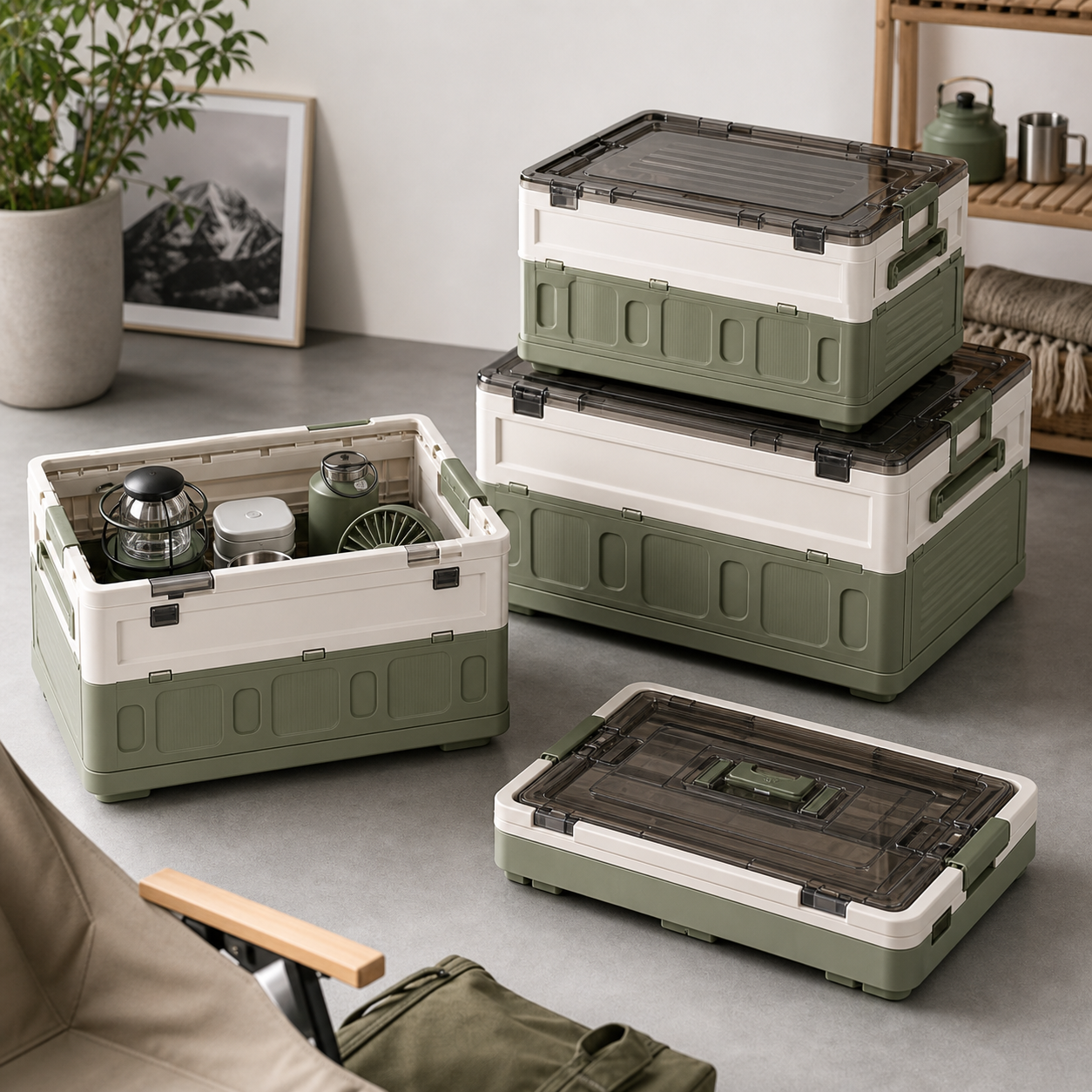
Describe why the customer needs the crate to fold. Occasional household storage, frequent retail replenishment and repeated delivery handling create different tasks. If the crate normally remains assembled, a folding mechanism may add complexity without much benefit. If empty storage is limited, foldability may be central to the product decision.
For crate stowage comparison, measure the assembled and folded envelope of the actual sample. State whether the lid and accessories are included. Do not compare a complete fixed crate with a folding crate whose essential parts have been removed from the photograph. Record any separate storage needed for those parts.
Keep space and mass separate. Folding reduces the occupied shape, not necessarily the product’s weight. A reinforced mechanism can add mass relative to another design. Compare the complete retail unit and intended handling, rather than assuming that compact storage also means lighter transport or greater load capacity.
Identify the Mechanism and Its Failure Consequences
Ask which hinges, wall connections and latches carry or retain the assembled structure. Inspect the mechanism when empty and cool, using the instructions. Some designs fold in a prescribed sequence; forcing another sequence can damage parts. The manual should make that sequence clear without requiring verbal coaching.
Distinguish a loose-looking cosmetic feature from a connection essential to structural retention. A latch failing to engage can have a different consequence from a superficial scratch. Record the symptom and location so the supplier can investigate. Do not collapse all findings into a general appearance grade.
For storage crate fold mechanism inspection, identify the exact sample revision and material information. A changed hinge construction can alter operation while preserving the exterior dimensions. Require relevant component changes to be reported, especially if the approved durability evidence depends on the original mechanism.
Define Repeated Setup Before Selecting a Cycle Count
Fold flat crate hinge durability needs a method that states what one cycle means. Does it include opening every wall, engaging every latch, fitting a lid and returning fully flat? Partial movement of one hinge is not equivalent to a complete customer setup. Ask the supplier to define its claimed test sequence.
Choose a screening sequence based on the intended routine and distinguish it from lifetime assessment. A buyer can observe early usability and wear, but cannot infer years of use from a short trial. If a numerical durability claim is required, request appropriate validation, sample selection and failure criteria rather than choosing an impressive round number.
Record who operates the sample, the instructions used and whether tools are needed. An expert assembling the same crate repeatedly may avoid difficulties a new user encounters. Include a suitable unfamiliar participant for comprehension review, while keeping any loading or structural testing within a professionally agreed method.
Build a Folding Crate Latch Cycle Test Record
| Observation | What to document | Why it matters |
|---|---|---|
| Opening sequence | Correct order and required effort | Reveals unclear setup instructions |
| Latch engagement | Visible and tactile confirmation | Helps identify incomplete assembly |
| Wall alignment | Position after setup | Affects the intended assembled form |
| Fold-down | Release sequence and clearance | Exposes awkward storage steps |
| Wear | Location and stage observed | Links deterioration to the mechanism |
| Recovery | Approved correction or stop condition | Prevents forcing a damaged interface |
Do not invent a force measurement from a subjective impression. If engagement force is a purchase requirement, agree an instrument and procedure. Otherwise, describe the observation plainly: a user could not engage a particular latch using the instructions, or a wall needed realignment before closure.
Retain unsuccessful observations. Repeating the task until it succeeds does not erase an intermittent problem. Record how often the symptom appeared within the defined trial, without extending that frequency to all production. A small sample result is a finding to investigate, not a market-wide failure estimate.
Review Folding Box Loaded Handling Separately
An empty mechanism trial cannot establish carrying performance. Define the approved load, distribution and handling method before any loaded evaluation. Use competent personnel and safeguards appropriate to the consequence of failure. Do not improvise heavy loads or place people beneath stacked products.
Check the manual’s carrying points and restrictions. A handhold may look convenient without being approved for every load or configuration. Loaded handling, static storage and stacking are different use conditions. The specification should not transfer a limit from one condition to another without evidence.
If customers use the crate for mixed contents, consider the approved load distribution rather than only total mass. A concentrated load can differ from evenly distributed household items. Request the supplier’s supported conditions and preserve them in the retail description. Avoid terms such as heavy duty without a meaningful, evidence-backed scope.
Mid-Article CTA
Send Your Requirements with your contents, handling routine, folded-storage target and quantity. Email info@kudbo.com to discuss a comparable sample request and the evidence needed for your intended use.
Check Pinch Points and Instruction Clarity
Movable walls and latches can create handling considerations that a fixed box does not have. Request the manufacturer’s precautions and have the actual design reviewed appropriately. Do not assume that a household storage product is suitable for unsupervised child use because it has bright colors or a small size.
Photograph the correct grip and release positions using a safe, reviewed setup. Avoid pictures showing hands in an ambiguous mechanism gap. A diagram should explain the approved sequence without suggesting that fingers are used to force a resistant hinge. Instruction changes need technical review as well as graphic approval.
The CPSC’s business education resources provide US product-safety context, not approval for a specific crate. Destination, intended users and product classification affect the review. Use competent specialists rather than assigning a generic compliance badge based on another supplier’s listing.
Evaluate Repeated Storage and Reopening
Collapsible crate repeated setup should include return-to-flat storage, not only opening. Check whether the folded unit stays in its intended form and whether lids or loose accessories remain organized. A compact crate with separate pieces that are easily misplaced may disappoint the target user.
Observe reopening after the agreed storage interval and condition. Identify whether deformation or component movement affects assembly. Do not create an extreme heat or chemical exposure test without a relevant approved method. The trial should answer the intended storage question, not invent a universal environmental resistance claim.
For comparison with another home organization product such as an AI laundry sorter bin, keep the task distinction clear. A stationary sorting product and a folding transport crate do not require the same mechanism or handling performance. Related catalog links should help selection, not imply interchangeability.
Compare the Complete Retail and Transport Pack
List the crate, lid, divider and other offered accessories. Confirm whether the shipment arrives folded or assembled and whether retail packaging constrains the intended mechanism. An outer sleeve should not conceal instructions essential to first setup. The quotation should identify the exact unit shown in the approved photographs.
Request carton dimensions and gross weight for the final pack-out. Folded shipping can reduce occupied space, but actual freight depends on carton design, handling and transport terms. Mark provisional data clearly and confirm it before booking. Do not advertise a freight-saving percentage based only on the product’s empty folded dimensions.
For private labeling, check marking locations on moving parts. A label or coating should not obstruct engagement, conceal an identifier or change an important interface without review. Approve a decorated functional sample rather than relying only on artwork placed over a photograph.
Preserve Evidence Through Production Changes
Keep the mechanism specification, approved sample identity, instructions and trial results together. Identify which materials and parts are critical to the reported behavior. If the supplier changes a hinge, latch or relevant wall construction, review the affected evidence before accepting the replacement as equivalent.
Factory testing should describe its actual checks, not simply say every product is inspected. Basic opening and latching checks can have value, but they are not the same as durability validation. Ask which records are retained and how nonconforming units are handled.
Shipment inspection should verify packed-unit completeness, identifiers and agreed functional screening. Define a failure to assemble or retain the approved form separately from minor cosmetic findings. FTC advertising guidance reinforces the need for supported claims; do not convert a visual shipment report into a lifetime guarantee.
A Practical Approval Scenario
Imagine a hypothetical buyer comparing two samples for frequent household folding. One has a smaller folded envelope but requires careful wall alignment before the final latch closes. The other occupies slightly more storage space but has a clearer setup sequence. The correct choice depends on the audience’s routine, not a single dimension.
Document the trade-off and request a revised sample if the first design’s difficulty is unacceptable. Retest the revised mechanism with the same sequence. This is not a KudBo customer case or measured comparative result. It shows how a usability finding can guide a product decision without inventing durability statistics.
Define a Customer-Visible Assembly Check
Ask how the user recognizes that the crate is fully assembled. The answer should rely on the approved mechanism and instructions, not an improvised push or pull test. A visible latch position or specified engagement cue can help, but the supplier must explain what that cue establishes and what it does not.
Include the check in the draft insert and observe comprehension with an empty sample. If users mistake an intermediate position for the assembled state, that is a design or instruction finding worth addressing. Do not assume that every customer will discover the missing step after loading the crate.
Define a response to a resistant or damaged latch. The customer should not be told to force it, add a makeshift strap or bypass the mechanism. Support should identify the model and symptom and follow the approved escalation process. A home-storage task still needs a clear boundary between normal adjustment and suspected damage.
For a retail display, show both the assembled and folded forms with the supplied lid and accessories. Identify anything that must be stored separately. A folded photograph without those pieces can exaggerate the real stowage benefit. Compare the complete customer arrangement rather than the smallest possible isolated component.
Use these observations when reviewing the price premium for foldability. A smaller storage envelope is valuable only when the user can reliably reach and leave that state. If setup is cumbersome for the intended audience, a fixed-wall option may be the better choice despite occupying more empty space. That is a practical trade-off, not a universal ranking of mechanisms.
Keep the accepted assembly cue, photographs and instructions in the product file. If a later latch or hinge revision changes the cue, update the retail information and repeat the relevant comprehension check. Otherwise, old instructions can persist on the website after the mechanism they describe has changed.
Related Buyer Resources
Continue with Self-Watering Planters vs Hydroponic Herb Gardens for a complementary purchasing question. Compare the full product catalog, or browse the KudBo sourcing blog or the product sourcing topic collection for additional buyer guides. These resources provide decision context; each product still needs its own model-specific approval.
Frequently Asked Questions
Does a stacking test prove hinge durability?
No. Stacking and repeated folding address different conditions. A static load result does not establish that hinges and latches remain usable after repeated assembly. Define the complete cycle, sample selection and failure criteria for any durability assessment, while keeping loaded handling and stacking evidence separate.
How many folding cycles should buyers require?
There is no universal count for every application. Base the review on the intended routine and distinguish short screening from a supported lifetime claim. Agree a method with the supplier and competent reviewers. Do not select a large number solely because it looks impressive in marketing copy.
Can a crate’s carrying limit be used as its stacking limit?
Do not assume so. Carrying, static storage and stacking have different loading conditions and potential consequences. Request the supported configuration and method for each claim. Preserve load distribution, orientation and handling restrictions rather than moving a number from one application to another.
What should a new-user setup check reveal?
It should reveal whether the instructions explain opening order, latch engagement, release and folding without coaching. Record the specific confusion or unsuccessful operation. A new-user check supports instruction improvement, but it is not a substitute for structural safety assessment or long-term mechanism validation.
Which changes deserve renewed review?
Relevant changes include hinges, latches, wall construction and materials affecting the approved mechanism. Require notification and reassess the affected claims. Retain the sample revision and evidence so a matching exterior is not mistaken for unchanged fold performance in a repeat order.
Conclusion
Fold flat crate hinge durability is a repeated-use question, not a static-load slogan. Define the customer routine, examine the complete mechanism cycle and compare storage benefits with setup effort. Traceable evidence and clear instructions help buyers choose a folding product with a credible, bounded purpose.
Final CTA
Get a Quote or email info@kudbo.com with your destination, quantity, contents and handling requirements. KudBo can discuss available storage options and sample arrangements. Confirm load conditions, mechanism evidence and the final retail unit before approval.