
Introduction
Ecommerce packaging should be developed around the complete product, retail pack and distribution route. Define what counts as product damage and unacceptable package degradation, select a test procedure that matches parcel, retailer-fulfillment or direct-import conditions, test representative packed units, and document every material and pack-out detail. A casual corner drop is useful only as an early screen; it is not a substitute for a controlled protocol.
The International Safe Transit Association explains that its 1-Series tests screen package integrity, 3-Series procedures simulate broad distribution hazards, and member procedures such as 6-Amazon.com address specific fulfillment environments. Use ISTA's current test-procedure directory with a packaging professional rather than choosing a famous procedure by habit.
Map the Real Distribution Route
Write the route from factory pack-out to customer opening. Include export carton, pallet or loose loading, ocean or air leg, deconsolidation, fulfillment-center handling, over-boxing or ship-in-own-container status, parcel carrier and final mile. Note orientation, climate, stacking, delivery region and return handling.
ISTA's selection guidance distinguishes parcel, LTL, ecommerce retailer fulfillment, manufacturer-direct delivery and other environments. Procedure 3A covers individual parcel shipments of 150 pounds or less and distinguishes standard, small, flat and elongated packages. Project 3M addresses international direct import from Asia-Pacific manufacturing sites to US distribution or fulfillment centers.
Define Failure Before Testing
Agree on objective product and packaging criteria. Product failures might include loss of function, cracks, leakage, permanent deformation, detached parts or unacceptable cosmetic damage. Packaging criteria may cover opening, crushed corners, label loss, puncture, product exposure or presentation damage.
Retail packaging may be part of the sellable product even when it is not the protective transport carton. Decide whether a scuff is acceptable for a distributor case but unacceptable for a gift box. Photograph and measure the specimen before testing, then use the same evaluation after testing.
Product and Package Are One System
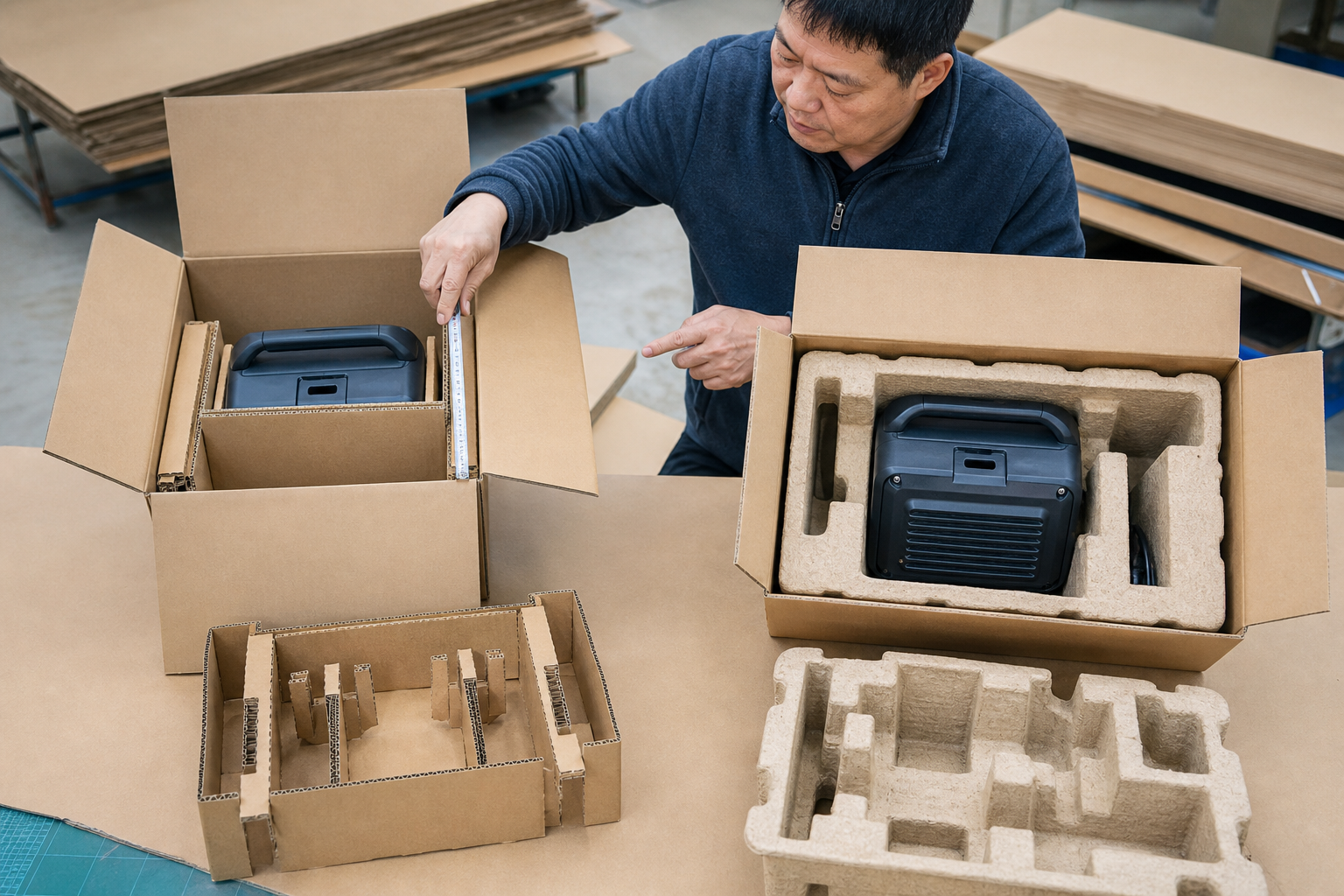
ISTA states that testing evaluates the packaged product, not an isolated packaging material. A stronger board grade cannot compensate for excessive void space, weak product geometry or inconsistent pack-out. Likewise, a molded-pulp insert must locate the actual product and accessories under the intended closure and carton dimensions.
For a portable espresso press, protect rigid parts and presentation surfaces. For compression packing cubes, control retail-box crushing and set completeness. For a smart pet feeder camera, immobilize the device and accessories without stressing its bowl, lid or electronic modules.
Compare Packaging Concepts at Sample Stage
Build at least two practical concepts when risk or volume justifies it. Compare product clearance, weak points, material count, assembly time, dimensional weight, recyclability claims, print area and cost. Use early screening to remove poor concepts, then validate the selected configuration with the relevant procedure.
Record corrugated style and grade, dimensions, insert material and density, closure tape, accessory position, bag thickness, protective films, unit orientation and carton packing pattern. One unrecorded change can make a previous result irrelevant.
Mid-Article CTA
Send info@kudbo.com your product, sales channel, packed dimensions, current damage concern and target delivery route. KudBo can coordinate samples, packaging prototypes and factory pack-out information for review with your packaging test provider.
Test Documentation Buyers Should Retain
Keep the test request, procedure and edition, specimen IDs, preconditioning, equipment, sequence, photographs, observations, acceptance criteria, results and any deviations. The ISTA 3A overview describes a general simulation for standard, small, flat and elongated parcel packages and includes optional low-pressure vibration for relevant sealed contents.
Do not say packaging is “ISTA certified” unless the exact program and conditions support that statement. Prefer precise language such as “tested to [procedure and edition]” with the tested configuration identified.
Retest After Meaningful Changes
ISTA recommends retesting when the product, package or process changes in a way that can affect performance. Triggers include product mass or geometry, brittle material, accessory position, insert, board, closure, supplier, carton dimensions and pack-out method. Keep revision control so the warehouse uses the tested version.
Production and Shipment Inspection
Production checks can measure carton dimensions, board and insert identity, fit, closure, unit orientation, accessory count, label placement and master-carton condition. Train packers with photographs and boundary samples. A good design can fail if inserts are reversed or void fill is omitted.
At pre-shipment inspection, select finished cartons from normal production. Compare pack-out with the approved specification and examine sampled units for movement or pressure points. Report wet, crushed or poorly sealed cartons before loading. Keep container preparation, desiccant and palletization requirements separate from parcel-test conclusions.
Packaging Cost Should Be Compared at System Level
Compare landed and fulfillment effects, not only the price of the box. Record packaging material cost, packing labor, finished dimensions, dimensional weight, units per master carton, pallet utilization, expected damage exposure, repacking at the fulfillment center and disposal requirements. A slightly more expensive insert may reduce volume or pack-out errors; a very strong oversized carton may add freight without addressing the actual weak point.
Run a dimensional model before printing. Verify internal dimensions against tolerance stacks, not a single perfect sample. Include protruding controls, cables and accessories. Confirm master-carton gross weight and worker handling. For multi-SKU orders, protect each SKU's approved packing method from being simplified at the consolidation warehouse.
Sustainability Claims Need Evidence
Terms such as recyclable, recycled, plastic-free or compostable can be regulated marketing claims and depend on composition and local collection systems. Keep supplier declarations and test evidence connected to the exact packaging material. Avoid broad environmental claims solely because molded pulp replaces foam.
Material reduction should follow protection validation. A package that causes damaged products and reshipments may not meet the buyer's environmental or commercial objective. Document the old and new configurations, use comparable tests and monitor real distribution outcomes.
Use Field Data After Launch
Laboratory testing is a model of distribution, not a guarantee of zero damage. Create reason codes for crushed packaging, cosmetic product damage, functional failure, missing accessories, leakage and customer-remorse returns. Preserve photographs and connect cases to product and packaging revisions, carrier route and fulfillment method.
Review early shipments more frequently. If damage clusters on one corner or accessory, inspect the corresponding load path and pack-out. If damage rises after a board or supplier change, quarantine remaining stock if appropriate and compare records. A structured feedback loop helps determine whether to adjust packaging, handling instructions, test severity or product design.
Keep a “packaging release pack” for every SKU: drawings, material specifications, assembly photographs, approved samples, test report, artwork, closure method, master-carton pattern and inspection limits. This file lets a new factory or packer reproduce the validated system without guesswork.
Packaging Development Brief for Suppliers
Give the packaging supplier a controlled physical product or accurate 3D data, product mass, fragile areas, cosmetic surfaces, accessory list, retail presentation requirements, distribution route, fulfillment method, target dimensions and material restrictions. Identify whether the retail package ships alone, inside an over-box or inside a master carton. If more than one route is used, state which route has priority or requires a separate configuration.
Ask for drawings that show internal and external dimensions, product orientation, clearances, insert geometry, accessory locations, closure and board or cushioning specifications. A photograph of a box is not enough to reproduce it. Record manufacturing tolerances and confirm that the worst reasonable product and package dimensions still assemble without excessive compression or movement.
Prototype review should include packer usability. Time several assemblies, observe whether inserts can be reversed, check whether cables escape their cavity and confirm that the product can be removed without tearing the presentation pack. Mark critical-to-quality points directly on the pack-out instruction with photographs. If tape length or fold sequence matters, specify it.
Before formal testing, confirm specimen quantity, conditioning, procedure edition, acceptance criteria and report format with the laboratory. The specimens should use production-intent materials and components. If handmade samples differ from planned mass-production board, glue or insert density, record the difference and decide whether validation must be repeated.
At production release, approve a packaging bill of materials and golden packed unit. Give the inspector measurable criteria: carton dimensions, insert identity, unit orientation, closure, movement limits where defined, accessory count and appearance thresholds. After launch, compare field damage with the tested failure modes. If real routes differ materially from the assumed route, update the brief and test plan rather than simply increasing board grade.
Frequently Asked Questions
Is a factory drop test enough for Amazon?
Usually not by itself. A controlled screening drop may guide development, while a specific retailer program or ISTA procedure may require defined specimens, sequences, conditioning and documentation.
Which ISTA test should an importer choose?
It depends on distribution type, package type, mass and objective. Map the route and consult the current ISTA selection guidance and a qualified laboratory.
Should the retail box be tested inside an over-box?
Test the configuration used in fulfillment. If some units ship in their own container and others are over-boxed, they represent different systems.
Can one test cover every size and color?
Only with a justified representative strategy. Changes in mass, geometry, materials or pack-out can change performance.
What should an inspection verify after testing is complete?
Verify that production uses the tested product, materials, dimensions, insert orientation, accessory layout and closure method.
Related KudBo Resources
Browse the KudBo product catalog, explore the buyer guide library, read more Packaging & Shipping sourcing guides, or send your product requirements for a focused sourcing discussion.
Conclusion
Packaging validation is a controlled decision process: map the route, define failure, select the right test, document the exact system and preserve it in production. This creates evidence buyers can use, instead of relying on a dramatic but unrepeatable drop demonstration.
Final CTA
Browse the KudBo catalog, read the wholesale travel-accessory QC guide, or email info@kudbo.com to request packaging prototypes and shipment-preparation information.