Introduction
Travel accessories are attractive for wholesale buyers because they are easy to demonstrate, suitable for gift sets, and useful across many markets. A good travel product can support business travelers, students, families, commuters, hotel guests, outdoor users, and ecommerce shoppers. However, travel products also carry practical risks: weak zippers, poor folding structures, leaking containers, unstable handles, unsafe heating components, oversized packaging, and unclear instructions.
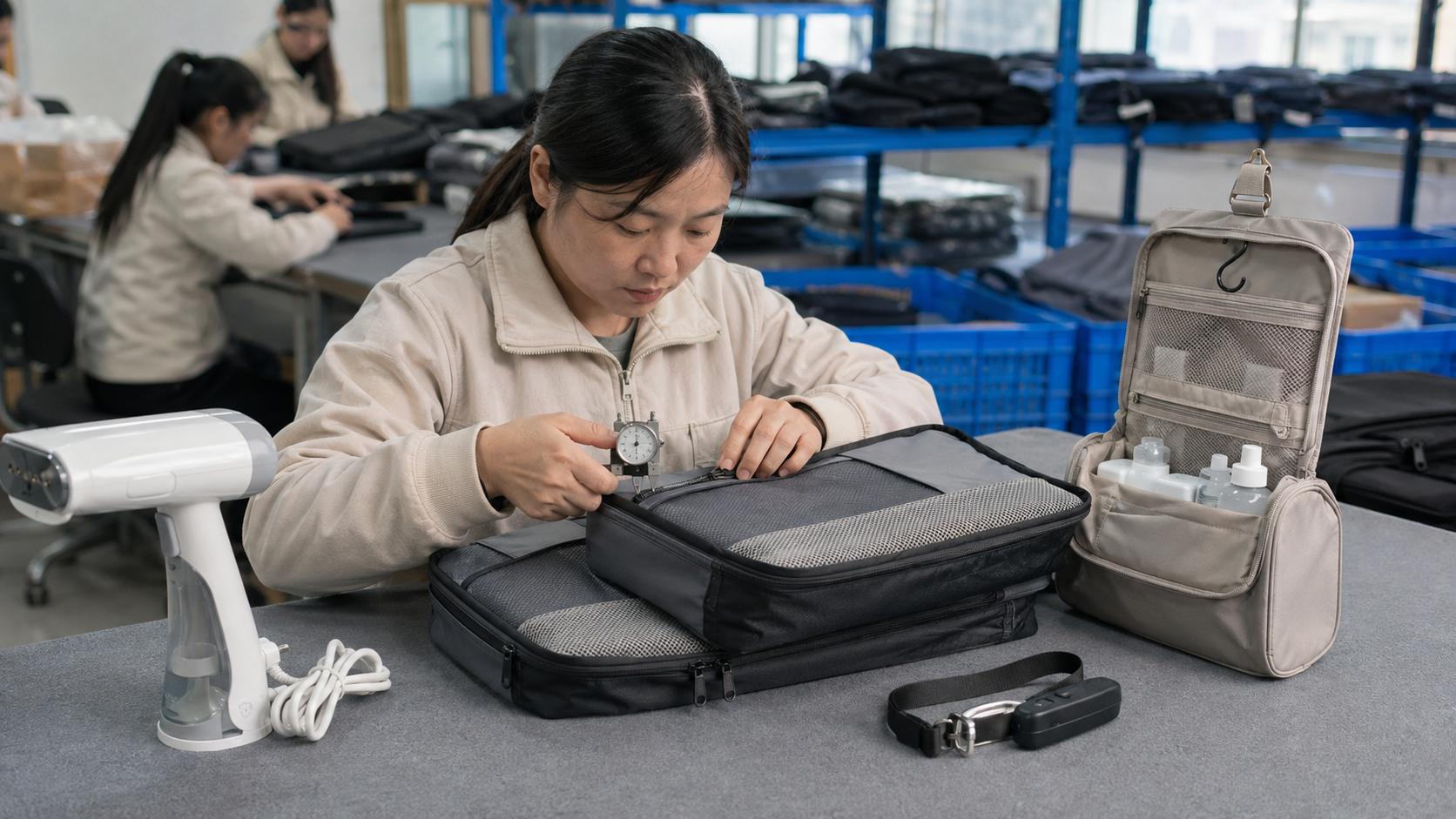
For overseas buyers, the goal is not only to find travel products that look good in photos. The goal is to approve products that can survive real use, pass shipment inspection, and arrive with packaging that explains the value quickly. This checklist is designed for buyers sourcing products such as solar commuter backpacks, compression packing cubes, portable espresso presses, collapsible travel kettles, travel garment steamers, smart luggage scale tags, and vacuum compression travel pouches.
Use it before sample approval, during factory testing, and before shipment inspection.
Why Travel Accessories Need a Specific QC Checklist
Travel products are handled more roughly than many home products. They are packed, folded, carried, compressed, charged, heated, washed, opened, closed, and used in temporary environments such as hotel rooms, airports, cars, dorm rooms, and luggage compartments. Because of this, a normal appearance check is not enough.
Buyers should test whether the product performs under likely travel conditions. A packing cube must handle zipper stress when overfilled. A collapsible kettle must fold cleanly and resist leakage. A solar commuter backpack must protect contents while keeping the charging interface accessible. A travel steamer must heat consistently and include clear safety instructions.
What Counts as a Wholesale Travel Accessory?
A wholesale travel accessory is a product that helps users pack, organize, clean, charge, prepare food or drink, maintain clothing, or improve comfort while away from home. It can be textile-based, plastic, silicone, metal, electronic, or a combination of materials.
KudBo’s travel-related product examples include:
- Solar Commuter Backpack.
- Portable Espresso Press.
- Travel Garment Steamer.
- Collapsible Travel Kettle.
- Compression Packing Cubes.
- Smart Luggage Scale Tag.
- Vacuum Compression Travel Pouch.
- Outdoor Filter Bottle.
- Picnic Cutlery Kit.
- Pet Travel Water Bottle.
The category is broad, but the review logic is similar: check portability, durability, safety, packaging, and use-case clarity.
Step 1: Confirm the Travel Use Case
Before testing the sample, define the use case. Is the product for business trips, family vacations, camping, hotel rooms, daily commuting, airport retail, or ecommerce bundles? A product can serve more than one use case, but the primary use case should be clear.
For example:
| Product | Primary Use Case | Secondary Use Case |
|---|---|---|
| Compression Packing Cubes | Luggage organization | Family packing and laundry separation |
| Collapsible Travel Kettle | Hotel hot water | Dorm rooms and compact kitchens |
| Travel Garment Steamer | Business clothing care | Small apartments |
| Smart Luggage Scale Tag | Baggage weight check | Identity tag and tracker storage |
| Solar Commuter Backpack | Daily commuting | Weekend travel and outdoor charging |
If the product application is unclear, buyers may struggle to create product pages, ads, and packaging copy.
Step 2: Check Product Dimensions and Packing Efficiency
Travel products must justify the space they occupy. A product that is portable in name but bulky in practice may disappoint customers.
Measure:
- Product open size.
- Folded or packed size.
- Net weight.
- Packaging size.
- Carton quantity.
- Gross weight per carton.
- Accessories included.
For ecommerce buyers, dimensional weight can affect shipping cost more than product cost. For retail buyers, shelf dimensions and hanging display options may matter more.
Step 3: Review Materials by Product Type
Material review should match how the product will be used.
Textile Travel Products
For backpacks, packing cubes, pouches, and organizers, check fabric thickness, stitching, zipper quality, handle reinforcement, water resistance, and color consistency. Pull zippers several times and test whether seams distort when lightly loaded.
Silicone or Folding Products
For collapsible kettles or folding containers, check folding memory, odor, edge finish, connection between silicone and hard parts, and whether the product stays stable when opened.
Electronic Travel Products
For powered items such as steamers, luggage scales, pumps, and charging backpacks, check power rating, cable quality, button response, heat behavior, charging port fit, and labeling. Ask the supplier which plug options, battery specifications, or regional versions are available.
Food-Contact Travel Products
For espresso presses, kettles, cutlery kits, and bottles, check material declarations, cleaning access, odor, sealing, and parts that touch water or food.
Step 4: Run Functional Factory Testing
Factory testing should confirm the product’s main promise. Do not only check whether the sample turns on or looks correct.
Functional Test Examples
| Product | Recommended Factory Tests |
|---|---|
| Travel Garment Steamer | Water tank fit, heating time, steam output, leakage, cable condition, brush attachment fit |
| Collapsible Travel Kettle | Folding cycles, boiling function, base stability, leakage, lid fit, plug and label check |
| Compression Packing Cubes | Zipper stress, seam pull, compression function, fabric consistency, window strength |
| Smart Luggage Scale Tag | Weight display response, strap strength, battery access, tag cover fit |
| Vacuum Compression Travel Pouch | Valve seal, pump connection, compression hold, pouch seam, cable charging |
| Solar Commuter Backpack | Solar panel attachment, USB-C output access, zipper, shoulder strap load, water-resistant finish |
The factory should test from an approved sample standard, not from a vague description. Buyers should keep an approved sample or sample video as the reference.

Mid-Article CTA
Sourcing travel accessories for ecommerce, retail, or private label? Send KudBo your product type, target market, quantity, and packaging needs. We can prepare a travel product catalog and sample options for review.
Button: Ask for Travel Product Catalog
Step 5: Inspect Safety and Labeling Requirements
Travel accessories may be simple, but many still need safety review. Powered products need clearer labeling than textile organizers. Food-contact products may require material declarations. Battery or charging products may require transport documentation depending on specifications.
Buyers should ask:
- Does the product use electricity, battery, heat, water, pressure, or sharp parts?
- Are warnings needed on packaging or manual?
- Are plug types correct for the destination market?
- Is the instruction manual understandable?
- Are claims realistic and supportable?
- Are product labels and carton labels consistent?
Avoid packaging claims that are stronger than the factory can support. For example, “waterproof” should not be used if the product is only water-resistant.
Step 6: Review Accessories and Replacement Risk
Travel products often include small accessories: cables, pouches, hooks, adapters, brushes, valves, spice pods, straps, or measuring cups. Missing accessories can cause complaints even when the main product is fine.
During sample review and shipment inspection, prepare an accessory checklist. For each SKU, confirm:
- Accessory name.
- Quantity per unit.
- Placement inside packaging.
- Material or color.
- Whether the accessory is visible in product photos.
- Whether replacements are available.
For bundled travel products, this checklist is especially important because the perceived value comes from the full set.
Step 7: Evaluate Packaging for Travel Retail
Travel products often sell through ecommerce, airport shops, luggage stores, gift stores, outdoor retailers, and seasonal promotions. Packaging should explain the product quickly.
Good travel packaging usually includes:
- Clear product image.
- Main use case.
- Compact feature list.
- Size or capacity if relevant.
- Accessory list.
- Safety notes.
- Barcode space.
- Durable inner protection.
For ecommerce, the package should survive parcel handling. For retail, the front panel should make the function obvious at a glance. For gift sets, unboxing and organization matter.
Step 8: Plan Pre-Shipment Inspection
Pre-shipment inspection should confirm consistency between bulk production and approved sample.
Check:
- Product appearance.
- Function test by random sampling.
- Accessories.
- Packaging print.
- Manual and labels.
- Carton markings.
- Quantity and SKU separation.
- Carton condition.
- Master carton weight.
- Product photo comparison with approved sample.
If the order includes multiple colors or packaging versions, inspect each version separately. Mixed packaging problems are common when buyers customize several SKUs at once.
Step 9: Compare Quotes Beyond Unit Price
Travel accessory quotes can look similar at first, but the details behind the unit price may be very different. A lower quote may exclude packaging, use thinner material, reduce accessory quality, or pack fewer units per master carton. Buyers should compare landed value, not only EXW or FOB unit cost.
When reviewing supplier quotes, request the same information from every supplier:
- Unit price by order quantity.
- Incoterm, such as EXW, FOB, or CIF.
- Packaging included or excluded.
- Product material grade.
- Accessory list.
- Carton quantity and carton size.
- Gross weight and net weight.
- Sample cost and sample lead time.
- Bulk production lead time.
- Customization cost for logo, color, manual, or box.
For ecommerce sellers, carton dimensions can affect fulfillment cost. For retail buyers, packaging structure can affect shelf presentation. For importers, the most important comparison may be stability: whether the supplier can repeat the same quality over several shipments.
Quote Comparison Example
| Quote Item | Supplier A | Supplier B | What to Check |
|---|---|---|---|
| Unit price | Lower | Higher | Is the same material and accessory set included? |
| Packaging | Plain box | Retail color box | Which one matches the sales channel? |
| Carton quantity | Higher | Lower | Does this reduce freight cost or increase damage risk? |
| Sample lead time | Fast | Slower | Is the supplier using an existing sample or making the requested version? |
| Custom logo | Included | Extra cost | Is the printing method confirmed? |
Step 10: Prepare Installation and Use Instructions
Many travel accessories do not require installation, but they still need preparation instructions. A customer may need to know how to fold a kettle, connect a compression pump, clean a coffee chamber, empty a steamer tank, attach a luggage scale strap, or store a solar backpack cable.
Instruction quality affects reviews. If the manual is unclear, customers may assume the product is defective when the issue is actually incorrect use. Buyers should review instructions during the sample stage, not after production.
Useful instruction checks include:
- Are diagrams clear enough without long text?
- Are warnings visible before first use?
- Are cleaning steps included for food-contact products?
- Are charging steps included for USB or battery products?
- Are folding and storage steps shown?
- Is the destination-market language correct?
For private label projects, buyers can prepare a short insert card with the most important steps. This is often more useful than a long manual that customers do not read.
Step 11: Compare Standard and Customized Versions
Travel accessories are often customized with logo, color, packaging, inserts, and bundle components. Buyers should compare whether customization changes the production process.
A logo on a pouch may be simple. A custom color for silicone or plastic may require higher MOQ and longer lead time. A customized carton or insert may require artwork approval and print proof. A changed accessory may affect packaging structure.
Ask the supplier to separate:
- Standard product MOQ.
- Logo MOQ.
- Custom color MOQ.
- Custom packaging MOQ.
- Sample lead time.
- Bulk lead time.
This prevents confusion when comparing quotes from different suppliers.
Step 12: Build a Retail Story Around Real Use
Travel products sell better when the buyer can show the product in a realistic setting. A product page should not only say “portable.” It should show where and why the product is portable.
Examples:
- Travel kettle: hotel room, dorm, compact kitchen.
- Packing cubes: open suitcase and organized clothing.
- Backpack: commuting, weekend trip, charging pocket.
- Garment steamer: business shirt on hanger.
- Luggage scale tag: suitcase handle before flight.
These application scenarios help both human shoppers and AI search systems understand the product context.
Step 13: Decide Whether the Product Belongs in a Bundle
Travel accessories often perform well as bundles because travel shoppers usually solve several problems at once. A business traveler may need a garment steamer, packing cubes, cable dock, and luggage scale. A family travel bundle may include compression pouches, pet water bottles, picnic cutlery, and car organizers. A hotel-room convenience bundle may include a collapsible kettle, portable espresso press, and compact food container.
Bundle planning should happen before packaging is finalized. Buyers should decide whether products will be sold separately, as a set, or as a seasonal promotion. This affects carton planning, product photography, barcode setup, and inventory forecasting.
Good bundle candidates share the same customer scenario, price level, and packaging style. Avoid bundling products only because they are available. A bundle should make the customer’s travel preparation easier to understand.
FAQ
What should buyers check first when sourcing travel accessories?
Buyers should first check the real travel use case, product size, weight, durability, and packaging dimensions. If the product is too bulky, fragile, or difficult to explain, it may not perform well even if the sample looks attractive.
Are powered travel products riskier than textile travel products?
Powered products usually require more testing because they involve heat, charging, cables, batteries, or motors. Textile products still need inspection, especially for stitching, zippers, fabric quality, and load-bearing points.
How do I inspect a travel product before shipment?
Use an approved sample as the reference. Check function, appearance, accessories, packaging, labels, carton markings, quantity, and carton condition. For products with multiple colors or versions, inspect each version separately.
What packaging works best for wholesale travel accessories?
The best packaging depends on the sales channel. Ecommerce needs compact and protective packaging. Retail needs quick visual explanation. Gift buyers may need better unboxing and a more complete accessory presentation.
What information should I include in a travel accessory RFQ?
Include product type, target market, quantity, customization requirements, packaging style, plug or battery needs if applicable, target price range, and expected delivery timeline.
Related KudBo Resources
Browse the KudBo product catalog, explore the buyer guide library, read more Travel Accessories sourcing guides, or send your product requirements for a focused sourcing discussion.
Official Reference Links
Conclusion
Wholesale travel accessories can be strong products for importers, retailers, and ecommerce sellers, but only when they are reviewed against real travel conditions. Buyers should evaluate use case, size, material, function, labeling, accessories, packaging, customization, and shipment inspection before approving bulk orders.
A careful QC process does not slow sourcing down. It makes sourcing clearer. It helps suppliers understand expectations and helps buyers reduce avoidable problems before the shipment leaves the factory.
Final CTA
Need travel accessories for your next private-label or wholesale project? KudBo can help you review portable product options, sample requirements, packaging choices, and export-ready order details.
Button: Get a Travel Accessories Quote
Popup Planning
- Trigger: Scroll to 45% or exit intent.
- Popup title: Planning a travel accessories order?
- Popup copy: Tell us your target product type, packaging needs, and quantity. We can prepare travel product options for review.
- Suggested fields: Name, Email, Product Interest, Message.
- Optional fields: Product Type, Quantity, Destination Market.
- Submit button: Ask for Catalog