Introduction
Choose a dry bag or water-resistant pouch by defining the expected water exposure, the value of the contents and how the user will close it. A roll-top bag can be appropriate for splash protection without being suitable for prolonged submersion. For overseas retailers and private-label outdoor buyers, “waterproof” should lead to questions about the complete bag, not just a fabric certificate.
Waterproof dry bag vs water resistant pouch is therefore a product-selection decision rather than a contest between labels. A pouch used inside luggage has different requirements from a bag carried on an exposed paddleboard. This guide translates those differences into an RFQ, sample review and shipment inspection brief without implying that any untested design protects sensitive equipment.
Quick Answer: Match Exposure to Construction
Start with rain, splash, wet storage or immersion as separate exposure categories. Specify the intended contents and whether an additional protective enclosure is necessary. Then compare the closure, seams, attachment points, fabric durability and usable capacity. Do not assign an immersion claim from a coating description or the presence of a roll-top buckle.
The Sea to Summit explanation of waterproofing distinguishes material resistance from the limits of dry-bag closures. Its model guidance illustrates why buyers must read whole-product limitations. Those published limits describe that manufacturer’s products; they neither qualify nor disqualify a different factory sample without an appropriate review.
Write the Exposure Brief Before Choosing Fabric
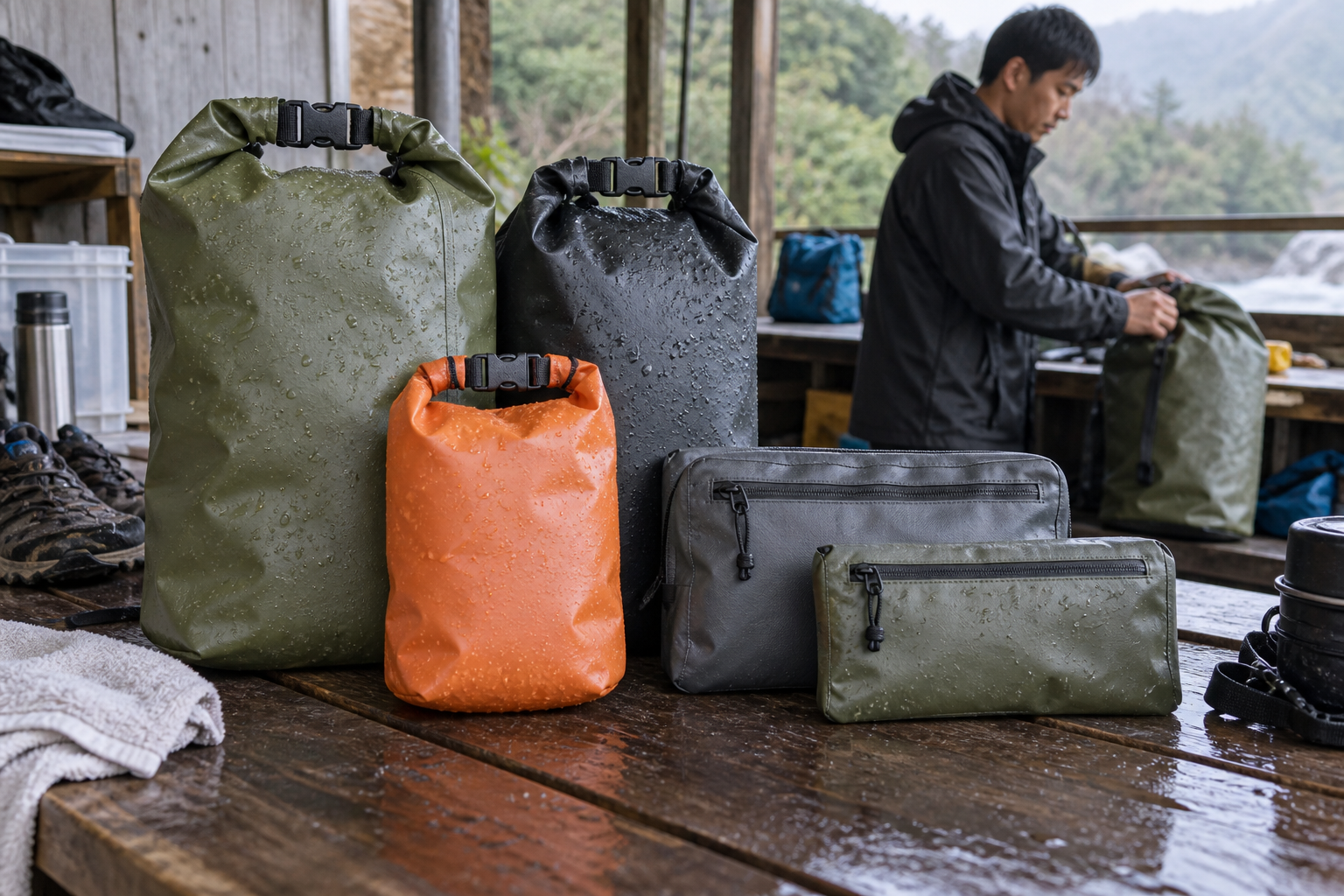
Describe a short product application scenario in plain language. For example, an illustrative beach accessory brief might specify damp swimwear, sand, occasional splashes and carrying within a tote. A different paddling brief might involve repeated spray and temporary contact with water. These examples are planning scenarios, not reports of verified product performance.
Record whether the bag will hold clothing, food packaging, documents or sensitive equipment. A reasonable product for towels may be unsuitable as the sole protection for equipment that cannot tolerate water. Avoid illustrating an ordinary storage bag with expensive electronics underwater. Images, captions, packaging and marketplace copy all contribute to what a customer expects.
Ask the supplier what use cases the sample explicitly excludes. Exclusions should be consistent with the intended sales channel and easy to explain. If the product only meets the brief when buyers follow a complicated series of steps, review whether a different construction would be more appropriate. A clear limitation is more useful than a vague guarantee.
Compare Roll Tops and Zippered Pouches
Roll tops depend on a properly formed closure and sufficient unused material at the opening. Overfilling can prevent the required closure from being made. Request instructions for the specific model, including how to expel excess air if appropriate and how to fasten the buckle. Do not prescribe one number of folds for every design.
A standard zippered pouch may offer convenient access but does not become watertight because its outer fabric repels water. A protective flap, coated tape and an actual watertight zipper are different solutions. Ask for the component specification and the finished-product test method. The seams around a premium closure still require evaluation.
Review the Closure With a Real Packing Load
Use representative contents or safe substitutes matching their shape. Have a reviewer follow only the proposed instructions. Observe whether the closure remains easy to form, whether fabric catches and whether the buckle is under unwanted tension. Repeat after unpacking rather than accepting one carefully arranged sales demonstration.
Document the maximum recommended fill position with a drawing or photograph. If a nominal 10 L bag has less usable space after closure, explain the measurement basis rather than promising that a particular 10 L object will fit. Capacity should serve a packing decision. Comparing flat dimensions alone can be misleading for bags with different bases.
Do Not Confuse Fabric Data With Whole-Bag Evidence
Request fabric construction, coating or laminate identity, thickness or mass where relevant, and the process used to join panels. Denier describes yarn linear density; it is not a complete ranking of abrasion resistance or water protection. Compare fabrics under defined test methods and consider the full construction instead of selecting the largest number.
A supplier’s material report may describe a flat swatch without needle holes, folds or hardware. Identify what the test actually covered. Ask whether the same material lot and finish will be used in production. If the color changes the coating or printing process, determine whether the evidence remains applicable rather than assuming cosmetic variants are technically identical.
The Sea to Summit dry-bag selection guide separates lightweight organization from more demanding outdoor use. The useful purchasing lesson is to match construction to the task. Do not transfer a named brand’s fabric specification or expected durability into a private-label quotation.
Inspect Seams, Bases and Attachment Points
Map every penetration and joint, including handles, straps, buckle anchors and logo patches. Ask whether seams are sewn, taped, welded or combined, and request a cross-section or clear production photographs when the join is hard to inspect. A clean-looking external seam does not reveal all construction details.
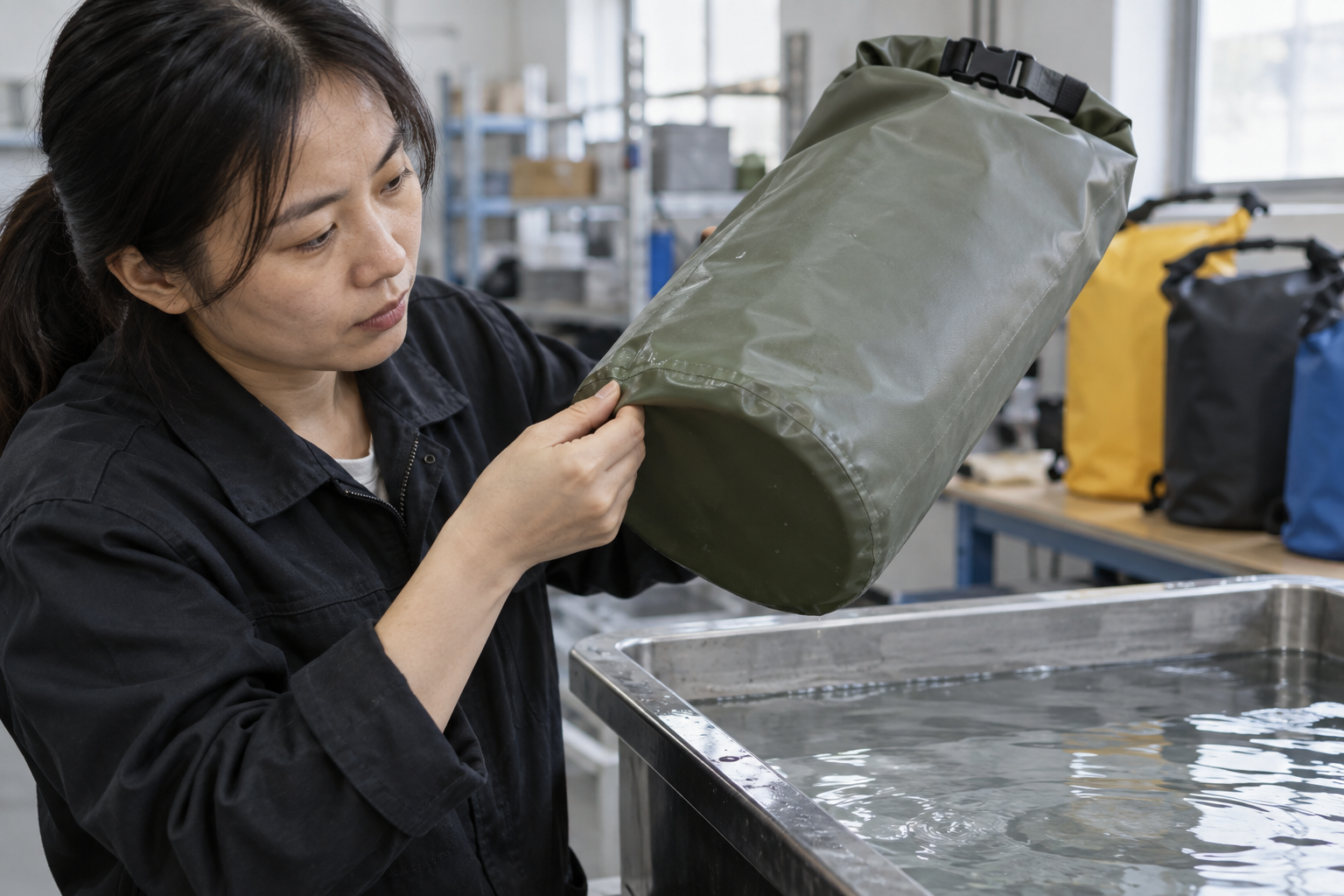
On samples, inspect corners and transitions where several materials meet. Look for incomplete joins, wrinkles, exposed edges and deformation near attachment points. These are inspection observations, not a substitute for functional testing. Record the location and sample code so the supplier can investigate the process rather than only replacing the demonstration sample.
If a carrying strap is included, define the intended carried load and evaluate the attachment as part of the bag. Avoid implying that a small accessory loop is a lifting point unless the design supports that use. Marketing photographs should show the approved carrying arrangement. A claim that is absent from text can still be suggested visually.
Define a Finished-Bag Test With Clear Limits
A useful brief identifies exposure type, duration, orientation, closure procedure, fill condition, sample conditioning and what counts as water ingress. Use safe test contents such as absorbent indicators rather than valuable equipment. Ask the laboratory or technical provider to select an appropriate method for the claimed application.
For a splash-only product, do not improvise an immersion demonstration and then turn it into a broad claim. If immersion is truly necessary, agree the depth, duration, preparation and acceptance criteria before qualification. State whether the result applies to new samples or also to samples after wear and repeated closure. Those are different evidence questions.
A proposed test log can include sample ID, construction revision, operator, closure condition, exposure start and end, observations and photographs. Numeric settings belong in the approved method; blank fields are preferable to invented defaults. Preserve unsuccessful results as well as successful ones because failure locations can reveal a correctable seam or closure issue.
Mid-Article CTA
Send Your Requirements. Review KudBo’s product catalog and email info@kudbo.com with intended contents, exposure, usable capacity, carrying method and destination. Ask for construction alternatives and a sample evaluation plan that matches the claim you actually need.
Consider Wear, Sand and Repeated Use
Initial water protection is only one part of selection. Review abrasion at the base, folding at the opening, buckle operation and the effect of normal cleaning. Choose conditions that represent the application. A bag carried inside a backpack need not be evaluated in the same way as one routinely placed on rough ground.
Sand and dirt can affect both closure operation and the user’s ability to inspect it. Ask what cleaning instructions are supported and whether the opening can be dried fully. Review whether trapped moisture or residue is likely after the intended use. Avoid claiming mold resistance or antimicrobial protection without a separate basis.
The YKK protective zipper support page gives product-specific operation and care requirements for specialized closures. It is an example of why closure instructions matter, not a recommendation to install that component in every pouch. Obtain equivalent technical guidance for the actual zipper supplied in your project.
Review Storage and Packing Instructions
A bag should be easy to inspect before use and store after cleaning. Ask whether prolonged compression or a sharp fold affects the selected construction. Include the supplier’s supported drying and storage advice in the leaflet. If the retail pack tightly creases the opening, check that the product remains easy to close when first unpacked.
Build an Honest Product Comparison
Compare a light organizer pouch, a roll-top splash bag and a purpose-designed immersion solution against the same intended task. Keep the strongest language reserved for supported claims. A lower-specification product may be the best choice for a simple use case when it is accurately described and easy to operate.
| Buyer question | Organizer pouch | Roll-top dry bag | Claimed immersion solution |
|---|---|---|---|
| Main decision | Access and organization | Closure discipline and splash use | Defined complete-product evidence |
| Capacity review | Shape and opening size | Space remaining after closure | Usable space under test configuration |
| Critical detail | Zipper and seam construction | Opening, buckle and base joins | Every seal, closure and penetration |
| Claim control | Avoid broad waterproof wording | State model-specific limitations | State supported depth and duration |
| Service need | Slider or pull availability | Buckle and strap availability | Approved seals or specialist service |
This is a planning framework, not a certification hierarchy. Supplier samples may differ from these broad groups. Require evidence at the selected model level and explain deviations. A salesperson should be able to describe the finished product without relying on an undefined category name.
Prepare Retail Copy and Image Guidance Together
Give marketing a claim sheet containing the approved application, closure steps, exclusions and evidence reference. “Water-resistant pouch for organizing damp travel items” conveys a different expectation from “submersible equipment protection.” Use the narrowest accurate wording that still helps the customer select the product.
Illustrative AI photography should show construction or an intended setting and be identified as such. It should not simulate a successful test result. A workshop image beside a tray can explain inspection planning; it cannot prove water resistance. Keep actual evidence in the technical file, linked to sample and production identifiers.
Check translations and distributor listings for expanded claims. A carefully qualified English instruction can lose its meaning when another listing shortens it to “fully waterproof.” Provide a concise approved description distributors can reuse. Review the largest visible wording on packaging, because a small limitation cannot reliably correct an opposite headline.
Quote the Delivered Product, Including Accessories
Ask suppliers to separate bag, strap, buckle variant, printing, retail packaging and test costs. Compare usable size and construction before comparing unit price. A quote for a pouch with a standard zipper is not equivalent to one with a specialized sealing closure even if the photographs look similar.
Review spare buckle compatibility and whether the user can replace the part without damaging the bag. If repair requires sewing through a protected panel, determine whether that changes water protection. Do not advertise repairability merely because a loose buckle is available. The replacement method belongs in the decision.
For gift programs, consider whether the user receives enough context to operate a roll top correctly. A short instruction card and clear application statement may be more valuable than an additional decorative accessory. Keep packaging quantities aligned with the actual fulfillment method, including mixed colors and personalized programs.
Use Shipment Inspection to Preserve the Approved Design
Provide the inspector with the approved closure instructions, panel construction, dimensions and artwork revision. Ask for verification that each required component is present and that the production model matches the reviewed sample. Agree sample selection and functional checks before the shipment date, especially if checking requires drying or destructive evaluation.
Separate cosmetic variation from functional defects. A scuffed print, incomplete seam join and incorrect buckle are different findings with different consequences. Use photographs and locations rather than an undifferentiated “poor quality” note. Where a functional issue appears, identify affected lots and require a documented disposition before shipment release.
Retain production samples where practical and record complaint categories after launch. Ask whether reported wet contents resulted from construction, damage, closure difficulty or an unsuitable use expectation. Do not assume user error. A recurring closure misunderstanding can indicate an instruction or design problem that the next order should address.
Frequently Asked Questions
Are roll-top dry bags safe for submersion?
Do not assume they are. Review the specific model’s limitations and complete-product evidence for the intended exposure. Some roll-top products are designed for splash protection and exclude submersion. If contents cannot tolerate water, choose an appropriately validated protection system rather than relying on a category label.
Does a high fabric waterproof rating cover the finished bag?
No. Fabric evidence concerns the tested material and method. Closures, seams, attachment points and production quality can change finished-product behavior. Request a bag-level evaluation linked to the proposed claim, and keep fabric reports as supporting material information rather than a complete product approval.
Is a coated zipper automatically watertight?
No. A water-repellent zipper, a protective flap and a specialized watertight closure are different constructions. Confirm the exact component and its technical conditions. Then evaluate how it is installed in the bag, since a capable zipper cannot compensate for an unsuitable seam or incomplete closure.
How should wholesale buyers compare bag capacity?
Use a shared measurement method and distinguish nominal volume from usable space after closure. Review representative contents, base shape and opening dimensions. For roll tops, the material needed to form the closure reduces available packing space. Record the recommended fill condition in instructions and sample approval.
What should an importer send with the first inquiry?
Send the intended use, contents, water exposure, capacity, carrying load, destination, quantities and branding needs. State whether splash resistance is sufficient or immersion evidence is required. Include examples of acceptable claim wording so the supplier can propose relevant constructions and explain where further testing is needed.
Related KudBo Resources
Browse the KudBo product catalog, explore the buyer guide library, read more Wholesale Buying sourcing guides, or send your product requirements for a focused sourcing discussion.
Conclusion
The waterproof dry bag vs water resistant pouch decision becomes clearer when exposure and contents come first. Compare the entire closure and seam system, verify usable capacity and request evidence matching the intended claim. Clear limitations, realistic images and workable instructions help the buyer choose a suitable product and describe it accurately.
For broader assortment planning, read the outdoor sourcing guide. The vacuum compression travel pouch is an adjacent organization category to discuss; its catalog presence should not be interpreted as a dry-bag or immersion qualification.
Final CTA
Get a Quote. Use KudBo’s contact section or email info@kudbo.com with your exposure brief and target quantity. Request a comparison of closure, seam construction, capacity, instructions and verification needs before selecting a wholesale sample.