Introduction
A travel steamer can work perfectly on its first fill and still disappoint after repeated packing if water care is unclear. Minerals, retained water and rough handling can lead to blocked flow, staining or confusion about whether the appliance is safe to store. Wholesale buyers should review the entire fill-use-cool-empty-dry sequence, not only the first burst of steam.
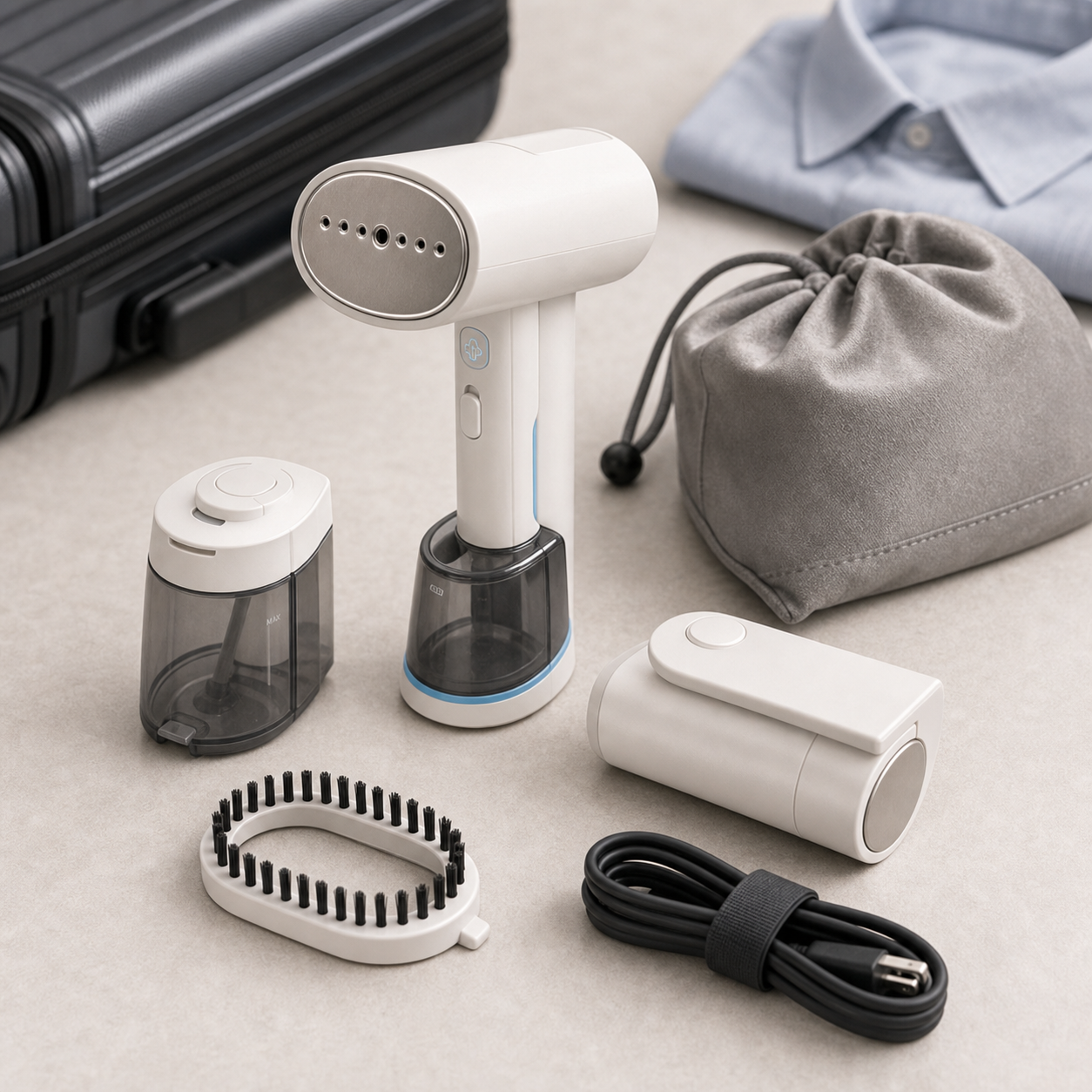
The KudBo travel garment steamer is a practical accessory for hospitality and travel assortments. Earlier guidance covers voltage and thermal safety. This article focuses on owner care and support, while leaving electrical and regulatory assessment to qualified people. No descaling frequency or water-type instruction in this guide should be copied onto a specific model without checking its actual manual.
A traveler may fill a device in a hotel bathroom, use it once, unplug it and hurry to repack. That plausible sequence differs from a factory demonstration where the appliance cools on a bench and is drained by a trained worker. Retail copy and a quick-start card need to serve the traveler, not only the sales meeting.
Confirm What Water the Model Accepts
Ask the supplier whether the finished model is intended for tap, distilled, purified or another specified water type, and what mineral limits matter. Do not assume all steamers give the same advice. Philips' garment-steamer support materials show why model-specific instructions are essential: consumers may need guidance on water, scale, spitting and post-use behavior. Philips guidance is not a manual for a KudBo model.
If a retailer sells across regions with different water hardness, ask how the maker has considered that variation. A simple sample comparison can reveal whether deposits accumulate under the chosen water and cycle conditions, but it cannot justify a universal life claim. Record water source, volume, run time and cleaning procedure so observations are interpretable.
Do not recommend adding perfume, vinegar or an improvised descaler merely because it works in a kitchen appliance. Such substances can affect seals, heaters or textile surfaces. The quick-start card should list only approved liquids and a clear “do not add” note where the manufacturer supports it.
Review the Tank and Fill Opening
Measure usable tank volume under its marked fill line rather than extrapolating from the external shape. Can a user see the line in poor hotel lighting? Does the cap seal reliably after several openings, and can the tank be seated without misalignment? A nominal capacity on a box should say what it measures.
Rehearse filling from a realistic small tap or cup while the appliance is unplugged and cool. Check whether water can run across electrical contacts, where droplets collect, and whether the instructions tell the user to wipe the exterior before connecting power. A removable tank can ease filling but introduces a latch or gasket that may need replacement. A fixed tank may simplify construction but be harder to empty completely.
Try packing the emptied unit as instructed. A few drops inside the tank may be normal, but a travel pouch should not become wet because the tank cannot be drained. Ask whether a cap lock or travel plug is included or optional. Photographs of a pouch beside the steamer should not imply the pouch is part of the sale if the quotation excludes it.
Treat Scale as a Performance and Service Question
Mineral deposits may affect flow and heating, but the rate depends on water and use. Ask where scale can collect, whether the model has a documented cleaning program and which parts a consumer can access safely. If the design is sealed, determine whether service is practical or unit replacement is the only supported remedy. Do not publish a time-to-failure figure from a handful of sample cycles.
Set up a controlled comparative trial if scale resistance is an important selling point. Keep identical water, run cycles and rest periods for competing models, then record visible changes, steam continuity and any staining. A buyer-run trial is useful for selection, not proof that a machine will last a stated number of years. Have qualified technicians assess unusual odors, discoloration or interrupted heating rather than asking consumers to dismantle the appliance.
The garment is part of the use case. Test on textiles that the supplier says the model can handle, with appropriate care advice. Steam output alone does not prove that every fabric can be treated or that creases disappear in a single pass. A retail image should avoid implying use on garments whose care labels prohibit it.
Specify Cooling and Storage Steps
Ask where the hot surfaces remain after the unit is switched off, what cooling time is recommended and how the user can recognize a safe-to-pack state. Do not invent one universal time. A thermal assessment for the exact product can support an instruction. A traveler cannot safely infer temperature from a power light that has gone out.
Check cord routing and strain relief when the appliance is folded or placed in a pouch. If a plug adapter is required in a destination market, identify it in the quote and customer guidance; a multi-voltage appearance does not prove worldwide electrical compatibility. Keep after-use water handling separate from electrical unplugging instructions so neither is obscured by a decorative icon.
Use the entire retail carton for a first-use exercise. Can the customer locate the water type, fill line, clothing precautions, cooling step and packing direction within one minute? A long manual may contain the details but a visible quick card is valuable when the product is used away from home.
Mid-Article CTA
Send Your Requirements with destination markets, voltage, expected water use and gift-pack needs. Email info@kudbo.com for a model-specific sample and care-card discussion. Include any requirement for a pouch or replacement tank seal.
Keep Performance Claims within the Test
If a supplier quotes steam output, heat-up time or operating duration, request method, water condition, voltage, ambient conditions and sample revision. A favorable number at one voltage may not describe another market's plug version. Separate typical behavior from guaranteed minimums and keep the data with the finished model's file.
Mark every consumer claim as physically observed, supplied in documentation or awaiting appropriate test evidence. “Removable water tank” is readily visible. “No scale ever” is a broad durability claim that a short demonstration cannot support. If a reviewer finds a recurring spit or stain issue, document it with water and garment conditions; do not dismiss it as user error without investigation.
Inspect production units against a signed reference for tank, gasket, cord, plug, labels and pack-out. Factory testing can check a defined heating and steam cycle. Shipment inspection can sample first-use functions and visible condition under a safe procedure. Neither replaces relevant electrical or thermal compliance review for the target market.
Price Consumables and Support
Ask whether tank caps, seals, brushes or approved cleaning accessories are available. If the unit is intentionally nonserviceable, plan a clear warranty remedy. An importer should know how many service inquiries can be answered with instructions and when a unit must be taken out of use. Keep repair or replacement recommendations within manufacturer-approved methods.
For a hospitality program, identify whether guests or property staff will fill and clean the unit. Staff training and storage space can make a low-price device expensive to operate. For retail, focus on readable guidance and a support URL that remains maintained after packaging is printed. The support plan should fit the actual channel.
| Buyer question | Sample check | Evidence or instruction needed |
|---|---|---|
| Water type | Fill with approved source only | Model-specific manual |
| Mineral buildup | Controlled cycle comparison | Defined method; no universal lifespan claim |
| Storage | Cool, empty and pack sequence | Safe-to-pack guidance |
| Service | Cap and seal identification | Approved spare list |
Specify a Traveler-Ready Instruction Card
The instruction card should answer questions in the order a traveler has them: voltage and plug, accepted water type, fill line, heat-up indication, safe garment distance, cool-down time and storage. If the model is not dual voltage, say so prominently. A universal-looking plug adapter does not convert voltage. The customer should be able to identify those constraints before leaving home, not only after discovering them at a hotel.
Create an acceptance trial with representative garments and defined settings if performance claims are planned. Delicate fabrics, heavy cotton and lined clothes differ. Document whether the test measured visible wrinkle change, operating time or water use; do not make one result stand for all fabrics. Photograph the same area before and after under matched lighting if images will support a listing. Marketing photos with different folding or camera angles can mislead even when the appliance works normally.
Ask service staff how to respond to a blocked steam path, leaking tank and mineral deposits. Those faults may have different causes. Give owners a manufacturer-approved care method instead of recommending a universal descaling chemical. Quote spare tank caps or seals when replaceable, and make sure the warranty process distinguishes normal mineral buildup from a manufacturing defect.
Distinguish Water Care from Electrical Support
If steam output weakens, the owner may assume a failed heater when the cause is mineral buildup or an empty tank. A useful service guide separates these observations: indicator response, heat-up, steam flow and visible leakage. Each step should be safe for an untrained customer and consistent with the manufacturer's approved method. Do not ask a user to open a hot appliance or remove an electrical cover.
For destination-market assortment, check the plug and voltage variant against the printed box and barcode. Similar housings can conceal different electrical configurations. A sampled power-on test in the factory's local voltage does not establish proper operation in every export market. Ask the supplier for the documents and markings that apply to the intended configuration and have the buyer's compliance team review them.
The travel pouch matters too. A steamer must cool and dry before it is sealed away. If the supplied pouch is water-resistant, tell customers whether it is meant for transport after cooling, not immediate storage of a wet hot unit. Test whether the cord, cap and empty tank fit without stress. Such simple ownership details can shape customer reviews more than a headline steam rate.
Put the Use Boundary on the Listing
A portable steamer can be a practical touch-up tool without replacing an iron for every textile. Identify the intended garment types and the degree of wrinkle reduction the buyer plans to show. A structured sample comparison should use garments prepared in the same way and images taken with consistent lighting. If the product is marketed for suits or delicate fabrics, ask for model-specific instructions and a test on representative material before showing a finished outfit.
Size and weight claims should include the travel pouch and cord when a customer is expected to pack them. A compact body with a bulky adapter may not fit the intended carry-on kit. Check the tank after travel vibration for leakage and whether residual water can be emptied easily. The user guide should not encourage carrying a hot or partly full appliance in a sealed bag.
For wholesale support, keep replacement tank caps and any seals identified by revision. The sales team should be able to answer whether a leak is caused by an open cap, overfill or damaged seal. This small parts plan makes the product easier to own and gives buyers a clearer total-cost picture.
The Philips water-type support note shows that manufacturers may prohibit scented water or added chemicals. It applies to Philips equipment, not automatically to KudBo's quoted steamer; request the exact model maker's instructions before copying any water-care advice.
Frequently Asked Questions
Can every travel steamer use tap water?
No universal rule applies. Read the exact model's manual and ask the supplier what water types and hardness ranges were considered. A competitor's instruction may not suit this heater and tank. Publish only the manufacturer-supported guidance for the final sold configuration.
Should users add vinegar to remove scale?
Not unless the actual manufacturer documents that method for the specific appliance. Improvised chemicals can damage components or leave residue on clothing. A buyer should obtain a validated cleaning procedure and communicate it clearly to users.
When can a steamer be packed after use?
Follow the model-specific cooling, emptying and drying instructions. Switching the device off or seeing a dark power light does not necessarily mean every surface is cool. Ask for a supported safe-packing procedure before approving a travel-use claim.
Does first-use steam prove long-term performance?
No. It confirms behavior under one water, voltage and sample condition. Mineral exposure, cleaning and repeated packing may change results. Use a defined comparison or technical assessment for durability claims, and retain the method and product revision.
What should a private-label carton include?
It should identify the actual voltage and plug, included tank or cup, approved water, fill limit, key safety warnings and after-use care. Artwork and the packed unit must match. A decorative hotel image should not imply a travel pouch or adapter is included if it is optional.
Conclusion
A credible travel-steamer program makes water and storage care easy to understand. Specify the exact approved water, observe the complete use cycle, and support the tank and seals as well as the heating function. Keep dramatic performance promises behind appropriate evidence.
Final CTA
For related sourcing questions, browse all buyer guides or the Product Sourcing collection.
Explore the current KudBo product catalog when comparing this guide with available SKUs.
Contact KudBo or email info@kudbo.com with market, quantity and desired pack contents. KudBo can help organize a model-specific sample review and a care-card brief before production artwork is signed off.