Introduction
A smart luggage scale tag succeeds only when the traveler can use it at the point of packing. A bright display and compact body are not enough if the battery is flat after storage, the strap is confusing, or the scale cannot be reset without a missing app. For importers, power arrangement and first-use instructions are product requirements, not fine print.
The KudBo smart luggage scale tag sits in a crowded travel-accessory market that also includes simpler handheld scales. Earlier KudBo guides discuss scale accuracy and reset/privacy questions. This article takes a different path: what a traveler needs to know before a flight, and how the buyer should specify battery, storage and handover details. It does not assume that the quoted unit is rechargeable, uses a coin cell or has a particular wireless feature.
Imagine a gift recipient opening the package on the evening before departure. Can they identify the power source, prepare the unit, change the weight unit, test a suitcase and store it safely? A wholesale sample review should rehearse that sequence with the complete retail pack. The result is more informative than a product photo with a perfect display reading.
Identify the Exact Power Architecture
Ask whether the quoted revision uses a replaceable primary cell, an internal rechargeable battery or another arrangement. Record battery chemistry, nominal capacity where applicable, accessible markings, included cable and supported charging input. If a cell is user-replaceable, ask how the cover is secured and what the instructions say about replacement and disposal. If the unit is sealed, clarify the realistic end-of-life path.
Do not infer run time from a nominal battery capacity printed on a component. Sleep current, display behavior, wireless activity, storage conditions and the number of weighing cycles change usable life. Define a buyer test around the actual customer's pattern: first setup, several weighed bags, idle storage and a later return to use. A model that measures well for a single afternoon can still create returns if it is shipped awake or cannot recover easily after low charge.
Battery documents should be linked to the exact product revision and shipment arrangement. If lithium chemistry is involved, confirm the applicable transport, labeling and packing requirements with a qualified logistics partner. A marketing team should not simplify those obligations into a universal “airline approved” badge. The IATA passenger battery guidance describes important distinctions among installed devices, spare cells and power banks; travelers must still check their airline and route.
Test Storage Mode and Wake-Up
Retail units may spend months in a carton. Ask whether there is an insulating pull tab, a hard-off switch, automatic sleep or only a software idle state. Check whether a packaging insert can accidentally press the button during transit. Where practical, measure or obtain documented standby behavior from the supplier, but record environmental and method conditions rather than claiming a shelf life from one bench reading.
Rehearse first wake-up after storage. The user should see a meaningful indicator if the device has insufficient power, and the instruction should not require an obscure reset that no traveler can find. If the tag uses an app, check whether core weighing works offline and whether an account is required for any optional function. A scale sold for quick travel use should not surprise its owner with a compulsory onboarding step unless that is clearly disclosed.
If a battery replacement is possible, perform the sequence on a real sample. Note tool requirements, small-part retention, polarity markings and whether the housing still closes as designed. Qualified reviewers must assess child-access and battery safety for the target market where relevant. Do not market an easy-access cover as a convenience if it creates a safety problem.
Make the Handle and Strap Part of the Measurement
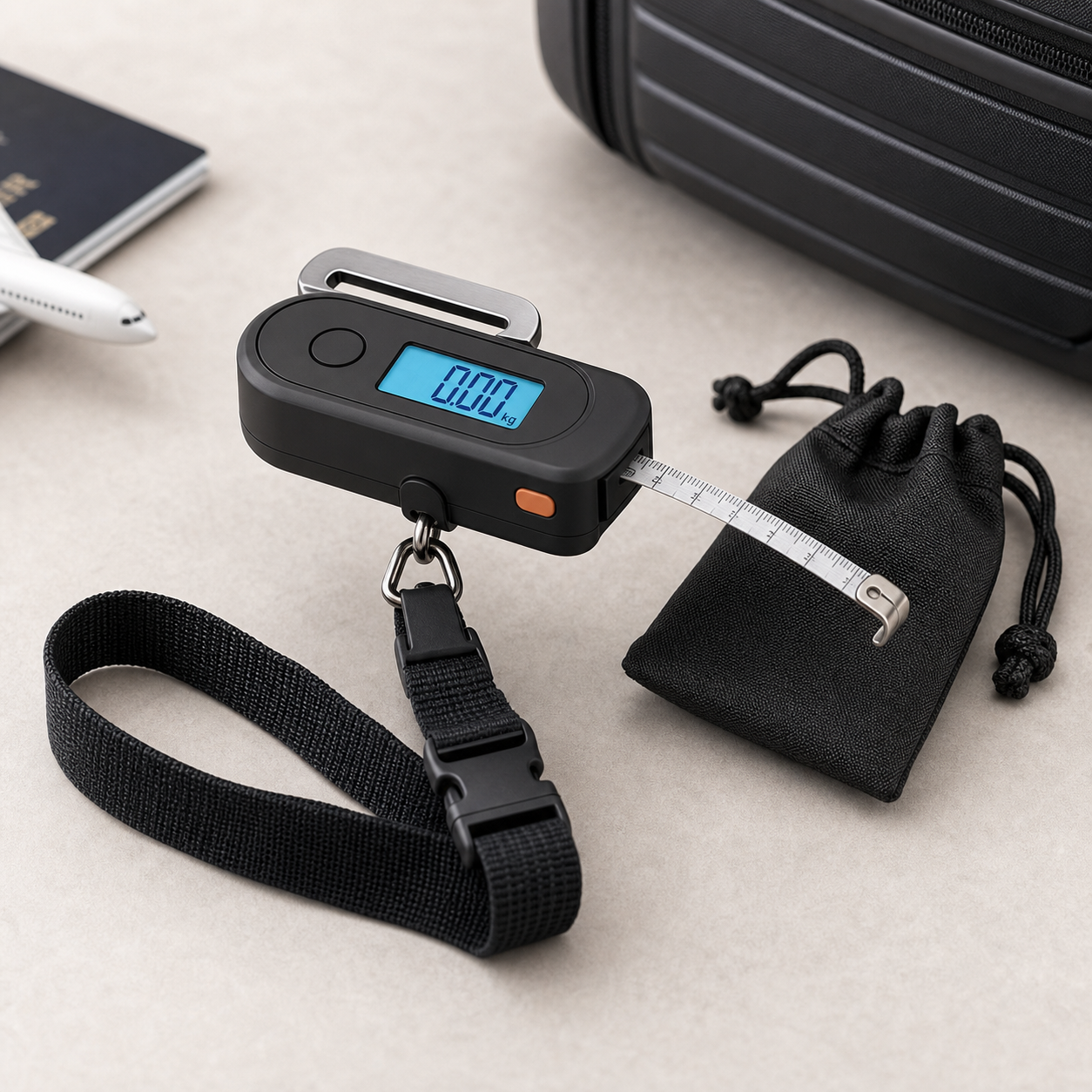
The strap, hook or tag attachment influences how people lift a bag. Test with handles of different shapes and widths. Can the traveler lift vertically without twisting or pulling the suitcase into their body? Does a flexible strap keep the bag clear of the ground? The scale must be used within the manufacturer's defined range; do not have untrained staff improvise heavy lifts for a marketing video.
Record the tare or zero procedure exactly as the consumer will perform it. Weighing with the strap under tension or the bag touching a surface may produce a misleading result even if the sensor itself is well calibrated. Use a defined reference load and repeat under stated conditions. Compare the result to the supplied instruction, not to a vague claim that every traveler will get the same number at an airline counter.
Airlines may use their own scales and baggage policies. The tag can help a traveler plan, but it cannot guarantee a checked-bag fee or acceptance outcome. That boundary belongs in the customer message. A retailer that promises “never pay excess baggage again” is making a claim the accessory alone cannot control.
Review Reset, Units and Low-Power Behavior
Ask how the device changes among supported weight units, whether that selection persists after sleep or battery change, and what reset actually clears. A reset might clear the last reading, a paired account or an entire configuration depending on the model. Document the difference. If there is connectivity, identify how a new owner safely removes a previous pairing before resale or support replacement.
Create a short edge-case test: a low battery during weighing, an interrupted display, a unit change between two readings and a device that has not been used for several weeks. Does it show an error, stale value or a clear prompt? A sticky old reading can be more confusing than a blank screen. Decide what behavior is acceptable before a supplier labels it normal.
Check readability in ordinary indoor light and at the angle a user sees while holding a case. A display-size specification does not tell whether a tired traveler can see the active unit. Place the entire retail instruction at arm's length and see whether the weight unit, power indication and reset step are legible without magnification.
Mid-Article CTA
Send Your Requirements with destination market, battery preference, luggage-handle examples and proposed quantity. Email info@kudbo.com for a sample and packaging-handover discussion. List any expected app or offline function explicitly.
Write a Travel-Ready Pack Insert
The insert should identify what is included, whether the battery is installed, how to wake the unit, how to lift safely, how to zero it and how to interpret a low-power symbol. If the product has a wireless feature, explain its role separately from the basic scale function. Do not hide the fact that a phone, account or cable is needed for a feature shown prominently in product photos.
Use plain diagrams based on the actual production strap and display. Test the insert with someone who was not in the procurement meeting. Ask them to find the battery information and perform one weighing task. Record where they hesitate and revise the card. This is an inexpensive usability review, not a certification result.
Where the retailer distributes internationally, check language needs, battery disposal instructions and any required marks with market-specific advisers. Do not copy a symbol from another device because it looks familiar. The printed accessory list, carton image and packed contents should describe the same revision.
Price After-Sales Support Honestly
A low unit cost may be offset by service contacts for dead-on-arrival cells, lost charging cables or inaccessible resets. Ask for spare cables, straps and battery covers where applicable. Quote the exact part, compatible revision, lead time and minimum service quantity. If the battery is not replaceable, decide whether the warranty remedy is replacement of the unit and how returns will be handled.
Factory testing can verify power-on, display, buttons and a defined reference-weighing check. Shipment inspection can sample pack-out, battery isolation, warnings and exterior condition against the signed reference. Neither guarantees that every airline or user will accept a baggage-weight result. Keep methods and claims aligned.
| Buyer question | Approval evidence | Consumer instruction |
|---|---|---|
| How is it powered? | Exact battery and charger specification | First charge or cell-install step |
| How does it travel? | Strap and lift review | Safe handling and airline-policy note |
| What happens after storage? | Wake-up and low-power check | Troubleshooting sequence |
| Can it be transferred? | Reset and pairing documentation | Clear reset path |
Prepare a Destination-Specific Travel Handover
The travel insert should describe the battery installed in the exact SKU, how it is isolated or turned off, whether it can be removed and where the traveler should check current airline rules. Do not copy a generic “airline approved” statement from a different device. Carrier policies and country restrictions can differ. For any lithium battery configuration, ask the supplier for the transport documentation associated with that cell and the packed product, then have the logistics provider review it for the planned route.
Put battery replacement or charging steps in the language of each market. A coin-cell cover that needs a tool should be illustrated; a rechargeable unit should show the connector and compatible input. Inspect that instructions do not encourage travelers to open the device at an airport gate or to place a damaged battery in luggage. The retail customer needs a quick, reliable answer before packing, not a technical datasheet after a flight is delayed.
If the tag also offers wireless tracking, treat that as a separate software and privacy review. Identify pairing, account reset, lost-device behavior and any recurring service cost. A scale-only SKU and a wireless SKU should not share identical packaging if only one supports an app. Shipment inspection can check power-up, display, included strap and pack-out, but a destination-market travel claim still needs document review against the actual SKU.
Compare a Traveler's Pre-Flight Sequence
Before leaving home, a traveler may check the tag's battery, select units, lift a packed case, read the display and attach the tag to the handle. Ask a sample user to do those steps from the printed card without a demonstration. Note whether the case must be held awkwardly, whether the reading persists long enough to view and whether the strap can be secured without twisting. Those observations are relevant to the purchase decision even if the sensor itself has a sound calibration record.
At the airport, the device may experience a different problem: it must be understood quickly. If there is a wireless feature, give the user a clear way to disable or remove the power source if required by a carrier. If there is no wireless feature, do not borrow language from smart trackers. The product should never promise that airline staff will accept a specific battery configuration; travelers should check current carrier and destination rules.
On arrival, the tag should still function as an identifier without displaying unnecessary personal details. A reusable name card can be helpful, but a public QR code or app profile introduces privacy questions. Ask what a finder sees and what the owner can reset. Put those answers into the model-specific handover, not a generic “smart travel” paragraph.
The IATA electronic baggage-tag overview describes airline-issued digital baggage tags, a different system from a consumer scale tag. That distinction belongs in retail copy: a weighing tag should not be pictured or named as though it issues an airline-recognized electronic baggage label.
Frequently Asked Questions
Is every smart luggage scale tag rechargeable?
No. Models can use different power sources and charging arrangements. Ask for the exact quoted revision and its included accessories. A listing photograph with a cable does not establish that the cable is included or that the battery can be replaced. Confirm the service plan before approving the retail box.
Can the tag guarantee an airline's final bag weight?
No. It can support packing decisions if used correctly within its stated limits. Handling technique, calibration, strap geometry and the airline's own equipment can affect the comparison. Retail copy should avoid guarantees about fees or baggage acceptance that depend on the carrier.
Do airline battery rules apply to a scale tag?
The answer depends on the battery chemistry, whether the cell is installed or spare, and the airline's policy. Refer to current carrier and relevant transport guidance for the exact configuration. Do not treat a general website sentence as a universal approval for every country or itinerary.
What should be checked after changing the battery?
Follow the manufacturer's instructions, then verify display startup, unit setting, zeroing and a defined reference weight. Check that the battery cover closes correctly. A battery replacement may not preserve settings or pairings; the manual should explain the expected behavior.
What can factory testing prove?
An agreed routine check can show that sampled production units turn on and weigh a defined reference under stated conditions. It does not establish indefinite battery life, universal accuracy across all loads or acceptance by every airline. Keep the report scope with the SKU and sample revision.
Conclusion
A travel scale is a small product with a large handover obligation. Select the power architecture, test wake-up and reset, and validate the complete lift task before approving an eye-catching display claim. The responsible wholesale offer includes instructions and service parts, not just a device.
Final CTA
For related sourcing questions, browse all buyer guides or the Product Sourcing collection.
Explore the current KudBo product catalog when comparing this guide with available SKUs.
Contact KudBo or email info@kudbo.com with market, quantity and preferred power arrangement. KudBo can help coordinate a model-specific sample and clarify which travel-use claims need evidence before artwork is released.