Introduction
A hydration reminder is not the same as a water-intake measurement. A coaster may signal after a timer, sense that a cup is present, or detect a change in weight. Those functions support different claims and customer expectations. A buyer should identify the exact sensing method before writing “tracks how much you drink” on packaging.
The KudBo smart hydration coaster is suited to desk-gift and wellness-accessory evaluation. A previous guide discusses app data and claims. This article focuses on the everyday desk experience and the boundary between prompting a behavior and verifying its result. It does not claim that a particular KudBo model measures fluid intake or improves health outcomes.
Classify the Function First
Start with a functional map. A timer-only coaster can remind users after a selected interval, even if the cup is empty. A presence sensor can tell that an object is on the coaster but not necessarily whether anyone drank. A weight-sensing design may detect mass changes, yet it must distinguish drinking from refilling, moving the cup or adding ice. An app may ask users to enter consumption manually. Put these distinctions in the buyer brief.
Ask the supplier for a simple sequence diagram: what starts the timer, what cancels or snoozes an alert, what data is stored and how the product resets. Test each branch on a production-intent sample. If the product has no actual volume sensor, describe it as a reminder or habit prompt. Do not turn a software estimate into a measured physiological fact.
The FTC guidance on health-product claims explains the importance of competent support for health-related statements. It does not prohibit every wellness accessory claim, nor does it validate a given coaster. For procurement, the safest path is to say exactly what the device does and omit disease, dehydration-prevention or medical-monitoring promises unless supported by appropriate evidence and review.
Test Cup Compatibility at a Real Desk
Create a cup matrix for the sales channel: narrow mug, wide glass, insulated bottle, ceramic cup and lightweight tumbler. Record base diameter, material and whether each sits securely within the sensing area. A coaster that works only with one demonstration cup should not be shown under every cup type. Note if condensation or a wet base changes sensor response or makes the desk slippery.
Check the indicator from the user's seated position. Can it be seen without being distracting? Does it remain visible under an opaque mug? Can a user silence it during a video call? Sound and light preferences vary across offices; a quiet or adjustable mode may be more important than a bright animation. Confirm actual settings on the quoted firmware.
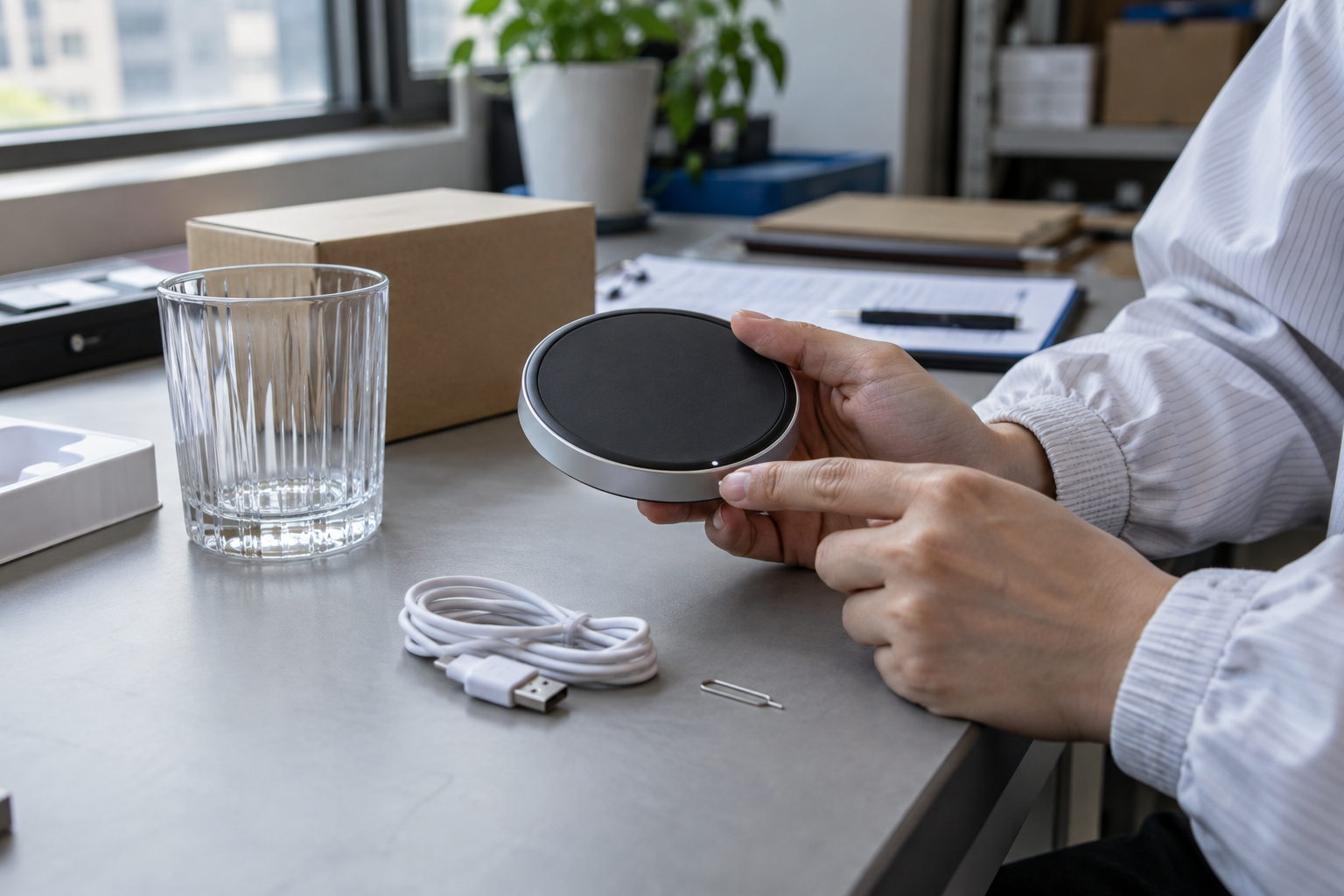
Inspect cable routing, power requirement, spill resistance and surface grip. If the product is rechargeable, clarify charging frequency under a defined alert setting, not a vague “long-lasting battery” claim. If it needs USB power, show the cable in product photos or explicitly call out that it is required. Do not imply it is a charging pad for phones unless the hardware actually supports that feature.
Review Reminders Without Inventing Wellness Results
Give two or three users a sample and ask them to follow the supplied quick-start guide for a week only if a buyer is conducting an actual trial. Log whether setup was clear, alerts were noticeable, and the device behaved predictably when the cup moved. Do not report unperformed field results or say users drank more water without a defined study.
For acceptance, simulate common events: put a full cup on the pad, lift it, return it, refill it and leave it unused. Observe alert behavior and any displayed data. Keep a written test protocol with firmware version and settings. An inspector can check core functions on a sample, but a short power-on check cannot establish long-term behavior change.
For office gifts, identify when the user controls the interval and when preset prompts are imposed. A universally “correct” drinking schedule is not a sound product promise. Individuals have different needs, and some have medical fluid restrictions. The coaster should not override professional medical advice or position itself as a health monitor.
Mid-Article CTA
Send Your Requirements with target cup types, alert method, power supply, app expectations and destination market. Email info@kudbo.com for a function-by-function claim and sample-review checklist.
Map the Data Path if an App Is Included
Ask whether the coaster pairs with a phone, stores timestamps, creates a profile or sends notifications through a cloud service. If an app is not included, the packaging should not use dashboard mockups that imply one. If an app is supplied, verify supported operating systems, account needs, deletion process and what happens when the customer changes phones.
The FTC's Internet of Things security guidance offers general design and disclosure principles for connected products. It is not a certification of any hydration coaster. A retailer should ask the supplier for actual update and data-handling practices and avoid a “privacy safe” badge with no defined basis.
If the product estimates intake, request an explanation of its method and limits. How does it treat a shared cup, a cup moved off the coaster or a refill? If those cases are not reliably handled, label the number as an estimate under specified conditions or omit it. The information architecture should let a customer understand the difference between an observed event and an inferred amount.
Make an Honest Procurement Specification
The purchase order should specify sensor type, supported cup base range, power input, alert modes, water-exposure limitations, app requirements and packaging language. Include a physical reference sample and firmware version. Ask for a change-control note when the supplier substitutes sensors or app components, since those changes may alter the behavior underlying marketing claims.
Shipment inspection can check pack-out, visible finish, power-on, alert sequence and reset on sampled units. It cannot prove a wellness benefit. Review the final retail listing against the accepted feature matrix before launch. Many avoidable disputes begin when the packaging promises measured intake while the hardware only offers timed nudges.
Draft a Claim Matrix Before Packaging
For every phrase on the carton, list the physical or software behavior that supports it. “Reminds you to take a break” may be supported by a configurable timer. “Detects when a cup is lifted” requires that behavior on the approved sample. “Measures daily hydration” is a different claim and needs a defined measurement method and an explanation of missed events. A persuasive product page can still be specific and modest; it does not need to promise that users become healthier.
Test the claim matrix with ordinary edge cases. Put an empty mug on the coaster, replace it with a different cup, spill a few drops, unplug and restart the device, and have two people share the desk. Record what the indicator does each time. If an app reports “cups consumed,” identify whether that is a manual entry, a weight estimate or a count of lifted-cup events. Each is useful in a different way, but only one might approach an actual volume estimate under controlled conditions.
If the product is given to employees, an office buyer should decide whether individual usage data is necessary at all. A standalone light prompt may satisfy the program without creating a workplace monitoring issue. If the app collects personal usage history, ask who can access it, how long it remains and how the user deletes it. Do not infer privacy protection from the absence of a camera; a timestamped behavior record can still be personal data.
Review the User's Right to Ignore the Prompt
An alert should be easy to pause during meetings, travel or sleep. Test whether a user can change intensity, timing and sound without creating an account. Some people have reasons to limit fluid intake; the instruction must not frame a reminder as mandatory medical advice. A thoughtful product experience respects the user's context instead of treating every missed prompt as a failure.
Ask whether the coaster remains useful when the app is discontinued or a phone is replaced. If core reminders work offline, state which settings persist. If app connectivity is essential, request an update and support commitment from the supplier. A gift product may be used months after purchase; activation that depends on an expired service creates avoidable returns.
Finally, photograph the product with a cup that actually fits the active area. If a catalog image uses a very wide bottle, verify base contact and stability. A realistic desk scene with a visible cable, when one is required, is more credible than an isolated glowing object. That honesty supports both SEO trust and post-purchase satisfaction.
Choose the Right Commercial Positioning
There are at least three plausible customer propositions. A simple desktop reminder suits gift and office channels that value low-friction setup. A connected habit tracker may suit customers who already use an app and accept an account. An intake-estimating device is a more demanding proposition because buyers must explain sensing error and edge cases. Treat those as distinct SKUs or clearly distinct modes, not as a single ambiguous “smart health” promise.
Show that difference in the quote. Price the hardware, accessories, app support and after-sales obligations separately. If the app requires maintenance, establish who supplies updates and for how long. A buyer should not assume that a low device price includes an indefinite software service. If no app is offered, that simplicity can be an advantage, and the product page should say so plainly.
When testing retail packaging, ask a reader what they believe the coaster measures after looking at the front panel for ten seconds. If they answer “my total water intake” but the device only starts a timer, revise the wording. This simple comprehension check is a proposed approval step, not a reported consumer study. It protects trust better than adding a longer disclaimer at the bottom of the box.
Plan a Support Life Beyond the Launch Photo
The buyer should ask what happens after a year of desk use. Can the indicator be cleaned around the rim? Does the coaster remain level after repeated warm cups and condensation? Can a battery be replaced or safely serviced? Those questions are ordinary product-quality issues even when the device is marketed as “smart.” Include representative cups and wet-desk conditions in sample review, but do not claim water resistance without a model-specific test and rating.
If the app is involved, preserve a screenshot and version of the approved workflow. Later updates may change permission prompts, displayed numbers or account requirements. The importer should receive change notice before an update alters a feature advertised on the carton. A local reminder that works without a phone may remain useful longer than a dashboard whose service is discontinued; that tradeoff should be part of the procurement decision.
Give customer service a claims sheet that says what the device senses and what it does not. When someone asks whether it detects actual drinking, support should give the same answer as the product page. Consistency across listing, manual, app and email response is central to trustworthy wellness-adjacent marketing.
Frequently Asked Questions
Does a smart hydration coaster measure how much water I drink?
Only if the specific model has a suitable sensing and calculation method, and even then accuracy depends on defined use conditions. A reminder-only coaster does not measure intake.
Can it work with any mug or bottle?
Do not assume so. Compare base diameter, material, weight and stability against the actual supported range. Test representative customer cups on the sample.
Is a hydration reminder a medical device?
That depends on its claims and intended use in the relevant market. A general desk reminder should not make diagnostic or treatment promises without specialist regulatory review.
What happens if the cup is refilled or moved?
Behavior varies by sensing method and software. Make these actions part of the sample test and describe any limitations in the user instructions.
Should an office buyer require an app?
Only if the program needs app features. A standalone reminder may be easier to deploy; an app introduces compatibility, privacy and update obligations.
Conclusion
Buyers should approve smart hydration coasters against a precise function statement: what triggers an alert, what the product senses, what it records and what it does not know. That clarity makes product descriptions more credible and customer support easier.
Final CTA
For related sourcing questions, browse all buyer guides or the Product Sourcing collection.
Explore the current KudBo product catalog when comparing this guide with available SKUs.
Ask for Product Catalog or send cup, alert and app requirements to info@kudbo.com. KudBo can help scope an honest feature and inspection brief for the selected configuration.