Introduction
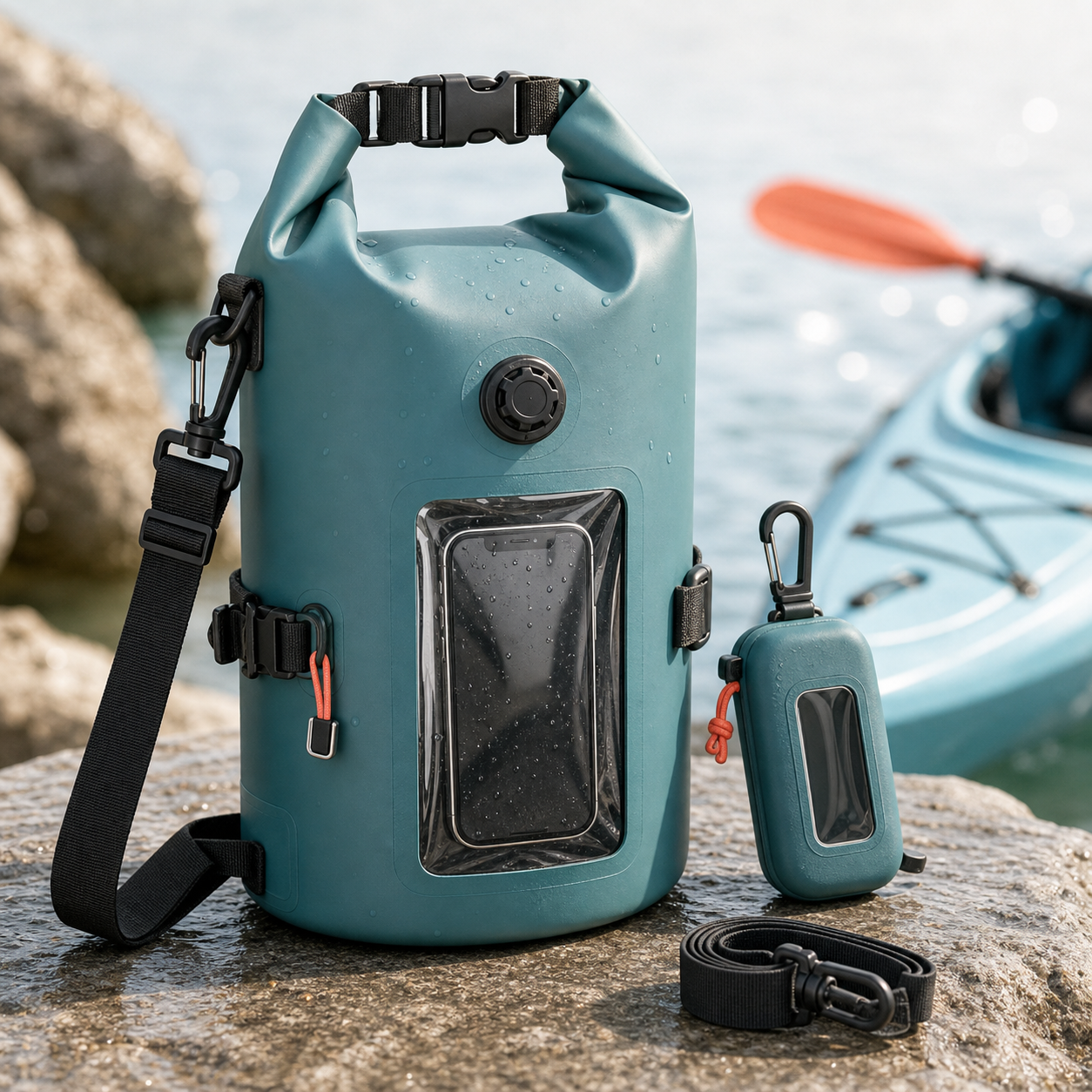
A roll-top and a zippered dry bag can protect different user tasks even when both are sold as “waterproof.” A roll-top depends on a correctly made fold and sufficient empty space above the contents; a zippered opening can offer quicker access but introduces a different seal and cleaning burden. The right wholesale decision starts with how the customer will open, close, carry and maintain the bag, not with a dramatic water photo.
Buyers reviewing the KudBo product catalog can use this category comparison alongside the earlier dry-bag closure and claims guide. This is a sourcing guide, not a claim that a dry-bag SKU is currently listed. It focuses on the purchasing tradeoff between closure mechanisms, including access frequency and serviceability. It does not assert that either construction is automatically submersible, or that a sample image establishes an IP rating. The exact finished product must be tested for the claim the importer intends to make.
Consider three buyers. A kayaking retailer may prioritize repeatedly closing a large bag after loading bulky clothing. A commuter-accessory buyer may prioritize access to keys and documents in rain. An outdoor-gift buyer may value a compact price point and clear first-use instructions. Those applications share a word, dry, but they do not share the same exposure or handling conditions.
Match Closure to the Water Scenario
Write the exposure in ordinary language: splash, rain, spray from a boat, brief wet deck contact or a possible immersion incident. Decide whether the shopper will expect a dry inner compartment after repeated opening. A buyer who says only “100% waterproof” has not given a factory an inspectable requirement and may be creating a claim that the product cannot support.
The manufacturer's NRS guide to sealing a roll-top dry bag explains that its closure requires a deliberate series of folds before fastening. It is useful as an example of how closure technique affects the result, not a universal instruction for every KudBo model. Ask the actual supplier to provide model-specific fold depth, number and orientation guidance, then test whether first-time users can follow it with the intended load.
For a zippered design, establish whether the zipper itself is intended for rain, spray or a stronger exposure claim. Examine end stops, garage details, protective flaps and the way the teeth or sealing lips meet under light bending. A water-resistant zipper on a pouch does not make every seam and panel equally resistant. The weakest path in a finished bag, not the most expensive component, determines the credible claim.
Compare Access Frequency, Not Just Closure Speed
Take the same set of objects through an ordinary use sequence. A roll-top bag often requires unfolding, opening the mouth and rebuilding a seal. A zippered pouch may expose a smaller area quickly. But if grit enters the zipper during frequent access, performance and closing force may change. Record how many times a user opens the bag in the likely outing, and where they will set it while doing so.
Try the sequence with gloves, damp hands and a partly filled bag. Do not place electronics or documents inside during a first uncontrolled water check; use inert contents. Observe whether people leave enough space to complete the fold, whether they pull a zipper around a crowded corner, and whether a shoulder strap interferes with the closure. These observations can reveal a mismatch that a static product photo cannot.
Accessibility is also a customer-support issue. A bag that requires a precise fold but provides no readable diagram will be returned as “leaking” even if the material is sound. A zipper that needs cleaning but has no care card may become stiff and be forced past its intended path. Training the buyer's staff and writing a two-panel closure instruction can be as consequential as changing the material.
Inspect Fabric, Seams and Junctions as a System
Ask how panel seams are made: welded, taped, stitched and sealed, or a combination. Different constructions deserve different inspection points. A stitched seam may create needle holes requiring appropriate sealing; a welded seam can be narrow, misaligned or stressed at a corner; an attached webbing loop can create a local load path. Do not imply that one method is superior in every use or material thickness.
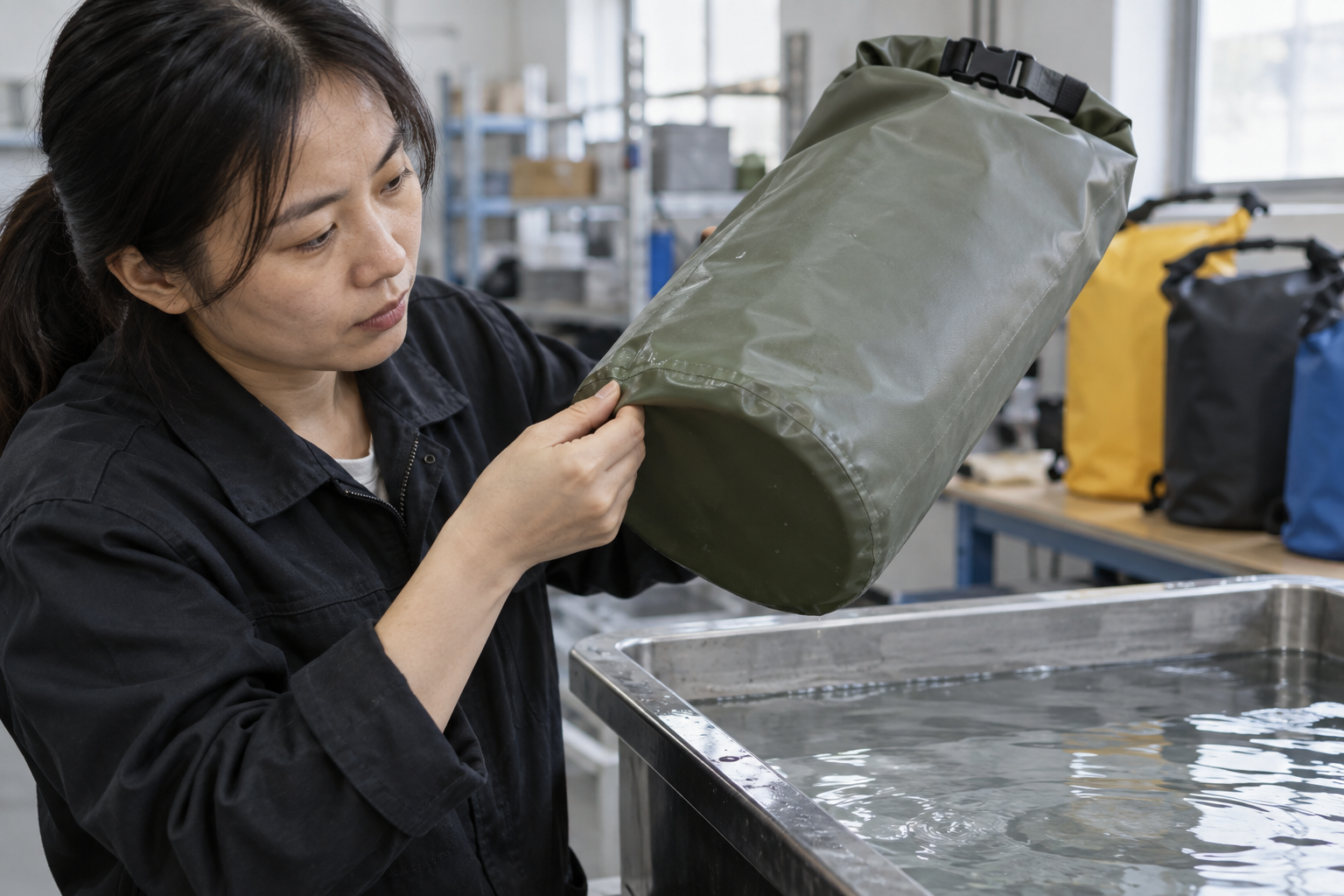
On the sample, map junctions where the closure meets the body, the strap joins the panel and the base bends when loaded. Look for inconsistent weld width, peeling, exposed thread, small cuts or distortion after repeated packing. Document the test load, fold count and orientation if a simple in-house water exercise is conducted. A short demonstration under a faucet should not become a universal immersion claim on the carton.
If a numeric water-resistance or ingress rating is proposed, request the exact method, duration, orientation, conditioning, sample size and report identity. An IP code for an electronic enclosure may not be the appropriate or complete evidence for a flexible bag. Obtain qualified advice on what the actual product and market claim require rather than copying an adjacent specification.
Include Cleaning and Repair in Ownership Cost
Outdoor use brings grit, salt, sunscreen and food residue. Ask which parts can be rinsed, what cleaning agents are permitted and how the bag must dry before storage. A zipper may need a care instruction and possibly an approved lubricant; the supplier must specify compatible products for its chosen construction. A roll-top's stiffening strip, buckle and webbing can also be damaged or lost.
Build a replacement-parts list with buckle model, strap clips, shoulder pad and any detachable insert. For a zippered model, ask whether a failed slider or seal can be repaired and by whom. The answer may vary by design. Avoid promising easy repairability until a real procedure, part supply and outcome have been documented. A retailer should know whether the practical remedy is a spare buckle, an approved repair, or a replacement bag.
Store a used, completely dried sample for a period in the intended pack shape, then reopen and inspect for persistent creases or sticking. This is a buyer-designed observation, not an accelerated durability certification. It helps the team discover whether a compact folded retail pack makes first use harder than a loose sample on a trade-show table.
Mid-Article CTA
Send Your Requirements with the water scenario, intended contents, opening frequency, preferred closure and target market. Email info@kudbo.com for a sample comparison and model-specific claim review. Include the maximum planned load and any required replacement hardware.
Build a Fair Side-by-Side Sample Test
Compare bags at similar usable volume, not merely similar external dimensions. Record the height lost to a roll-top fold and the space a zipper opening offers. Use a defined load that leaves the closure in its normal operating geometry. Ask two reviewers to follow only the supplied instructions and note misunderstandings before a trained staff member demonstrates the “right” closure.
Create separate observations for closing, carrying, wet exposure and reopening. If the user opens a wet bag, water on the outside can enter through handling even when the closed bag passed a check. Photograph the outside and the inert inner indicator before concluding where moisture came from. A supplier deserves an accurate failure description; a buyer needs the same accuracy before publishing a promise.
After the test, inspect the contents, seams and closure without asserting laboratory equivalence. Repeat at least one dry/wet cycle after cleaning if that represents customer behavior. Choose acceptance criteria before seeing the result. Otherwise the team may rationalize a damp indicator on a favored design and reject the same observation on the other.
Plan Pack-Out and Shipment Inspection
Confirm finished dimensions, rolled or flat retail presentation, the count of straps and buckles, care card and warning wording. Outer-carton compression can crease a closure or deform a buckle. A pack-out drawing should show how many finished units fit without bending the functional seal area beyond the agreed configuration.
During shipment inspection, compare the production bag against a dated sample for material hand, seam appearance, closure alignment, accessory count and printed instructions. A routine inspector can observe those points and perform an agreed simple function sequence. They cannot sign off on a broad water-resistance claim unless the scope and method of that inspection actually support it. Keep any independent report tied to the correct production revision.
Look at the claim across every consumer touchpoint. A product title, lifestyle image, marketplace badge and box copy can imply a stronger promise than the manual. If the bag is suitable for rain but not immersion, say so plainly and show the correct closure technique. A qualified, specific statement often sells better to informed outdoor buyers than a dramatic but unprovable universal promise.
| Decision | Roll-top review | Zippered review |
|---|---|---|
| User action | Fold length and remaining headroom | Closure path and sealing effort |
| Frequent access | Time and technique to remake fold | Grit management and repeated opening |
| Damage path | Buckle, strip, seam corners | Teeth or seal, end stops, seam corners |
| Claim evidence | Finished-bag test with correct fold | Finished-bag test with correct zipper state |
Match the Closure to the Sales Channel
An outdoor retailer selling paddling equipment may need a different disclosure from an airport-accessory shop selling rain protection for spare clothes. Build a two-column listing matrix: expected exposure on one side and exclusions on the other. “Protects against splashes when closed as instructed” is materially different from “waterproof for submersion.” For either design, ask for the actual closing sequence in the user instructions and repeat it during sample review. The closure system should be judged as users will operate it, not as a technician can seal it for a photograph.
Check how the closure ages in ordinary ownership. A zipper may need cleaning after sand or grit exposure; a roll-top may become awkward when overfilled or when stiff material is cold. Ask for a sample after repeated opening and closing, then inspect pullers, seam junctions and the area where straps load the top edge. A claimed cycle figure is only meaningful when the loaded condition and failure definition are supplied. For a private-label assortment, a simple care card may reduce returns more effectively than another waterproof badge.
For mixed shipments, keep closure types clearly separated in cartons and barcodes. A similar-looking bag with a different closure may have different operating instructions and exposure limits. Inspect one packed unit against the approved artwork and verify the retailer listing does not reuse a hero photo from the other variant. If the brand offers replacement straps or repair support, specify them at the first purchase order rather than after customer complaints appear.
For quotation comparison, request one sample of each closure at the same nominal volume and with equivalent fabric weight. A larger or heavier bag may appear more protective even when the difference has little to do with the closure. Measure usable packed volume after closing the bag correctly, not only the flat-panel dimensions. A roll-top needs free fabric for its folds; a zipper may need a protected end stop. Those details change real carrying capacity and can be decisive when the buyer is comparing shelf prices.
For zipper care, NRS's dry-wear maintenance guide offers a useful example of why grit and bending can matter to a waterproof zipper. It concerns NRS apparel, not this bag; buyers should still obtain the exact bag maker's care instructions and verify them on the sample.
Frequently Asked Questions
Is a roll-top bag automatically submersible?
No. Material, seam construction, fold technique, fill level and the finished model all matter. A roll-top may protect against specified wet conditions when closed correctly, but a retailer should not infer an immersion guarantee from the closure style. Request a model-specific test for the exact statement proposed on the listing and carton.
Does a zippered closure always leak sooner?
No universal ranking follows from the name. Different zippers, seal profiles and seam designs behave differently. Compare finished samples under the same relevant conditions and include repeated opening and care. A fast-access zipper may be the better choice for one use case even if a larger roll-top suits another.
What should the first-use instruction show?
It should show the correct closure action, required free space, accessory attachment and the exposure limit the supplier can support. Use clear photographs or diagrams of the actual model. Ask a person unfamiliar with the bag to follow the card before production artwork is approved.
Should buyers perform only a single water test?
A single informal test is useful for finding obvious problems, not for substantiating a broad claim. Define exposure, load, duration, condition and sample size for the intended claim. Consider repeated opening, cleaning and packing because the customer does not use the bag only once.
How can after-sales support reduce returns?
Provide closure instructions and a route to replacement buckles or other parts where the design permits. Record the exact part revision. If a closure cannot be repaired responsibly, state the realistic support remedy. Clear limitations and care guidance help users avoid treating improper closure as a manufacturing defect.
Conclusion
Roll-top versus zippered is a use-case decision. Compare closures on the same defined task, inspect seams and junctions, verify the actual exposure claim and price the service plan. The winning sample is the one whose handling and evidence match the retailer's promise.
Final CTA
For related sourcing questions, browse all buyer guides or the Product Sourcing collection.
Contact KudBo or email info@kudbo.com with capacity, use scenario, order quantity and destination market. KudBo can help organize a closure comparison and a production-reference file for the chosen configuration.