Introduction
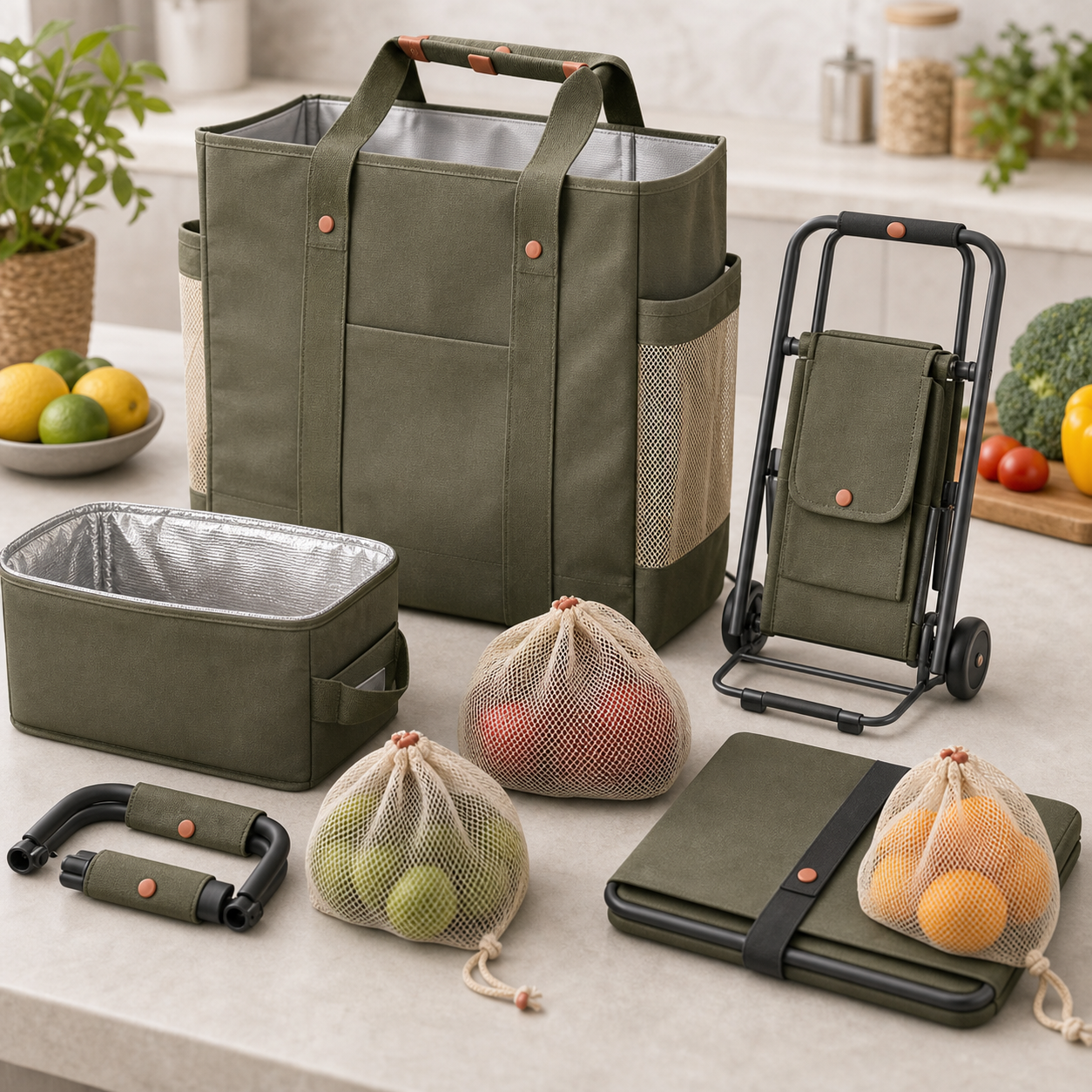
A reusable grocery bag should be specified for repeated carrying and credible care, not just for its folded size or a green-sounding label. Shoppers lift uneven loads, set bags on damp counters and store them folded before the next trip. A buyer who approves only a flat artwork proof can miss handle anchors, uncomfortable grips and wash instructions that do not match the actual fabric.
The KudBo reusable grocery bag set can serve supermarket, gift and home-organization programs, but those channels need different capacities and packaging. An earlier wholesale sourcing guide addresses the category broadly. Here the focus is the repeated lift-and-clean cycle and what evidence supports a claim about reuse or material content. No load, lifespan or recycled-content result is asserted for a specific KudBo model in this article.
Begin with the customer's journey. A person carries groceries in from a store, unloads, wipes or washes the bag and folds it into a pocket or vehicle compartment. Can the product survive and support every one of those ordinary steps? That is a better procurement brief than “premium eco tote,” which gives neither the supplier nor the inspection team a way to distinguish a successful product.
Define a Representative Carry Load
Decide what will actually go in the bag: boxed dry goods, bottles, produce or a mix. Specify the load in mass, shape and distribution for a sample exercise, and distinguish a comfortable recommended carry load from any destructive strength figure. A bottle concentrated at one corner stresses the base differently from the same mass in uniform packages.
The intended carrying method matters. Short handles may work in the hand but not on the shoulder; long handles may drag a full bag near the ground. Test with a person of ordinary reach while observing posture and grip, not with an extreme stunt designed for social media. If the set contains several sizes, each needs its own usable dimensions, handle length and practical load story.
Measure packed volume and empty weight only when they help the decision. A very light, thin bag can be convenient as a spare but may be poor for heavy bottles. A stronger base may add bulk that changes the pocket-size promise. The buyer should choose deliberately rather than treating every tradeoff as a defect.
Inspect Where Handles Transfer Force
Lay out the load path from the hand through the handle, anchor stitching, side panel and base seam. Check whether handle ends are reinforced, whether thread ends are secured and whether a load line crosses a decorative seam. A wide handle can feel comfortable yet fail at a narrow attachment point. One row of sewing visible on the outside is not sufficient evidence of the complete internal construction.
Agree on a finished-bag strength assessment with a competent test partner if the listing will make a numerical load claim. Ask for method, conditioning, sample count, failure description and how the result maps to a recommended user limit. A single bag holding a heavy object for a photograph is not a repeat-use performance result. Some failure modes appear only after lift cycles or laundering.
For an in-house comparison, use identical inert loads, the same carrying distance and several controlled lifts. Photograph handle alignment, seam opening, base shape and any new fraying. This exercise helps choose between samples; do not promote it as independent certification. Mark sample color and production revision because changes to fabric coating or thread can affect the result.
Review Base Shape and Leakage of Small Items
A grocery bag may use a flat bottom, gusset or removable base board. Check how it stands when partly loaded and what happens when one bottle is removed. A removable board can improve shape but may complicate washing or be lost. If the bag is intended for loose produce, inspect holes and seams that could trap dirt or allow small items to escape.
Run a pack-and-unpack sequence with ordinary groceries in a clean sample space. Are corners accessible to wipe? Does the bag collapse into the food as items are removed? Can the user carry two bags without hard hardware striking each other? These are not regulated performance measurements, but they show whether the product fits the chosen channel's daily task.
If a lining or coating is present, ask what it is made of, whether it is food-contacting under the intended use and how it should be cleaned. A grocery bag touching packaged food is not the same as a container intended for direct contact with unpackaged food. Buyers should define the intended contact scenario and seek product-specific material review rather than copying a food-safe claim from another bag.
Make Washability a Verified Instruction
“Machine washable” is a precise practical promise. Test the complete bag through the proposed care sequence and check shrinkage, handle twist, print transfer, base stiffener distortion and drying time. If a removable liner or base board must come out, the instruction must say so before the user discovers damage. A hand-wipe design may be acceptable, but its copy should not quietly imply machine washing.
The FTC's garment care-label resources address covered apparel and certain textiles, not every shopping bag. They are useful for the broader principle that care instructions should be supportable and clear. Confirm the applicable labeling duties for the actual product and destination market. Do not transplant legal obligations from apparel to a bag without review.
Drying conditions deserve the same attention as washing. A coated bag folded while damp may smell or mark, especially after a long storage period. Repack a cleaned, fully dry sample as the consumer would. An instruction that requires an unusually elaborate process should be weighed against the bag's intended low-effort use.
Mid-Article CTA
Send Your Requirements with bag sizes, intended load, preferred wash method, artwork position and sales channel. Email info@kudbo.com to request a model-specific material and sample review. Include any recycled-content wording you plan to use before asking for print proofs.
Treat Environmental Language as a Separate Evidence File
Reusable does not mean zero impact. A bag's benefit depends on material, production and how often it is actually reused; avoid an unsupported claim that one product is automatically better for the environment in every scenario. If the listing says “made with recycled material,” request the material stream, proportion, chain of evidence and whether the claim applies to the bag, handles, packaging or all of them.
The FTC Green Guides give U.S. marketers guidance on qualifying environmental claims. They do not certify a particular tote. Keep supplier statements, purchasing records and any independent verification linked to the finished bag's exact material and revision. A recycling logo on a fiber roll is not proof that the completed multicomponent bag contains the same proportion.
Ask whether colorants, coatings and mixed materials affect a proposed end-of-life or recyclability statement. Do not promise curbside recyclability for every locale without checking the real collection pathway. For many buyers, a more useful consumer message may simply describe the actual fabric composition and how to care for the bag, rather than claiming a broad environmental outcome.
Check Printing and Retail Pack-Out
Print area may change when a bag is loaded. Review artwork on a filled sample as well as on a flat proof; text near a handle seam may distort or disappear. Test color transfer and adhesion after the care cycle the retailer will advertise. If the bag folds into a self-pocket, make sure the printed design and care information remain available when the item is unpacked.
Count every piece of a multi-bag set, including pouch, hangtag and insert. A retailer may sell one large bag plus two small ones; the box should make that mix unmistakable. Use a pack-out photo tied to the SKU so shipment inspection can catch missing sizes before cartons leave the factory. A compact retail sleeve should not hide the handle stitching the customer is meant to inspect.
When planning shipping cartons, protect the bags from dampness and unwanted creasing. A pre-shipment inspection can compare stitching, count, print, dimensions and clean condition with the signed reference. It cannot substantiate a long-term lifetime or environmental benefit unless a distinct test or evidence file actually covers that claim.
| Buyer decision | Practical evidence | Avoid saying |
|---|---|---|
| Carry limit | Finished-bag load method and user fit | “Holds anything” |
| Wash method | Complete-bag care trial | “Machine washable” from fabric alone |
| Material content | Traceable component records | “100% recycled” without composition proof |
| Pack-out | Size and quantity reference photo | “Three-piece set” if parts vary |
Set a Repeat-Use Acceptance Standard
Buyers can make “reusable” more concrete by defining the expected duty cycle. Choose a representative shopping load with a realistic distribution of heavy and light items. Record how the handle feels when carried for a short walk, whether seams twist, and whether the base remains usable when the bag is set down repeatedly. This is a proposed buyer test, not a claim that every model has passed a universal cycle standard. Keep the number of repetitions and failure criteria in the purchase-order specification if the result will support retail claims.
Then repeat after the care process that will be printed on the label. A fabric may carry weight when new but shrink, deform or lose printing after washing. Check handle length and bag opening after drying; a few millimeters may matter if the bag is designed to sit on a checkout fixture. Do not assume that machine washability follows from a textile name. Coatings, inserts and printed inks can dictate the safe cleaning method.
For private-label orders, approve a physical strike-off with the real bag material, not only a digital color proof. Printing over folded seams may obscure a QR code or care message. If an environmental claim appears on a hangtag, file its evidence separately from the load test. Durability supports repeated use, but it does not by itself establish recycled content, carbon savings or an unlimited service life.
Design the Assortment Around Ordinary Shopping
The intended channel shapes the bag specification. A supermarket program may need a wide opening and sturdy base so the bag can be loaded at a checkout. A gift shop may prefer a small foldable pouch that fits in a handbag. A delivery service may need handles that remain comfortable when carried upstairs. Use these use cases to choose dimensions and test loads; one “reusable grocery bag” title cannot tell the buyer which behavior matters most.
Ask for the full folded and open dimensions with the approved fabric, because a thicker lining can change both. Check whether the pouch or closure remains attached to the bag; separate storage sacks are easy to lose. If the bag can stand alone, photograph it under a representative fill, not artificially propped up. If it cannot, describe it as a carry bag rather than making a freestanding claim.
The quote should identify material, handle construction, print method, care label, packaging and minimum order by design. Different colorways can use different dyes and finishing. A buyer should request a wash check on each material/print combination that will be sold, especially if “machine washable” is a central promise. That evidence is more useful than a generic material name.
Frequently Asked Questions
Can a supplier's fabric strength report prove the whole bag's load rating?
No. The complete bag includes handles, anchors, side and base seams. A fabric report is one input, not evidence that the finished product survives a specified carrying task. Request finished-bag testing under a defined method for any numerical claim.
Should reusable grocery bags be washed after every use?
Care depends on what the bag carried and the manufacturer's validated instructions. Buyers should provide clear cleaning directions and examine how consumers will remove visible soil. Do not imply a universal wash cycle or disinfecting result from the fact that the bag is reusable.
Does recycled fabric make the entire set recycled?
Not necessarily. Handles, coating, zippers, tags and packaging may have different compositions. State exactly what component and proportion the claim covers, supported by appropriate records for the finished configuration. Qualify claims according to the target market's rules.
What changes require another sample review?
Fabric weight, coating, handle tape, stitching, reinforcement, print process and base construction can affect use or care. Document proposed substitutions and repeat relevant checks before production approval. A new color may also warrant a colorfastness review if the material or dye process changes.
Is an informal carry trial enough for a weight limit?
No. It can reveal obvious fit or construction issues during sample comparison, but an advertised numerical capacity needs a method and evidence suited to the final product. Record actual trial conditions and use appropriate testing and specialist review where required.
Conclusion
A strong reusable-bag offer combines comfortable carrying, durable joints, honest care and precise material language. Define the shopper's load and wash routine before approving the construction. Keep the bag, print and evidence file aligned through production changes.
Final CTA
For related sourcing questions, browse all buyer guides or the Product Sourcing collection.
Explore the current KudBo product catalog when comparing this guide with available SKUs.
Contact KudBo or email info@kudbo.com with sizes, target quantity, destination and packaging direction. KudBo can coordinate a sample and help identify the material, care and printing questions that need confirmation before your order.