Introduction
How do wholesale buyers review a portable camp shower pump? Start with a controlled buyer brief, not a supplier image. The brief should name the intended customer, destination market, retail channel, exact configuration, packaging direction and the person who can approve a change. This guide explains how to make that work for portable camp shower pumps without treating a factory check, a supplier statement or a sample photo as certification, legal advice or a guarantee of consumer results.
For importers, private-label ecommerce teams, distributors, retail buyers and gift-program buyers, the practical output is a retrievable product file. It should show what was requested, what the supplier supplied, what the sample reviewer observed, and what the final retail unit is meant to contain. That file supports a clearer quotation, factory communication, shipment inspection and future reorder.
Turn the idea into a comparable buyer brief
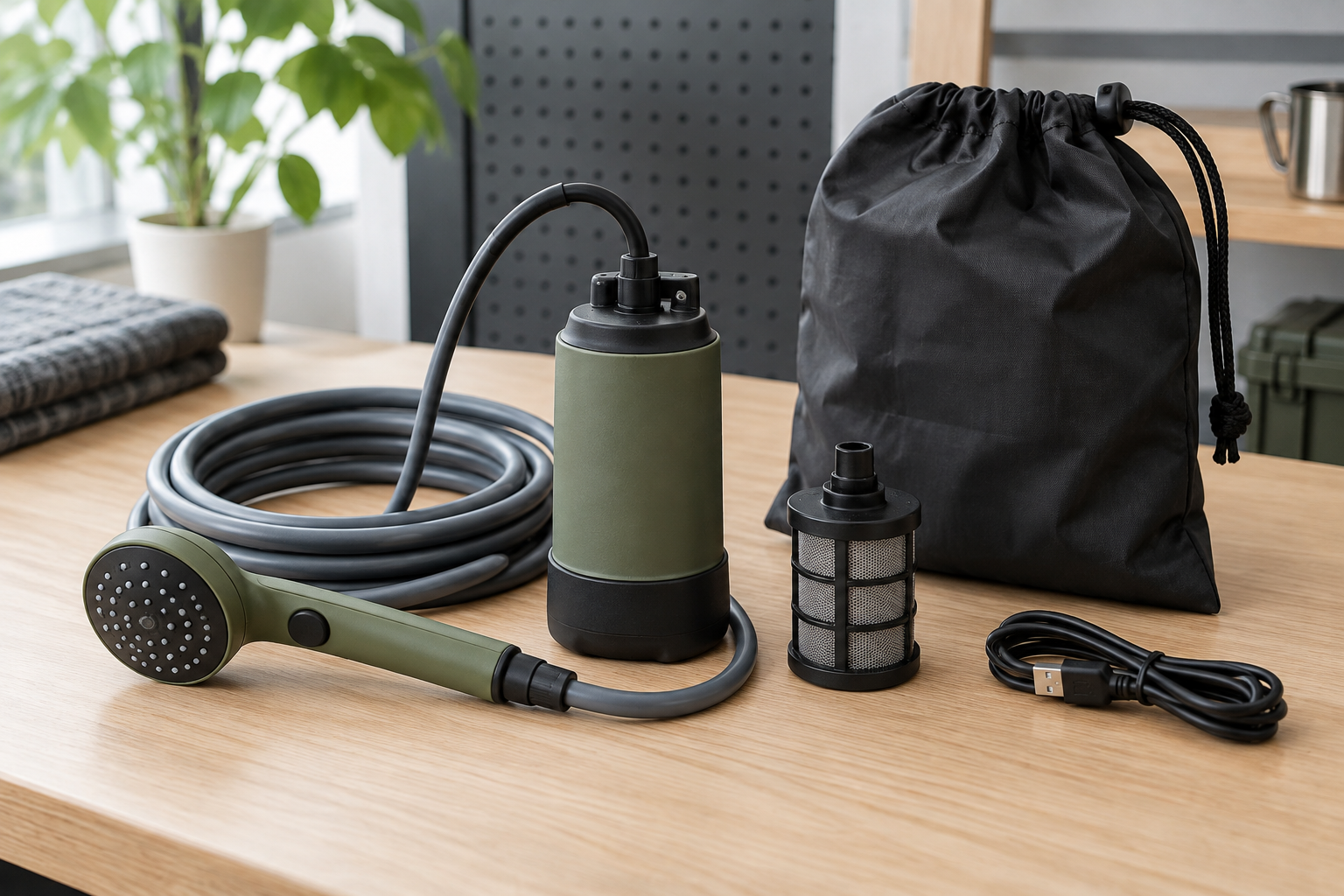
Begin with the customer scenario rather than the feature list. Describe who will open the product, where it will be used, what must be inside the retail unit, what first-use action is expected, how it will be cleaned or stored, and which statement may appear on the listing. For this category, define the pump body, hose, shower head, intake filter, battery or power cable, hanging fixture, storage bag and instructions. Ask the supplier to quote one identified model or revision and to flag any feature that remains provisional. Two quotations cannot be fairly compared if one includes a different accessory, power arrangement or packaging method.
Split the brief into fixed requirements and preferences. Fixed requirements might include a required component, product dimensions, instruction language, intended market, colour, label position and pack-out. Preferences might include an optional colourway or display approach. The separation lets the supplier identify a cost or lead-time effect before it becomes an unrecorded substitution.
Questions to settle before a sample is ordered
- What exact model, material, component revision and accessory count are being quoted?
- Which facts can appear on the carton or product page, and which claims still need product-specific review?
- What customer action should the instruction cover from unpacking through storage?
- Which change requires written approval: material, component, artwork, pack-out, software or sub-supplier?
- What dated reference will the factory and inspection team use at shipment release?
Review a sample in the customer sequence
A presentation sample can look polished while leaving basic handover questions unanswered. Review the same sequence a customer will follow: open the carton, identify the contents, locate the instructions, assemble or prepare the product exactly as written, perform the basic intended action, clean or store it and repack it. Photograph the complete unit, including inserts and accessories. Record observed conditions rather than conclusions that the evidence cannot support.
For an unbranded portable camp shower pump kit with hose, shower head, filter and storage pouch, check whether every piece matches the bill of materials and whether the instructions describe the actual sample. Look for access issues, unclear icons, loose parts, poor fit, missing preparation steps or consumer-facing language that exceeds the available evidence. These observations are useful for sample control. They are not independent tests or proof of compliance.
Keep the reference sample controlled
Label the approved reference with the date, product name, revision and pack-out. Keep it with the signed specification, artwork proof, component list and feedback log. If the supplier proposes a different material, tool, component, finish, cable, insert or carton, open a written change record. State what changes, what consumer communication is affected, what new evidence is needed and who releases it. A visually similar substitute is still a different decision.
Make factory testing and inspection observable
Factory checks have value when they can be repeated and recorded. Define the condition, sample quantity, observation, responsible person and disposition for every important checkpoint. Use simple language such as “accessory count agrees with approved pack-out” or “printed instruction revision matches the release file.” Avoid broad words such as “premium,” “safe,” “universal” or “fully tested” unless the exact support for them has been reviewed separately.
At pre-shipment inspection, compare selected production units and cartons with the dated reference. Inspect appearance, included items, visible assembly, labels, instructions, carton marks and the agreed basic function under the stated condition. If a difference appears, note the lot, the scope observed, photo evidence, possible consumer impact and corrective-action owner. An inspection checks agreement with a defined reference; it does not create certification or erase unresolved requirements.
| Review area | Buyer question | Evidence to retain |
|---|---|---|
| Product identity | Is the model and component set the version approved? | Dated sample photos and component list |
| Consumer handover | Can a first-time user identify, prepare and store it? | Instruction proof and review notes |
| Pack-out | Are all stated items, labels and inserts present? | Pack-out drawing and carton photos |
| Change control | Was every material or component change approved? | Change register and buyer decision |
Control claims, instructions and images together
The carton, marketplace listing, product images and leaflet combine into one message. Keep a claim inventory with the exact wording, location, market, evidence owner and approval status. General guidance from the FTC and consumer-product authorities helps a buyer ask better questions; it does not approve a specific SKU. Do not turn a feature into a health, safety, environmental, compatibility or performance promise unless the finished configuration and applicable evidence support that wording.
In everyday buyer work, the safer and more useful approach is specificity. Name the component, included accessory or care step that has been approved. Do not imply an outcome that has not been evaluated. If information remains open, remove or qualify the proposed phrase before artwork is frozen. This reduces the chance that a later component change leaves a strong claim on a carton with no clear basis.

Mid-Article CTA
Send Your Requirements. Review the KudBo product catalog, compare related buyer sourcing guides and product-sourcing topics, or email info@kudbo.com with your target market, sales channel, quantity, product configuration and packaging direction. KudBo can help organise a sample brief, factory communication and an approval checklist.
Build a release file before mass production
The release file should be usable by someone who was not on the supplier call. Include the approved sample photos, model and component list, artwork PDFs, language versions, carton marks, instruction revision, pack-out sequence, inspection checkpoints and escalation contacts. Put all open items in a short exception log with an owner and decision date. “Resolved” should point to the final evidence, not merely to a chat message.
Before release, run a retrieval exercise. Ask a colleague to locate the product revision, the full included-item list, the final artwork, the specific consumer instructions and the decision for any proposed substitute. If that cannot be done quickly, the program relies too heavily on personal memory. The factory may assemble the product, but the buyer needs to own the consumer promise and the destination-market decision.
Product application and installation preparation
Review the product where it is meant to be used. Note the surface, water, power, storage, cleaning, assembly or accessory conditions that affect a first-time user. This is especially valuable for imported consumer goods because a studio photograph does not show what happens when the product reaches a real household, vehicle, campsite or retail counter. Translate any meaningful condition into a clear instruction or a point for the sample review.
Use factory photos honestly. A photograph can show that staff inspected a visible detail or packed a component on a given day. It cannot establish a test result, certification, customer delivery, safety outcome or market authorization. Captions should explain the scene without adding claims the image cannot prove.
Compare supplier evidence before comparing price
Unit price is meaningful only when the buyer can identify the retail unit behind it. Place quotations in a comparison sheet beside the model reference, component list, accessory count, sample stage, packaging, production lead time, artwork scope and any documentation the supplier says it can provide. Ask each supplier to identify assumptions rather than silently accepting different configurations under a common product name. A higher number may include a different power option, a more complete pack-out or a controlled component; a lower number may simply describe a smaller or less defined unit.
Evidence quality deserves its own column. Useful supplier records connect a document or photograph to the exact sample revision: a dated material statement, a labelled component image, an artwork proof, a packing illustration or a factory-record template. The buyer does not need a vast archive before the order begins. The goal is a small body of evidence that lets the team distinguish a known fact, a supplier proposal and an unresolved question. If a supplier cannot identify the revision attached to its own information, ask for clarification before consumer copy is approved.
Prepare the inspection team early
Give the inspection team a one-page task sheet before goods are close to completion. It should show the approved reference photographs, model identity, expected pack-out, carton marks, visible checkpoints and the escalation contact. A concise sheet is more useful than a long generic quality policy because it directs attention to the features that would change the consumer experience. For example, it can ask the inspector to verify the relevant accessory is present, the instruction is the approved revision, and the retail carton presents the correct configuration.
Set a decision rule in advance. Some variation can be cosmetic and may be acceptable within an agreed limit; a changed component, omitted safety or care information, wrong instruction, missing accessory or unsupported claim needs a buyer decision. Record the issue without guesswork, then decide whether to contain the affected lot, correct it, obtain further information or hold release. This process is not adversarial. It gives both buyer and supplier a shared way to resolve a concrete problem while the goods are still under control.
Plan the repeat order while approving the first one
The first order produces practical knowledge that should not disappear when the shipment leaves the factory. Retain the approved sample, final bill of materials, artwork, carton dimensions, production observations, inspection report and any corrective action in one SKU folder. After launch, classify questions from retailers or consumers: missing component, unclear instruction, fit, care, damage, setup or claim confusion. A pattern can then be traced back to the relevant stage of the buyer brief rather than treated as a series of isolated support cases.
Before the repeat order, compare the requested configuration to the original release set. Ask the supplier directly whether any material, component source, process, packaging supplier or instructions have changed. If the answer is yes, identify the customer-visible effect and reopen only the relevant sample or document review. This is more efficient than restarting every approval, and safer than assuming a product with the same name is identical. Clear change control gives an importer a practical route to continuity without promising that a general product category is risk-free.
Frequently Asked Questions
What should buyers confirm before ordering?
Confirm the exact product revision, materials and components, intended customer scenario, included accessories, package, instructions, sample status, claim wording, change-control rule and target-market requirements. Compare all of them to the supplier quotation before production is released.
Is a factory check the same as certification?
No. A factory check can document an agreed production observation. It does not replace independent testing, regulatory assessment, certification or specialist advice when any of those are required for the finished product and market.
How should a buyer compare suppliers?
Compare the complete retail unit and evidence quality, not only a unit price. Look at model identity, components, pack-out, sample lead time, production lead time, written change control, documentation and the supplier’s willingness to identify limits early.
What should be checked during shipment inspection?
Compare selected units and cartons to the approved reference for visible construction, included items, labels, instructions, packaging, carton count and agreed basic checks. Record the scope inspected and contain meaningful mismatches before shipment release.
When should a buyer pause release?
Pause when a difference changes product identity, consumer instructions, included parts, artwork, claims, required documentation or the agreed function. Determine the affected lot and corrective action before deciding whether the goods can move.
Official sources and responsible buyer questions
For this program, use the first official reference, consumer-product business guidance and advertising or product-specific guidance as starting points. They explain general principles and do not replace the product-specific, market-specific work that an importer must complete. Keep dated links, supplier documents and the final decisions in the product file.
Conclusion
Reliable sourcing begins with a clear customer scenario and a sample that can be traced to a written specification. Define the retail unit, observe the real first-use sequence, make factory checks repeatable, control substitutions and keep claims within the evidence available. This does not remove every sourcing risk, but it makes the decisions visible while they can still be managed.
Final CTA
Ask for a Product Sourcing Plan. Browse the KudBo catalog, visit the contact page, or email info@kudbo.com with the product, destination market, quantity, retail channel and launch timing. KudBo can help structure sample requirements, packaging inputs, factory communication and shipment inspection.