Introduction
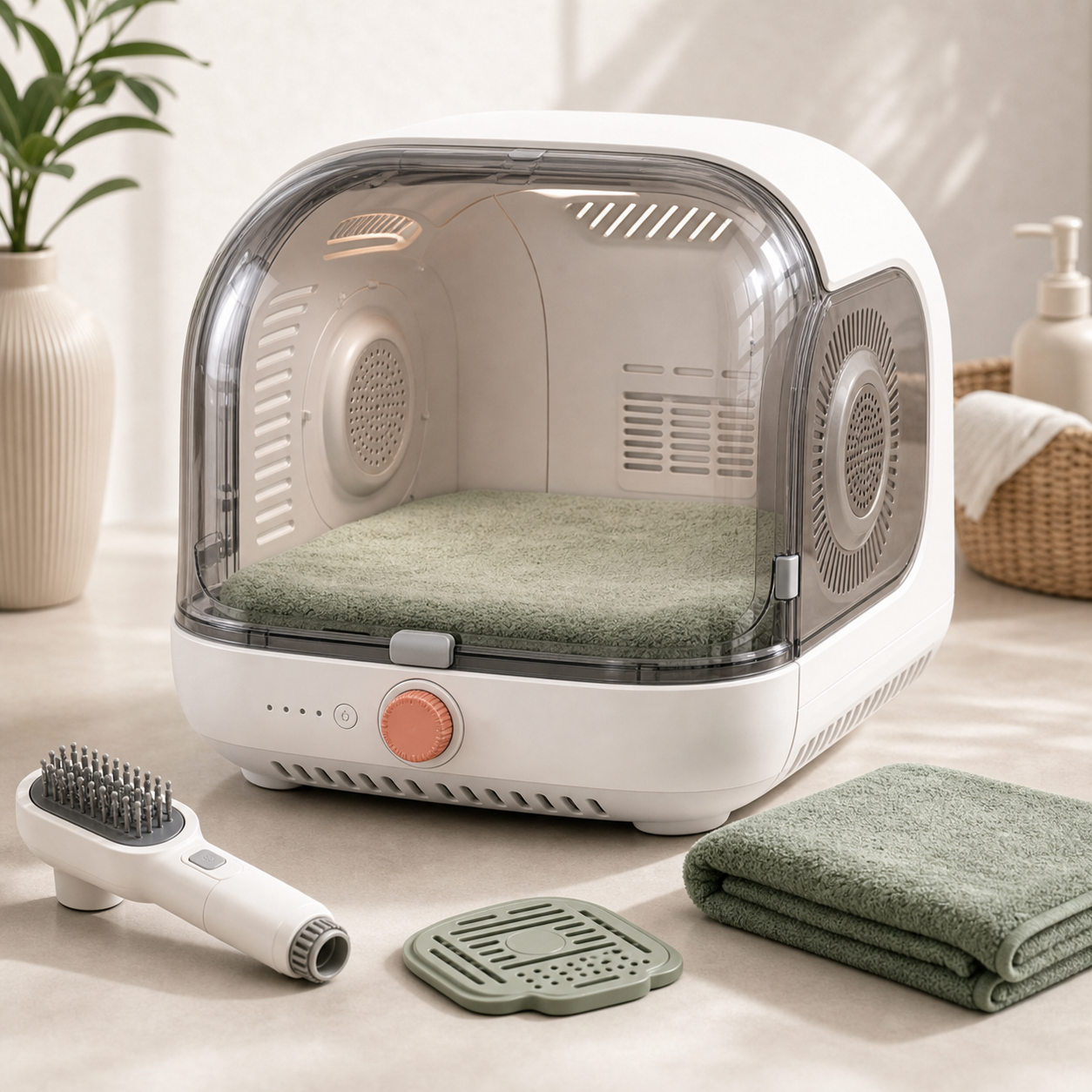
A pet drying box should be bought as a controlled drying environment, not simply as an attractive enclosure with a fan. Air must reach the intended coat surfaces without trapping heat, blocking an animal's exit or leaving damp areas difficult to clean. For a wholesale buyer, the first useful question is what the exact model can do under a defined setup, not how many modes are printed on a display.
An enclosed dryer belongs in a different decision set from the KudBo pet grooming vacuum brush. One affects the animal's whole environment; the other is a handheld grooming accessory. For handheld options, see the grooming noise and filter guide. This guide treats enclosure suitability, cleaning and evidence as separate purchasing decisions, not as a listing for a confirmed KudBo dryer model. It is not veterinary advice, a test report or a statement that every available model is suitable for every pet.
That distinction matters when a distributor sells into grooming salons, pet shops and direct-to-consumer channels. The operator in each setting may have different supervision, cleaning time and access to qualified animal-care advice. A credible specification states the intended animal size, restrictions, operating method, power arrangement and instructions for stopping use. A photograph of a relaxed pet cannot establish any of those requirements.
Begin with the Intended Animal and Operator
Write the intended user and animal profile before requesting samples. Is the product for a supervised grooming salon, an experienced household owner or a display-led retail range? Record the allowed animal size and condition only where supported by the final instructions. Do not infer suitability from the opening dimensions alone: turning space, standing height, coat density, drying stage and sensitivity to noise or heat all affect the experience.
The American Veterinary Medical Association's warm-weather guidance reminds owners to recognize heat-stress risks and seek veterinary guidance for vulnerable animals. That guidance is broader than drying equipment; it is a reason to avoid marketing an enclosed heater as universally comfortable. Buyers should ask a veterinarian or qualified animal-care professional to review the intended-use instructions and exclusions for the specific configuration.
The operator must be able to observe the animal and end a session promptly. Ask how the door opens during ordinary use and after a power interruption. Review latch force and the possibility of accidental closure while cleaning. A display that looks intuitive to a purchasing team may be confusing to a first-time owner who is also managing a wet, unsettled pet.
Map Airflow Rather Than Trusting a Fan Rating
Airflow at a free fan outlet is not the same as distribution inside a loaded chamber. Mark each inlet, outlet, return path and removable obstruction on the exact model. Ask where air goes when a towel or a long coat partially covers a floor grille. The buyer needs to know whether air can circulate without a single concentrated jet on the animal's face, and whether filters or mesh screens change flow as they collect fur.
A useful bench review starts empty: run the unit through its available settings according to its instructions, observe airflow at several chamber positions and note the operating noise without pretending the result is an accredited acoustic measurement. Follow with a defined inert load that represents the space taken by a pet; do not place an animal in an unapproved prototype. Record the ambient conditions, sample revision and measurement locations. Repeat the check after reassembling any removable panel.
If the supplier provides a numerical airflow claim, request its unit, test method, tolerance, operating mode and whether the value was measured at the fan, vent or finished enclosure. A factory test of electrical function may confirm that a fan starts; it does not prove comfortable distribution throughout the animal space. Demand the right evidence for the actual statement proposed on packaging.
Separate Temperature Setpoint from Chamber Behavior
What a controller displays, what a sensor sees and what an animal experiences can differ. Ask where temperature is sensed, how quickly the system responds, what happens if an inlet is blocked, and how heating stops if a sensor or fan fails. A buyer can commission model-specific electrical and thermal assessment from competent specialists; a quick showroom demonstration does not replace it.
Prepare a review matrix covering start-up, steady operation, mode changes, door opening, blocked or dirty filters and power return. Do not invent a universal safe temperature threshold for all species, coat types and health conditions. Instead, require the manufacturer to define operating limits and have qualified animal-care and safety reviewers judge the actual use case. The worst case may be a warm room with a long session, not a cool laboratory bench.
Ask whether the product relies on a timer, a temperature cutoff, operator presence or a combination. A timer alone cannot detect distress. The instructions should make supervision and stop conditions explicit, and the device should not imply that an owner can leave an animal unattended merely because a countdown is running. Note every assumption the control strategy makes about room ventilation and power supply.
Review Exit, Visibility and Noise as One Experience
The animal's ability to move and the person's ability to intervene deserve a physical check. Open and close the door repeatedly with the enclosure on its intended surface. Check edges, hinges, fasteners, viewing windows and the position of any leash point. Any restraint or confinement guidance needs specialist review; do not invent a default restraint practice for a retail article.
Run a controlled human-observation exercise with no animal first. Can the operator see into the chamber from the likely position? Is the control legible while the door is open? Can a user stop the unit without navigating several menus? Is there a clear indication of the active heating and fan state? These are practical usability questions, separate from regulatory testing.
Noise should be recorded with a stated distance, background and mode if quoted. An unspecified decibel number is weak evidence, especially when measurements from different rooms or distances are compared. For a salon, distinguish product noise from dryers and conversation already present. For a home, test the unit in the kind of room in which it will actually sit.
Make Cleaning Access Part of the Quotation
Wet fur and water contact make cleaning design central to ownership. Remove the tray, screen and any washable insert using only the supplied instructions. Look for inaccessible corners, exposed electrical openings, sharp edges and parts that are easy to reinstall incorrectly. Photograph the condition before and after an ordinary cleaning sequence. A clean studio image does not show whether a user can reach the fur trapped behind a grille.
The CDC's pet-supply cleaning guidance distinguishes routine cleaning from additional disinfection and tells owners to follow product instructions. Apply that principle narrowly: ask for approved cleaning agents and water exposure limits for the exact dryer. Do not claim a tray is dishwasher-safe or a chamber can be hosed down unless the manufacturer has documented and validated those instructions.
Check whether drying the cleaned components before reassembly is required, and whether a damp filter affects airflow. Replacement filter availability and a clear part identifier are more useful to a distributor than a vague statement that the unit is easy to maintain. Record a sample cleaning time only as a test result with stated conditions, never as an assumed universal claim.
Mid-Article CTA
Send Your Requirements with the target animal size, sales market, operator setting and cleaning expectations. Email info@kudbo.com for a model-specific sample and documentation discussion. Include any requirement for removable parts and service inventory before requesting a price.
Ask for a Model-Specific Evidence Pack
The reference pack should identify the exact model, hardware revision, supplied power components, instructions, filters and intended use. Request available electrical and product-safety documentation relevant to the destination market, then have the importer or its qualified adviser determine applicability. A report for a neighbouring model is not automatically transferable. A photograph of a test bench is evidence of a scene, not of a pass result.
Use three evidence labels in the purchasing file: supplier statement, observed sample result and independent or specialist assessment. Keep each claim tied to one of them. For example, a visibly removable tray is observed; a temperature-limit claim requires an appropriate measurement and method; suitability for a particular animal may require specialist judgment. This simple separation prevents marketing copy from gaining authority just because it appears in a supplier slide deck.
When a sample changes, repeat the affected checks. A new fan, heater, door or filter can alter airflow, noise, heat behavior or service instructions. Ask who authorizes such substitutions, how affected reports are evaluated and which revision appears on the production label. The signed sample should not become a floating reference with no date.
Design a Responsible Sample Review
A staged review protects both purchasing decisions and animals. First inspect the packed unit: count parts, verify electrical markings, read the manual and check transit damage. Second run bench functional observations with no animal. Third commission any necessary safety or animal-care review before any supervised real-world use. Do not use a live animal to discover a basic control or heat problem that could have been found earlier.
Record the room temperature, configuration, mode, duration, sensor locations, filter state and person conducting the review. A disagreement about an outcome is then traceable. If an unusual smell, unexpected stop or inaccessible hot area occurs, stop and investigate rather than averaging the issue away over several runs. A pass/fail sheet without conditions is hard to interpret when orders arrive months later.
The review should also cover unpacking and first-use comprehension. Give the draft instructions to someone unfamiliar with the sample. Can they locate all air vents, prepare the tray, set the mode and stop operation? Note where they pause or improvise. This is a usability evaluation, not a substitute for formal compliance testing, but it often exposes avoidable customer-support burden.
Compare Total Ownership, Not Only Unit Price
A low initial price can conceal a short filter life, fragile door latch or unavailable tray. Ask for part names, replacement prices, minimum-order quantities and realistic lead times. Decide how a retailer will support a customer who loses a filter or breaks a tray without ordering an entire new enclosure. Do not promise future spare availability until it is included in a written supply arrangement.
Estimate the space the packed unit occupies, the protection needed for its door and control panel, and the cost of returns after transit damage. A factory's pack-out check can confirm that the agreed components are present; a shipment inspection can compare production units to a signed reference. Neither proves animal comfort or long-term reliability by itself. Keep those evidence streams separate.
| Buyer decision | Question to resolve | Suitable evidence |
|---|---|---|
| Intended use | Which animals and operators are included? | Final manual and specialist review |
| Air and heat | What happens across defined modes and fault conditions? | Method-specific finished-unit results |
| Cleaning | Can ordinary users remove, wash and refit parts? | Observed sample sequence and instructions |
| Service | Can a retailer obtain the exact replacement parts? | Part list, terms and approved revision |
Frequently Asked Questions
Is a larger enclosure always safer for a pet?
No. Interior size is one factor, but airflow distribution, operating control, supervision, access and the actual animal matter too. A larger empty chamber may still have poorly placed vents or an awkward door. Confirm the intended animal profile and have qualified reviewers assess the exact model and instructions rather than treating volume as a safety certificate.
Can a fan specification prove the chamber dries evenly?
No. A free-air fan rating does not establish what happens inside a chamber containing an animal, tray and filter. Ask where the rating was measured and inspect airflow at several positions on a finished sample under stated conditions. Avoid promising a uniform drying time without a defined and appropriately reviewed test.
Should buyers run a live-animal trial on the first sample?
Start with packaging, electrical, control and empty-chamber checks. If a real-world trial is appropriate, it should follow model-specific safety review, welfare advice, clear stop criteria and continuous supervision. This article does not prescribe a trial protocol or assert that every animal can use an enclosed dryer.
What parts should a retailer quote separately?
Request a list for filters, trays, door hardware, power components where replaceable and any approved cleaning accessories. Match each part to the exact hardware revision. Ask about supply terms and customer-facing instructions; a generic photograph of an accessory does not confirm cross-model compatibility.
Does a factory inspection prove welfare suitability?
No. Inspection can check a defined production sample against an approved reference for visible construction, pack-out and agreed routine functions. Animal comfort, medical exclusions and suitability require other evidence and qualified judgment. Keep the inspection report within the scope it actually covered.
Conclusion
The sound wholesale decision is an evidence-backed pairing of intended use, airflow, heat controls, access and cleaning. Treat the enclosure as a supervised animal-use product, not a generic appliance with a pet photograph. Approve the exact revision and retain a clear route for service parts and change control.
Final CTA
For related sourcing questions, browse all buyer guides or the Product Sourcing collection.
Explore the current KudBo product catalog when comparing this guide with available SKUs.
Contact KudBo or email info@kudbo.com with your market, quantity and sample-review priorities. KudBo can discuss available pet-product options and organize a supplier evidence request; model-specific safety and animal-care decisions remain with qualified reviewers.