
Introduction
Ocean shipment moisture control starts with dry products, dry packaging and a documented loading process. Desiccants, barriers and container measures can then address the remaining exposure. They cannot reliably compensate for wet cartons or poorly dried goods. Buyers should select protection for the actual material, shipping route, storage period and receiving conditions, then agree what evidence will support release and arrival inspection.
For fabric accessories, paper gift boxes and mixed-material consumer products, moisture damage may show up as staining, odor, corrosion or weakened packaging. A product does not need to be visibly soaked to create a customer complaint. This guide sets out a purchasing workflow for importers and distributors, with proposed checks rather than claims that a particular KudBo shipment has passed testing.
Identify What Needs Protection Before Buying Desiccant
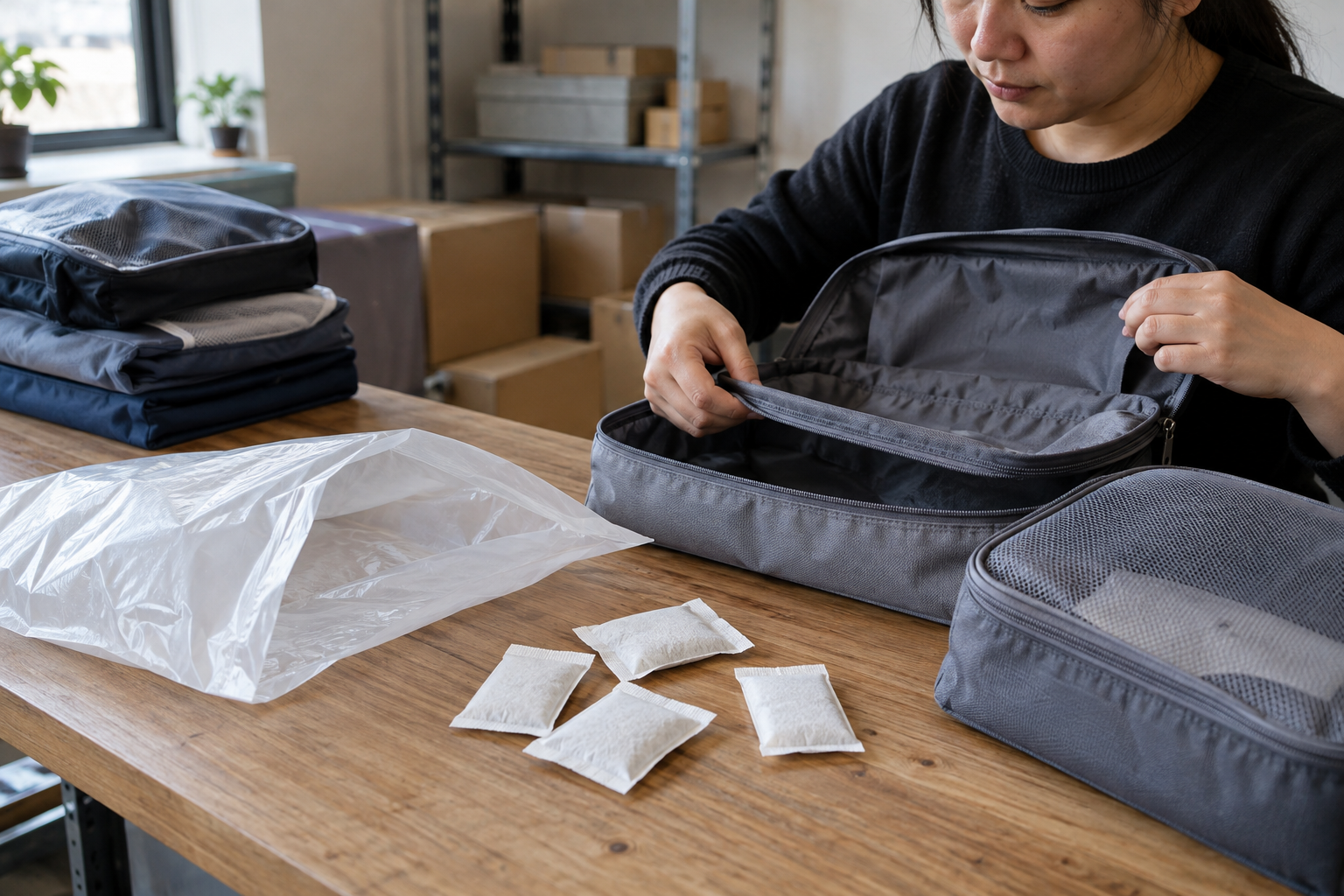
List the materials in the product and its complete packaging. Fabric, paperboard, metal fittings, coatings and adhesives may respond differently to the same environment. For a compression packing cube range, inspect the fabric, zipper hardware, printed insert, protective bag and master carton as separate items. A clean textile sample does not establish that its final carton and instruction card were dry when packed.
Ask the supplier where moisture could enter the process. Washing, printing, coating, storage near an open loading door and movement between rooms deserve attention where relevant. The useful response is a process description with hold points and records. A statement that the factory always uses moisture protection leaves the buyer unable to compare alternatives or investigate a later problem.
Describe the Journey, Including the Last Warehouse
Record the origin warehouse, loading location, expected transport stages, possible transshipment, destination season and storage arrangements. Treat schedule estimates as planning assumptions, not guaranteed exposure limits. A delayed container or an unconditioned receiving warehouse can change the problem even when the ocean route remains the same.
Include the final opening step. If a package will remain sealed until retail sale, the barrier must remain practical throughout that period. If a distributor opens cartons immediately, inspection and resealing procedures matter. Procurement should share this information with the packaging specialist before asking for a desiccant quantity or bag specification.
Understand the Difference Between Moisture Sources and Barriers
The UNECE CTU Code provides a primary reference for container packing and condensation risk. Moisture can be carried into a container by cargo, packaging and loading conditions. The buying implication is to control what enters the load as well as what surrounds it. Adding protection at the last minute leaves upstream moisture sources unresolved.
A protective bag creates a boundary only to the extent supported by its material and closure. An open bag, a punctured liner and a properly sealed barrier are different systems. Request the relevant material specification, closure method and compatibility information. Avoid treating the word waterproof on a quotation as a substitute for a defined package construction and an agreed exposure evaluation.
Keep Product-Level and Container-Level Measures Separate
A sachet inside an individual pack protects a different space from a container-level absorber. Neither automatically substitutes for the other. The right combination depends on moisture loading, barrier performance and the planned distribution environment. Have the selected provider explain the assumptions behind its recommendation, including the consequences of a broken seal or an extended storage period.
Do not publish a universal sachet count for every carton. A quantity that is reasonable for one material and package may be inappropriate for another. The RFQ should ask for a justified proposal, identification of the absorber material, safe placement, containment and removal instructions where necessary. Product safety and material compatibility remain part of the decision.
Compare Three Practical Packaging Approaches
Start with the least complex system capable of meeting the requirement, then validate it. More layers are not automatically better if they trap moisture, obscure inspection or complicate unpacking. Cost comparisons should include packing labor, material identification, disposal instructions and the ability of warehouse staff to reproduce the approved method.
| Approach | Useful question | Approval evidence |
|---|---|---|
| Dry handling with ordinary protective packaging | Is the expected environment compatible with the material? | Documented drying, storage and route assessment |
| Product barrier with suitable moisture control | Can the specified closure be repeated reliably? | Complete pack specification and representative evaluation |
| Additional container-level measures | What remaining load exposure is being addressed? | Loading plan, placement instructions and receiving records |
These approaches can be combined, but each should have a stated purpose. For example, a product bag may reduce direct contact with a damp carton while doing little to address moisture already enclosed with the goods. That is a reason to review the process, not simply to choose a thicker bag without evidence.
Build a Sample Evaluation Around the Actual Pack
Send the packaging laboratory or technical provider the complete proposed configuration. Include the real product, inserts, closures, carton and any absorber. Identify the intended distribution path and the concerns that prompted the review. A test performed on an empty bag does not establish the performance of a packed product with seams, sharp hardware and changing storage conditions.
The ISTA guidance on ocean shipments highlights hazards beyond a simple ocean vibration profile, including humidity, temperature, handling and stacking. Use that guidance to discuss a suitable evaluation with the laboratory. Do not describe a generic parcel test as a complete simulation of an ocean journey or claim certification from a planning exercise.
Agree Observable Acceptance Criteria
Write what will be examined after evaluation: package integrity, visible staining, corrosion, label legibility, adhesive condition and product function as applicable. Where odor matters, define the assessment procedure and decision owner instead of using an undefined instruction such as no smell. Separate cosmetic acceptance from any safety-related concern that requires specialist investigation.
Retain an unexposed comparison sample from the same preparation batch where practical. Photograph the packing arrangement before closing it. Record material versions, sample conditioning, observation timing and deviations. These records help distinguish a packaging weakness from a mismatch between the tested sample and the production pack.
Mid-Article CTA
Planning an ocean shipment of fabric accessories or mixed-material gift products? Send Your Requirements with the product list, destination, expected storage period and current packaging proposal. KudBo can discuss sample preparation and packing coordination; the final moisture-control specification should be supported by evidence for your actual shipment conditions.
Make Dryness a Release Check, Not an Assumption
Decide which observations or measurements are needed before packing, who performs them and where records are stored. If an instrument is used, identify its suitability for the material and the method. A reading from one material should not be interpreted through an unrelated material setting. Define escalation for unusual results rather than letting operators repeatedly measure until they obtain a favorable value.
Move approved goods into a controlled holding area appropriate to the material. Keep cartons away from direct floor moisture and visible leaks. Define how exposed packaging is handled after interruptions. If packing stops during rain or a storage incident, the restart decision should follow the agreed procedure rather than the original schedule alone.
Control the Time Between Preparation and Closure
An approved preparation step loses value if the product waits in an unsuitable area before sealing. Record the sequence and any permitted holding conditions. Packaging staff should know when a pack must be reassessed because it was opened, delayed or exposed. Avoid assuming that the same preparation remains valid indefinitely.
Treat absorber handling similarly. Ask the provider how unused material should be stored and when it should be inserted. Include checks for damaged sachets, incorrect placement and interference with the product. The buyer should be able to identify the approved material from purchasing records without relying on a generic appearance.
Plan Container Loading and Receiving Together
The loading team needs a written checklist covering visible container condition, cleanliness, dryness, appropriate load arrangement and the approved protective measures. Keep dated photographs linked to the shipment reference. Loading photographs can document visible conditions; they do not prove the condition of every enclosed product or establish how the environment changed during transit.
Discuss load arrangement alongside the palletized versus floor-loaded shipment decision. Access for inspection, carton support and warehouse handling may change when the loading method changes. Review moisture protection at the same time rather than treating it as a separate purchasing line that remains fixed through every logistics revision.
At destination, specify who checks the container and cartons before goods are dispersed. Record arrival condition, affected locations, packaging versions and the point at which packages are opened. If suspicious moisture, staining or odor appears, isolate affected stock and obtain appropriate technical advice before sale. Repacking should not erase the evidence needed to understand the problem.
Use a Hypothetical Comparison to Improve the RFQ
Consider two proposed offers for the same textile organizer. Offer A includes an ordinary bag with an unspecified sachet. Offer B includes a defined barrier, documented closure process and a moisture-control proposal with stated assumptions. This example does not establish that B performs better. It shows why the offers cannot be compared using unit price alone: their evidence and process definitions differ.
Ask both suppliers to quote against one common brief. Require separate costs for packaging materials, preparation, evaluation and loading measures. If either supplier excludes a step, make the exclusion visible. The buyer can then compare a complete system and decide which unresolved assumptions need further work before ordering.
For mixed-category orders, use the KudBo product catalog to identify product families that may need different packing specifications. A shared outer carton does not mean every item should receive the same internal protection. Grouping by material and exposure can produce a clearer validation plan than assigning one rule to the entire purchase order.
Prepare a Receiving and Improvement Record
Create a simple record with shipment reference, product lot, carton location, observed condition, photographs and disposition. Include whether the package was unopened when the issue was found. This prevents later discussion from mixing transport observations with damage introduced during repacking or storage.
Where monitoring devices are proposed, agree their purpose and interpretation before loading. A single location may not represent the entire container. Recorded conditions can support an investigation, but their relationship to product damage must be evaluated. Do not promise that a logger or indicator prevents moisture exposure simply because it records or signals a condition.
Review actual receiving observations before the next order. Keep successful specifications under version control and investigate failures before changing multiple variables at once. If a route, season, material or closure changes, reassess the relevant assumptions. A repeat order deserves a repeatability check even when the product name and supplier remain unchanged.
Turn the Packing Proposal Into a Responsibility Matrix
Put each step beside a named owner: product preparation, packaging storage, absorber supply, sealing, container checks and destination inspection. Identify the record that proves the step occurred and the condition that stops release. This is especially useful when the product factory, packing service and freight provider are separate businesses. Otherwise, each may assume another party checked the same critical condition.
Ask who pays for a reassessment if goods wait longer than planned before loading. Also agree how opened cartons are handled after a random inspection. The protection system may need restoration before the carton is released. A practical instruction should explain which materials can be reused, which must be replaced and who confirms the restored pack matches the approved configuration.
Keep a short exception log. If the scheduled container is unsuitable or loading is interrupted, record the event and the decision made. A replacement container or delayed departure is not automatically a moisture failure, but it can change assumptions behind the plan. Written exceptions let the receiving team interpret the shipment history without relying on memory.
Finally, agree the information required for a supplier investigation: original packaging, affected quantity, lot references, location within the load and dated arrival observations. Do not set an arbitrary commercial remedy before understanding the cause. A useful agreement creates a prompt evidence-sharing process and separates stock disposition from later responsibility discussions. That helps both parties protect the goods and make a sound next-order decision.
Frequently Asked Questions
Can desiccant fix packaging that is already damp?
Do not approve it on that assumption. First identify the moisture source and determine whether the product and packaging are suitable for packing. Absorber selection depends on the system and exposure. Damp materials can exceed the assumptions behind an otherwise reasonable proposal and should trigger a documented review before shipment.
Is a sealed plastic bag always the best option?
No. A bag must be selected with its barrier properties, closure, product compatibility and enclosed moisture in mind. It may trap moisture introduced during packing. Compare the complete packaging system and its opening process, then obtain evidence for the chosen construction rather than relying on a material name.
Should every product in a mixed container use the same protection?
Not necessarily. Textile items, metal accessories and paper gift packaging can have different vulnerabilities. Create material-based groups and assess their exposure. Shared container measures may complement individual packaging, but each product family still needs a suitable specification and a clear receiving inspection plan.
What should a buyer request from the moisture-control supplier?
Request the recommended material and quantity, the assumptions supporting that recommendation, placement and containment instructions, storage requirements and compatibility limits. Provide product, packaging and route information. Ask how delays or opened seals affect the proposal and identify what evaluation is needed before relying on it.
Does successful sample testing guarantee a damage-free shipment?
No. Sample evaluation supports a decision within defined conditions. Production variation, handling, delays and unexpected environments can differ from those conditions. Use testing alongside controlled packing, shipment inspection and receiving records. Keep the tested configuration identifiable so that production can reproduce it and changes can be assessed.
Conclusion
Effective ocean shipment moisture control is a purchasing and handling system. Start with material vulnerabilities, control moisture before closure, specify each protective measure and evaluate the complete pack. Connect factory release to destination inspection so the next order benefits from actual observations. This produces a more defensible decision than adding an unspecified absorber to every carton.
Related Buyer Resources
Continue with the KudBo buyer blog and product sourcing collection, or use the sourcing enquiry section to describe the application and approval evidence you need.
Final CTA
Get a Quote or contact KudBo with your product categories, order quantity, destination and moisture concerns. Ask for a coordinated review of samples, packaging options and shipment preparation. Clear customer requirements help establish which evidence and packing decisions are needed before the order is released.