Introduction
A tidy meeting summary can conceal missed speakers, wrongly attributed decisions and incomplete action items. The KudBo AI meeting note button is described as a tool for marking meeting moments, actions and follow-ups. Buyers should not infer its recording architecture, cloud processing or supported languages from that short description. The first procurement question is whether it captures usable audio in the rooms where it will actually be used.
The privacy documentation guide covers broader records questions. This article proposes a pilot that links microphone position, consent, transcript review and action-item acceptance. The suggested protocol is not a claim about KudBo transcription performance. The final workflow must match the actual device, software and the customer's legal obligations.
Choose Representative Meetings, Not an Ideal Demo
Select at least three controlled meeting conditions: a small quiet room, a larger table where speakers sit farther away and a hybrid call where some participants are on a laptop speaker. Use volunteer participants who consent to the test, and prepare a short scripted agenda with known names, numbers and action assignments. Real names are not necessary; neutral labels reduce privacy exposure. If the device supports no recording feature itself, revise the pilot around the actual supported capture method rather than inventing one.
Place the button where the supplier instructs, then note the distance and orientation of each participant. Repeat the short test with the device at a different plausible location. A microphone near a noisy laptop fan or a cup can perform differently from one near the center of the table. Record background noise and whether a participant turned away while speaking. These contextual notes matter more than an unsupported universal accuracy percentage.
Do not judge only whether the prose reads smoothly. Mark a reference transcript for decisions, owners, deadlines, negations and uncertain statements. A system that changes “do not ship” into “ship” creates an operational risk far beyond a missing filler word. Review outputs against the agreed reference, classify errors and decide which require human confirmation before a summary is shared. If the service creates speaker labels, test whether they are genuinely reliable or should be omitted in the customer workflow.
Define an Acceptance Rule for Action Items
Before running the pilot, choose observable criteria: are action items captured, is the owner correct, is the deadline correct, and does the system distinguish a proposed action from an approved one? Decide what the human reviewer must sign off. A tool can still be useful when it drafts notes for review; the problem is promising a final record without an appropriate approval step.
If button presses mark moments, test the timing behavior. Press during a key sentence, before a decision and after a follow-up assignment. Determine how those markers appear in the output and whether users can correct or delete them. Test a missed press as well: a meeting should not become uninterpretable because one participant forgot a gesture. Write instructions that match the system's actual state, not an aspirational demo.
The NIST AI Risk Management Framework offers a structured way to think about context, measurement and oversight for AI-enabled workflows. It does not certify a particular note device. Use it as a lens for human review, data governance and the consequences of errors rather than as a marketing badge.
Mid-Article CTA
Send Your Requirements with room sizes, languages, consent workflow and intended retention policy. Email info@kudbo.com for a sample and system-architecture discussion.
Make Consent and Data Flow Visible
Identify what is recorded, where processing occurs, who has access and when content is deleted. If a connected service is involved, ask about account roles, export format, retention settings and subprocessors. If processing is local, ask how files leave the device and how a lost device is handled. The exact answer depends on the offered system; do not assume either local-only or cloud-only processing from the word “AI.”
Build the consent step into the meeting opening, not as a hidden footnote after recording starts. The requirements differ by jurisdiction and organization, so buyers should obtain applicable legal guidance. Provide participants a way to know when capture is active and what alternatives exist. Ask whether the device shows a clear recording state and whether the button can be activated accidentally in a pocket or bag.
The FTC guidance on connected-device security is relevant if the product connects to an app or network. It is general guidance, not evidence of this product's controls. Ask the supplier for update policy, default settings, vulnerability reporting and account recovery if those features apply. Separate the hardware purchase from any recurring service terms in the quote.
Inspect the Hardware and Support Plan
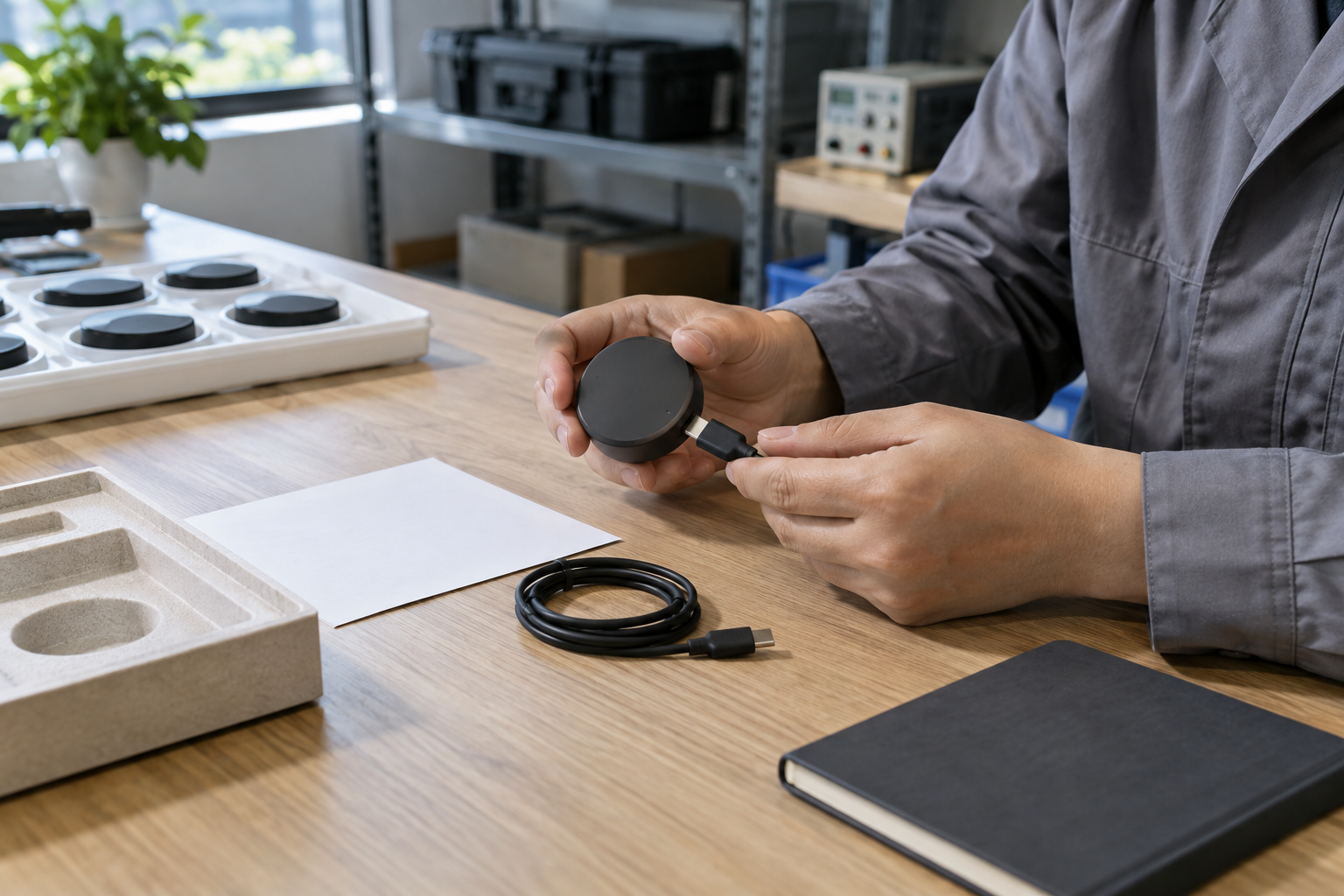
Test activation feedback, battery or power indications, buttons, charging connector, storage and firmware update steps on the actual sample. A subtle indicator may look elegant but be hard to see across a conference table. The product manual should state how to start, pause and end a session, recover from a failed sync and delete an unwanted recording. Do not imply that a button press is a guaranteed timestamp if the device has not synchronized correctly.
At shipment inspection, compare the packed accessory count, printed instructions, device revision and app or service onboarding instructions with the approved sample. One hardware revision can alter microphone placement or firmware behavior. A retailer should have a contact path for support and a customer-facing explanation of what happens if the associated service is unavailable or changes. An unusable account flow turns working hardware into a return.
Publish only claims supported by pilot data with named test conditions. “Captures every action item” is inappropriate without extensive evidence. “Creates draft notes for review” may better reflect a responsible workflow if the exact system supports it. Keep a log of sample revision, software version and test date so a later model update can be evaluated rather than assumed equivalent.
Buying for a Team Versus One User
A single-user pilot can hide account and permissions issues that appear when a team shares devices. Ask whether each button is tied to one account, whether a meeting host can transfer ownership and how a lost device is disabled. Test a handover between authorized users with a dummy recording. If the old user can still access new meeting content, the deployment process is not ready. If the new user must erase everything to pair the device, the organization needs a records-retention workflow before reassignment.
For enterprise buyers, separate hardware cost from service fees, storage, language support and support obligations. A low-cost button may rely on a paid transcription service. A quote should show the period of included access, what happens at renewal and whether raw audio and notes can be exported. Buyers should not assume a device remains fully functional after a subscription ends. The product page should state dependencies plainly rather than bury them in an app-store link.
Security and privacy review should use the exact vendor architecture, not a generic AI checklist. If encryption, regional storage or deletion timing are asserted, request the corresponding policy and technical evidence. Use a small consented dataset for the pilot. The outcome is an honest deployment decision: who may use the product, in which meetings, under what review and retention rules. That is more valuable than an unqualified transcription-accuracy promise.
Pilot Scorecard and Go-Live Decision
Give each pilot meeting a reference sheet with planned decisions, one deliberately corrected statement and one action item whose owner changes during discussion. The review team should compare output to this reference, not to whether the summary sounds polished. Mark critical errors separately: a missed negation, wrong owner or wrong deadline is not equivalent to a misspelled filler word. Decide before testing whether any critical error requires mandatory human review. That rule should be in the customer workflow, not hidden in an internal report.
Test speaker distance as a variable. In one run, place the button centrally; in another, keep the same group but place it near one participant. Note whether quieter speakers disappear or the system labels them incorrectly. A hybrid meeting adds a different audio path from the laptop speaker, so its results should not be averaged with a fully in-person meeting. If a vendor reports a single accuracy figure, ask for the dataset, language, noise conditions and version before using it in a product page.
Design an explicit disposition for each recording. The host announces capture and where the draft notes will be stored. Participants can ask for a pause, and the host should know how to stop and verify that recording ended. After the meeting, an authorized reviewer approves, corrects or deletes the draft. Test export and deletion with a dummy meeting before live deployment. If a feature cannot be demonstrated on the quoted version, mark it as a procurement gap rather than assuming a future software update will add it.
The go-live decision can then be conditional: suitable for internal draft notes with human approval, unsuitable for confidential external meetings, or not yet ready because account and retention controls are unclear. This is more informative than a binary “AI works” statement. Keep a record of hardware revision, app version, service terms and test date. Any subsequent software change that affects transcription or storage should trigger targeted retesting of the acceptance items.
Customer Support Without Inventing Accuracy
A support team needs to distinguish audio capture failure, synchronization failure and summary-quality dissatisfaction. For the first, ask whether the device showed an active state and whether a test file exists. For the second, ask about app version and connection state. For the third, request an anonymized excerpt only with the customer's authorization; do not invite a customer to email a confidential recording unprotected. A clear escalation path matters for business buyers who may make decisions from meeting records.
When publishing use cases, write “draft meeting notes for review” unless a stronger claim is supported by the exact system in the exact conditions. Give a plain-language description of what the button does and what the associated service does. If a subscription, cloud account or language pack is required, disclose it before purchase. Buyers should verify what still works if the service terminates, because durable hardware is not the same as durable access to transcription.
What a Pilot Report Should Contain
A short pilot report should identify the room, number of speakers, device placement, audio source, language, hardware revision, software version and whether participants consented. It should state the number of reference decisions and action items, then describe errors by type. A polished paragraph in the output is not a measured success. The decision maker needs to know whether a wrong deadline was caught by human review and whether the exported record reflects the correction.
Keep privacy observations alongside accuracy observations, not in a separate folder no one reads. Note how a meeting is announced, who can view draft notes, whether raw audio is kept, how a user deletes it and what happens when the host leaves the organization. A device can create acceptable draft text while being unsuitable for the buyer's data policy. Conversely, a strong security document does not guarantee useful notes in a noisy room. The purchase decision needs both.
After a pilot, choose one of three outcomes: reject, limit to a clearly defined low-risk use, or proceed with a documented human-review and retention process. If the organization proceeds, assign owners for training, software updates and incident response. A retailer selling the device to business customers should be able to answer who provides app support and how customers learn about service changes. These operational commitments are part of the product, not optional paperwork.
A public case study should not reveal real meeting content without authorization. If the brand wants to show a sample summary, use a synthetic agenda and label it. It is possible to demonstrate the workflow credibly without inventing a factory pilot, client testimonial or transcription score. Serious procurement teams often trust that restraint more than a perfection claim.
Frequently Asked Questions
Where should a meeting note button be placed?
Follow the maker's instructions and test plausible positions with speakers at different distances. A center-table setup is not automatically best when a laptop speaker or background noise dominates.
Can AI meeting notes replace human minutes?
That depends on the organization's risk and the tested output. For decisions, owners and deadlines, a human review step is prudent unless the buyer has a validated alternative process.
Is participant consent required?
Requirements vary by jurisdiction and organizational policy. Build a visible notice-and-consent process and obtain legal advice for the intended markets and meeting types.
How should transcript quality be measured?
Use a consented reference meeting and classify errors that matter operationally, especially negations, owners, dates and decisions. A single vendor accuracy percentage may not represent the buyer's rooms.
What if the associated app or service is offline?
Ask what the exact system stores locally, whether recording can continue, how data syncs later and what the user sees. Document the behavior in the retail instructions rather than assuming offline continuity.
Conclusion
A meeting-note button should be bought as a workflow, not a promise of automatic perfect minutes. Microphone location, room conditions, consent, human review and data retention determine whether the output is trustworthy enough for the intended use. A small, documented pilot can clarify these questions before a buyer scales distribution.
Final CTA
Contact KudBo at info@kudbo.com with your meeting use cases and deployment questions. See the product catalog, article index and product sourcing topics for related procurement guidance.