
Introduction
The short answer is that a US importer should not buy a STEM toy on the strength of a supplier's generic test report. Start by defining the product's intended age, materials, play pattern and included components. Map the applicable US children's-product rules, arrange testing through a CPSC-accepted laboratory where required, and issue the Children's Product Certificate based on passing results. Then lock the tested construction, tracking information, packaging and production controls before shipment.
This is a procurement workflow, not legal advice. The applicable rules depend on the actual product and market. A magnetic construction set, digital microscope, coding mat and drawing projector can fall into different rule sets because their components, power sources, age grading and foreseeable use differ. Buyers should review the current CPSC Online Sellers' Safety Guide and obtain qualified compliance advice for the final SKU.
Why the Importer Must Own the Compliance File
For an overseas-made children's product sold in the United States, the importer is responsible for issuing the CPC. The laboratory supplies test results; it does not replace the responsible firm's certificate. The CPSC's CPC FAQ also explains that the certificate must be based on passing results from a CPSC-accepted third-party laboratory when a children's product safety rule applies.
That distinction changes the purchasing conversation. “Do you have a certificate?” is too broad. A better request asks for the product model, sample description, applicable rule citations, laboratory identity, report date, tested materials and components, photographs, and any differences between the report sample and the proposed private-label version. The buyer then determines whether the evidence supports its own certificate.
Build a Product Identity Sheet First
Create one controlled sheet covering product name, model, age grade, bill of materials, colors, component count, magnet or battery details, packaging configuration, warnings and factory location. Add photographs of the sample and every component that affects safety. This becomes the reference used by the lab, artwork team, production staff and inspector.
Do not treat a different pigment, plastic formulation, coating, adhesive, electronic module or magnet enclosure as a cosmetic change without review. A material or design change can affect which evidence remains relevant. The safest workflow is to ask the responsible compliance specialist whether retesting or document updates are required before approving the change.
Age Grading Is a Design Decision
Age grading should reflect the abilities and interests of the intended child, the product's design and foreseeable use. It should not be selected only to avoid a rule. Small parts, strong magnets, projectiles, cords, accessible batteries and electrical functions require particular attention.
When reviewing a magnetic STEM construction set, request clear component dimensions, enclosure construction and assembly controls. For a kids digital microscope, review power, accessible parts, optical components, instructions and the complete accessory list. Product selection and compliance planning should happen together, before artwork and large-volume packaging are ordered.
Map the Applicable Rules and Tests
There is no single “CPSIA test” that covers every toy. The buyer needs a product-specific test plan. The CPSC publishes a current list of rules requiring third-party testing and a CPC. Ask the laboratory to provide an itemized scope and explain why each citation applies.
Typical review areas may include mechanical and physical hazards, small parts, lead in paint or substrate materials, phthalates in accessible plasticized components, labeling and product-specific requirements. Battery-powered or wireless products can add other obligations outside the core toy review. The importer should confirm the complete scope for its precise design and destination.
Select Representative Samples
The tested sample must represent production. CPSC guidance on selecting a third-party laboratory warns about non-representative “golden samples” and material substitution. Buyers can reduce that risk by recording resin, colorant, coating and component sources; selecting samples from normal production where practical; and linking each report to an approved bill of materials.
Mid-Article CTA
Planning a kids-learning range? Review KudBo's kids and learning products, then email info@kudbo.com with your destination market, age range, product list, packaging format and required approval timeline. We can organize the sourcing brief, samples and factory-side inspection checkpoints; final compliance decisions remain with the responsible importer and qualified specialists.
Tracking Labels and Packaging Controls
Children's products require identifying information that enables the production source to be determined. The CPSC tracking-label FAQ identifies the manufacturer or private labeler, production location and date, batch or run information, and other source-identifying characteristics. The information should be visible, legible and permanently affixed to the product and packaging to the extent practicable.
Build tracking content into artwork before printing. A practical code can connect the retail unit to purchase order, factory, date window and batch. Keep a decoding record so a complaint can be traced. Confirm that the production code is applied in the approved location and survives normal handling.
Packaging review should also cover component count, age and safety statements, instructions, polybag controls where relevant, barcode placement, country-of-origin marking, suffocation warnings where applicable, retail-box closure and master-carton identification. Avoid claims such as “educationally proven” unless the seller has appropriate substantiation.
Factory and Shipment Inspection Plan
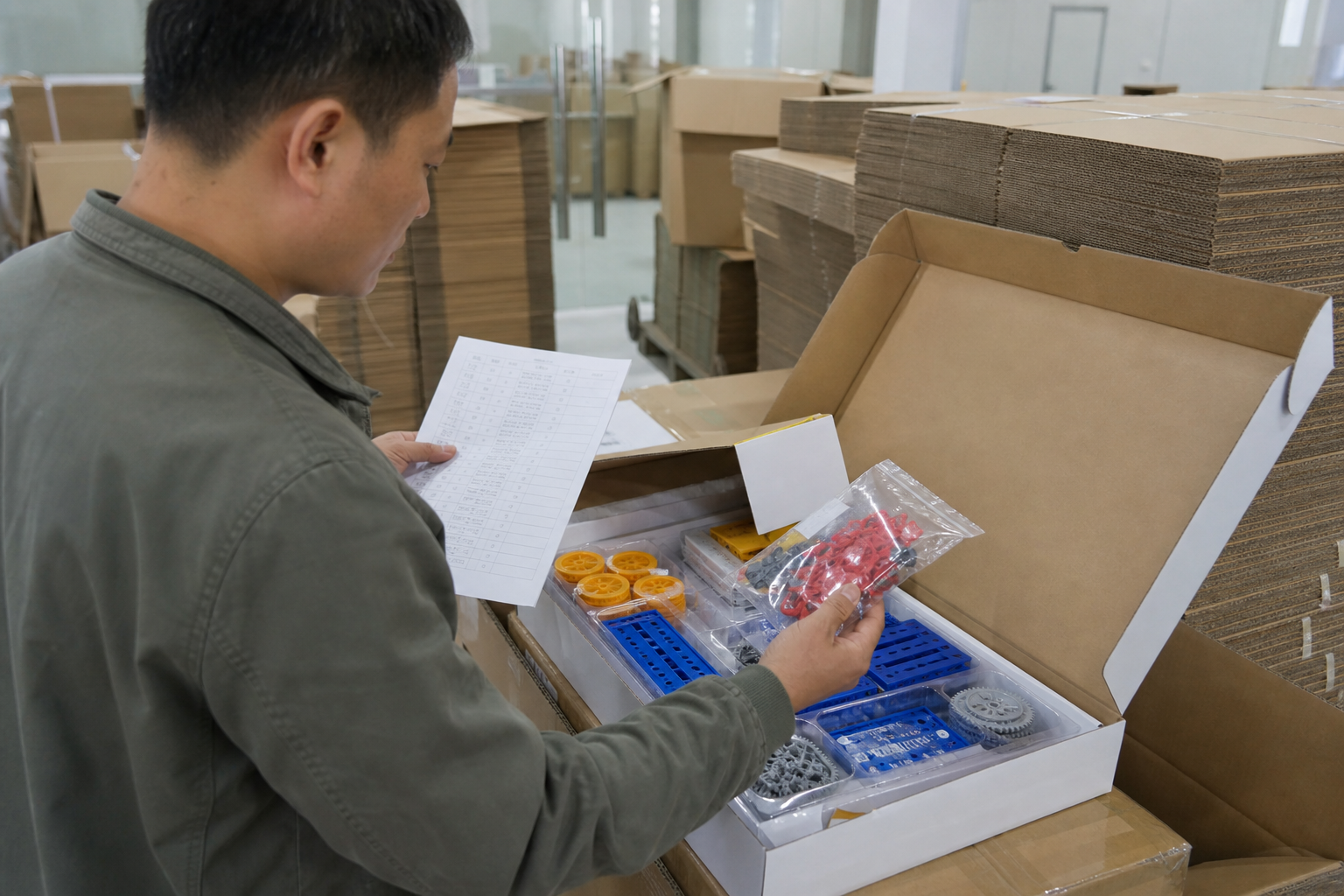
Factory testing should verify the product that was specified, not recreate regulatory laboratory testing. Useful checks include component identity and count, accessible edges, assembly security, battery-compartment access, switch operation, instruction inclusion, label placement, packaging fit and carton condition. Define objective acceptance criteria before inspection.
For continuing production, establish change control and review CPSC guidance on periodic testing. Record changes to materials, suppliers, tools, software, construction and manufacturing location. A shipment inspection should compare production units with the approved sample and current artwork, while the compliance owner confirms whether changes affect the certificate or test basis.
Purchase-Order Controls and Evidence Retention
Convert the approved product identity sheet into enforceable order details. The purchase order should reference the approved sample date, model and artwork revision; permitted materials and component sources; component count; age grade; packaging configuration; required production code; change-notification rule; inspection plan; and document-delivery milestone. If the supplier proposes an alternative part, require a written deviation request that identifies the reason, affected units and supporting evidence before production uses it.
Maintain a technical file that a colleague can understand without relying on the original merchandiser's memory. Include specifications, drawings, bill of materials, risk review, laboratory quotations and reports, CPC, tracking-label logic, artwork, manuals, sample approvals, production-change records, inspections and complaint information. Use stable file names and revision dates. The goal is not paperwork volume; it is the ability to show which design was reviewed and which batch was shipped.
Plan the First Production Run Conservatively
For a first order, allow time between production completion and booking so discrepancies can be resolved without pressure to ship. Ask for in-process photographs at agreed milestones, but do not treat photographs as proof of the entire lot. Where material identity is critical, agree on incoming records and retain samples. When the product includes many small components, use count fixtures or weighed kit checks backed by periodic manual counts.
After launch, collect structured customer feedback by failure mode: missing component, breakage, unclear instruction, battery access, magnet release, packaging damage or age mismatch. Escalate safety-related information immediately to responsible specialists. Feedback can refine instructions and quality controls, but a listing review is not a substitute for formal incident and reporting processes.
Comparing Two STEM Toy Suppliers
Compare suppliers on evidence quality and change discipline, not only unit price. Ask both candidates to quote the identical controlled specification. Score whether they identify the actual production factory, disclose material and component sources, support representative sampling, explain test-document applicability, maintain batch records and accept written change approval. Review how they isolate nonconforming components and whether the packing line can prevent missing pieces.
A lower quotation may exclude laboratory scope, upgraded enclosures, traceability marking, packaging inserts or inspection rework. Normalize these items before comparing. Also distinguish tooling ownership, replacement-part availability and the lead time for corrected samples. A supplier that responds clearly to technical questions can reduce project uncertainty even when no supplier can guarantee market acceptance.
RFQ Checklist for a US STEM Toy Program
An effective request for quotation gives the supplier enough information to expose risk early. State the intended age range, sales channel, destination, target quantity, forecast reorder pattern, desired colors, component list, private-label changes, battery configuration, packaging format, instruction languages, barcode owner and target ship date. Attach photographs or sketches, but label conceptual features that are not yet engineered.
Ask the supplier to return a completed compliance-data sheet rather than a yes/no promise. It should identify the legal manufacturer and production site, existing model, bill-of-material version, available test evidence, laboratory and dates, tracking-label method, change-control contact, sample lead time, tooling, packaging lead time and known differences between the existing item and your proposed version.
During quotation review, classify every answer as confirmed, buyer decision, supplier action or specialist review. For example, component count can be confirmed by the factory; age grading and applicable rules require qualified judgment; logo color is a buyer decision; and a new enclosure may require supplier engineering followed by compliance review. This simple ownership system prevents assumptions from being hidden inside the price.
Before authorizing mass production, hold a release review. Confirm that the final product sample, packaging proof, instruction file, product code, laboratory sample description and purchase order all use the same model and revision. List open items with owners and deadlines. A production deposit should not be treated as automatic approval of unresolved compliance details.
For shipment release, require document delivery before the inspection date, not after cargo is booked. The responsible importer should have the evidence needed to issue and maintain the CPC, while the inspector receives only the controlled references needed for observable checks. If any sampled product differs from the tested or approved construction, record the deviation and obtain a disposition from the responsible technical team.
Frequently Asked Questions
Can an importer use the foreign factory's test report?
Potentially, if the evidence is valid, applicable and representative, and the importer exercises due care. The importer still issues its own CPC for an imported children's product.
Does a tracking label need third-party testing?
The CPSC says the tracking-label requirement itself is not a rule requiring third-party laboratory assessment. The importer still needs to ensure the required identifying information is present.
Should every color be tested?
Testing scope depends on material differences and applicable rules. Different pigments or material sources may affect the evidence. Ask the laboratory to define representative grouping rather than assuming colors are interchangeable.
What should be ready before a quotation?
Provide destination, age grade, product configuration, colors, private-label changes, packaging, forecast quantity and required documents. This allows suppliers to identify cost and timing dependencies without inventing a compliance promise.
Is a factory inspection a substitute for laboratory testing?
No. Inspection checks production against specifications and approved references; it does not replace required third-party testing or the importer's certification responsibility.
Related KudBo Resources
Browse the KudBo product catalog, explore the buyer guide library, read more Compliance & Documentation sourcing guides, or send your product requirements for a focused sourcing discussion.
Conclusion
Reliable STEM toy sourcing begins with product identity and age grading, then connects test scope, CPC responsibility, tracking labels, change control and shipment inspection. The most useful supplier is not the one that sends the largest folder. It is the one that can explain which evidence belongs to the exact product and keep production aligned with that evidence.
Final CTA
To prepare a STEM toy sourcing brief, browse the KudBo product catalog, read our private-label product selection guide, or email info@kudbo.com with your product, market, age grade and packaging requirements.