Introduction
Folding camping chair wholesale testing should cover the assembled chair’s safety, stability, repeated use and instructions, not only a static weight placed on its seat. Overseas distributors and private-label outdoor buyers should first define adult use, expected setting, portability and assembly requirements. Then compare complete models with evidence appropriate to the target market and application.
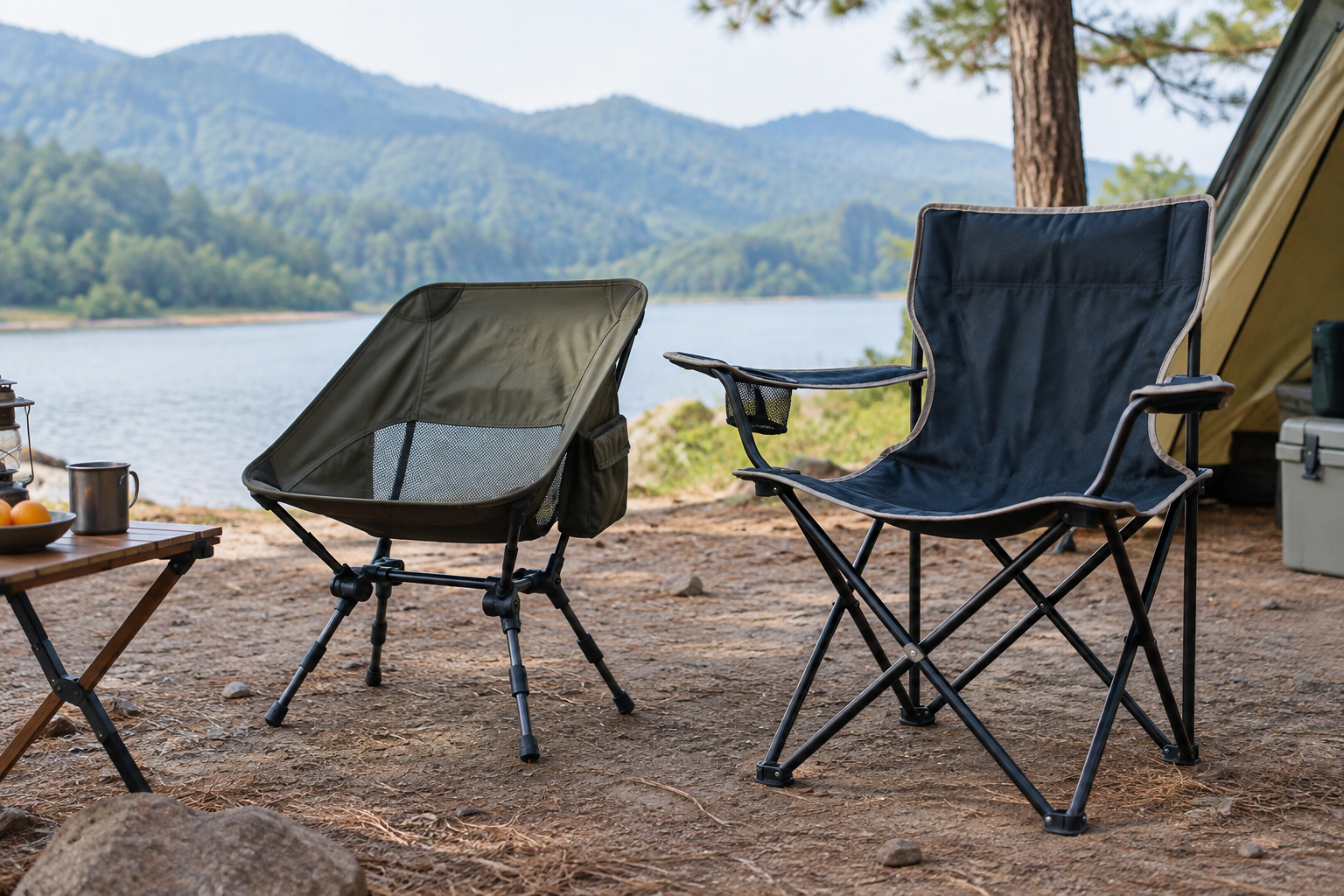
A compact segmented-frame chair and a conventional folding chair may serve different customers even when their advertised capacities look similar. Packed size, seat geometry, feet, fabric attachment and service parts can matter as much as the headline load. This guide provides a practical sourcing framework and proposed review questions; it does not report testing of any KudBo chair or establish a universal load rating.
Quick Answer: What Should the Buyer Verify?
Verify model identity, intended user and use category, frame and joint construction, seat attachment, stability evidence, strength and durability evaluation, folding hazards, instructions and traceable production controls. Ask how the advertised capacity was established and what conditions apply. Retain the actual report rather than accepting a photograph of stacked weights.
As of the research date, BSI lists BS EN 581-2:2026 for outdoor seating. Its public scope addresses adult seating for camping, domestic and contract use. Have the laboratory confirm the appropriate edition, category and related requirements for your project; a standards listing is not evidence that a specific product complies.
Choose the Use Case Before the Frame Architecture
A backpacking customer may prioritize packed weight and volume. A vehicle-based camper may prioritize seat height, setup speed and comfort. A promotional event buyer may care about repeated handling, storage and simple instructions. Record these priorities before comparing quotes so an attractive low-weight option is not judged against an unrelated use expectation.
Specify whether the chair will be sold to adults and whether it is intended for occasional camping or another setting. Do not assume an adult camping-chair assessment covers children’s seating or commercial use. If the sales plan changes, reopen the technical review. A small marketing change can create a different intended-use question.
Write one ordinary use scenario and one foreseeable difficult scenario for the design discussion. For example, assembly after unpacking and seating on the approved type of ground are ordinary tasks. A user misunderstanding the assembly sequence is a foreseeable concern. These scenarios guide review; they are not permission to market the product for unsafe or unsupported conditions.
Compare Segmented and Conventional Folding Frames
A segmented frame can pack into a small bundle but requires correct assembly and engagement at each connection. A conventional folding frame may simplify setup while increasing packed volume. Compare the entire product, including bag, seat fabric and accessories, instead of weighing only the frame.
Ask the supplier to identify tube material, dimensions, joint design, fasteners and surface treatment in a controlled drawing. Material descriptions should be specific enough to track changes, but material prestige should not replace finished-chair evidence. A named alloy alone does not establish the behavior of joints or the stability of the assembled geometry.
Inspect Assembly Clarity
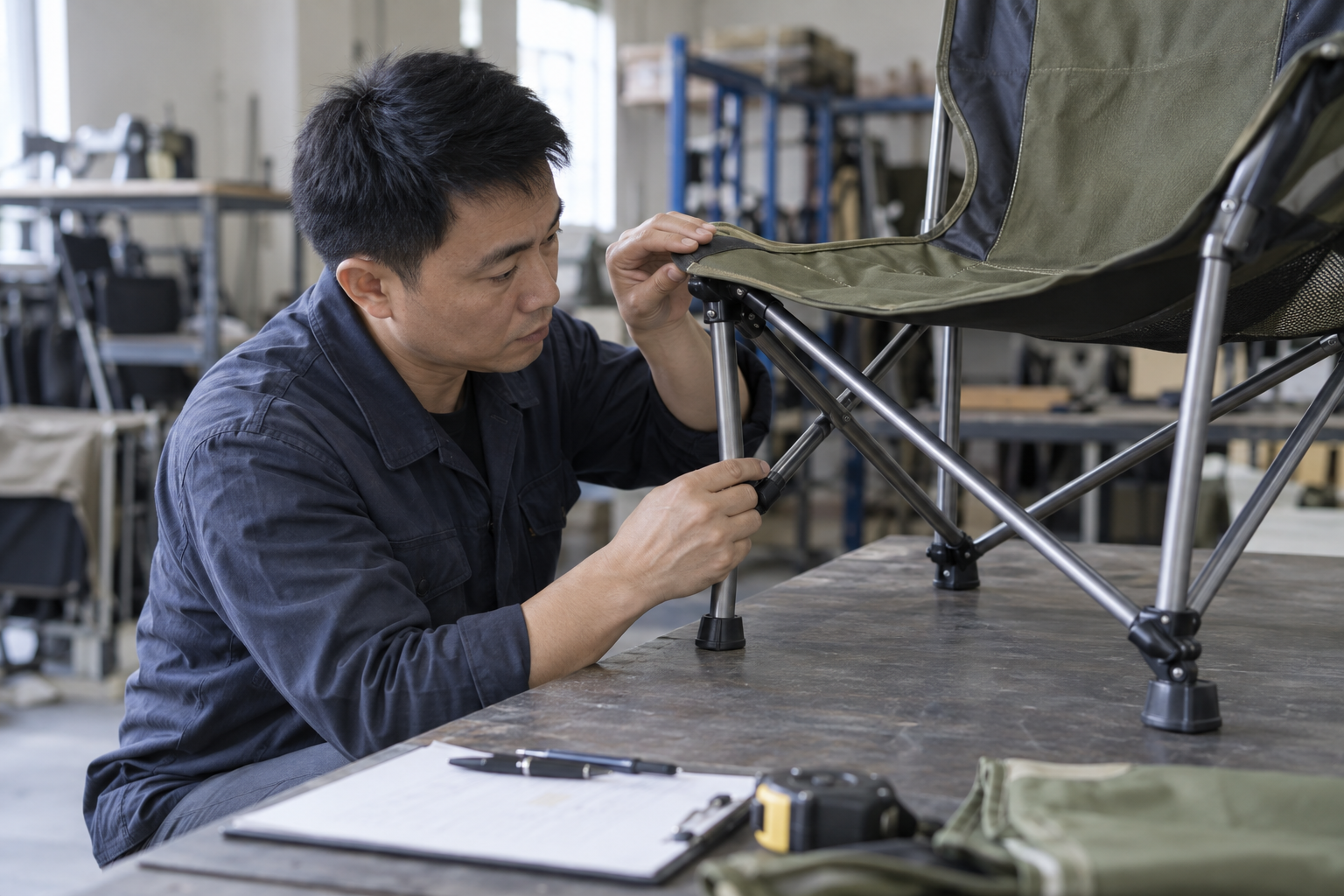
Give a reviewer the packed sample and draft instructions without verbal coaching. Observe whether the correct orientation is obvious and whether connections can appear engaged when they are not. Record confusion before modifying the instructions. If the physical design invites incorrect assembly, text alone may not be an adequate solution.
Ask how the factory checks joint fit and component identity during production. If similar tubes have different lengths or shapes, identify how mix-ups are prevented. A retained sample can help, but an operator also needs an understandable process and clear acceptance criteria. Keep the approved drawing revision visible in the production file.
Understand What a Load Claim Does and Does Not Say
Ask whether capacity refers to an evenly distributed static load, a user mass recommendation or another defined condition. Request the evidence behind the exact wording. Do not convert a laboratory force into a marketing mass figure without a justified interpretation, and do not treat a short static demonstration as a durability program.
The Helinox Chair Two guide provides model-specific assembly, surface and loading guidance. It is a useful example of the detail that should accompany a chair. Its capacity and warranty belong to that model and must not be copied to a private-label alternative.
Keep safety evaluation with competent technical personnel and suitable equipment. Buyers should not ask staff to jump on a chair or overload it as an improvised qualification exercise. Procurement can define questions, obtain evidence and observe ordinary assembly while a laboratory establishes appropriate controlled testing.
Evaluate Stability Separately From Frame Strength
A chair can have strong components and still be unsuitable on a particular surface or in a particular posture. Discuss the footprint, seat geometry, backrest and intended ground conditions with the technical provider. Ask which stability methods apply and how the report identifies the tested configuration.
Do not use a picturesque uneven campsite image to suggest that a chair works on all terrain. Match application photography to the instructions. If the approved use requires flat, solid ground, state that clearly and show it consistently. A removable foot accessory should not be presented as a universal stability solution.
Consider Feet and Surface Interaction
Review foot geometry, attachment and wear separately from frame strength. Ask whether replacement feet are available and how the correct size is identified. If a foot can become detached during normal packing, the design and instructions need review. Do not assume a generic rubber cap fits every frame revision.
For soft-ground accessories, request evidence and instructions for the exact combination. Evaluate whether adding an accessory changes setup, storage or stability considerations. The supplier should identify compatible chair models rather than offering a loose accessory with a broad “fits all” statement.
Review Fabric, Seams and Attachment Pockets
The seat fabric is part of the load-bearing assembly. Request its construction and the reinforcement details at attachment points. Review stitching, edge finishing and how the fabric engages the frame. A material swatch report alone cannot establish the strength of a finished pocket or seam.
Inspect production-equivalent samples for concentrated wear at corners and frame contact areas. Ask the laboratory which conditioning and repeated-use evaluations are relevant. Keep cosmetic abrasion and structural damage separately described, while recognizing that one may lead to the other. A clear defect vocabulary helps the factory understand what must change.
If mesh panels, cup holders or storage pockets are included, define their intended purpose and any supported limits. Extra features should not create misleading handholds or interfere with folding. Have the reviewer pack the product with accessories attached as instructed. A chair that fits its bag only after an undocumented trick needs further development.
Mid-Article CTA
Send Your Requirements. Browse KudBo’s product catalog and email info@kudbo.com with your intended user, sales market, setup preference, packed-size target and quantities. Ask for model comparisons, evidence review and a production inspection brief for the proposed chair.
Build a Qualification Plan With the Laboratory
Provide the intended use, drawings, materials, assembly instructions and planned claims before requesting a test quotation. Ask the provider to explain scope, edition, sample quantities and whether conditioning or destructive evaluation is included. Avoid selecting a laboratory package only because it has the shortest turnaround.
The BSI EN 581-1 overview describes general safety requirements for adult outdoor furniture. Read it alongside the applicable mechanical evaluation scope with the provider. Do not claim compliance with a complete series when only one part or selected clauses were assessed.
Agree how changes will be handled. A revised seat, tube, hinge or fastener may require additional evaluation even when the product name stays the same. The report should identify the tested model and configuration clearly enough to compare with production. A certificate image with no supporting detail is not an adequate change-control reference.
Compare Samples With a Procurement Scorecard
Use mandatory technical requirements as gates, then score commercial and usability preferences. Do not let a compact bag or attractive color offset missing safety evidence. Keep comments specific enough that another buyer can understand the decision without seeing the original sales presentation.
| Review area | Procurement question | Evidence or reference |
|---|---|---|
| Intended use | Which adult application is supported? | Brief and instructions |
| Assembly | Can the chair be assembled correctly from the leaflet? | Observed sample review |
| Structure | Which exact frame and seat were assessed? | Drawing and report identity |
| Stability | Which surface and configuration apply? | Relevant evaluation scope |
| Portability | What is packed weight and volume? | Measured complete sample |
| Service | Which parts can be replaced safely? | Model-linked parts list |
| Production | How are component changes approved? | Written control process |
Record measured values with units and measurement conditions. For example, packed dimensions should include the supplied bag and all standard accessories. Do not compare one supplier’s bare-frame weight with another’s retail set. Clear measurement boundaries reduce arguments later in negotiation.
Design Packaging Around Handling and Repacking
Check protection at protruding frame ends and whether loose components can rub through the carry bag. Review the packed product after ordinary unpacking and reassembly. Factory packing may be unusually compact; a user should still be able to repack the chair following the instructions.
For ecommerce, evaluate the retail package within the actual shipping arrangement. A long narrow pack may move differently from a short dense one. Discuss the relevant distribution test with the packaging provider and record the configuration. Do not assume a chair’s structural report covers transport damage.
For distributors, identify the carton count, model assortment and how receiving staff distinguish sizes or colors. Include parts lists where components are detachable. A missing seat or incorrect frame segment can make a complete carton count misleading. Shipment documentation should describe sellable sets, not only the number of loose pieces.
Prepare Shipment Inspection Before Production Ends
Supply the inspector with the approved model, drawings, instructions, packaging specification and agreed sampling plan. Include component counting, assembly checks, visible finish and selected functional checks appropriate to the inspection scope. Do not wait until cartons are sealed to discover that required evaluation needs unpacking or additional equipment.
Record deformation, joint fit, sharp edges, incorrect components, seam defects and missing labels separately. The severity and release consequences should follow the agreed plan and technical assessment. An inspector should not invent a safe capacity or approve a structural redesign at the shipping dock.
When a repeated problem appears, identify affected production groups and request corrective evidence. Replacing the sampled item is not the same as correcting the lot. Confirm what was inspected, reworked or retested and how the replacement population was identified. Clear disposition records protect both the buyer’s decision and the supplier’s next production run.
Negotiate Spare Parts and After-Sales Support
Ask about replaceable seats, feet, carry bags and other approved service items before the initial order. Keep model and revision compatibility explicit. The Helinox replacement-parts catalog demonstrates model-specific service items as an industry example; it does not establish availability for another manufacturer.
Determine which replacements are user-serviceable and which require a controlled repair route. Do not distribute structural parts without appropriate instructions and compatibility review. A low-cost component can create a serious mismatch if its dimensions or attachment differ from the original design.
Agree replenishment lead time and minimum quantities instead of assuming service stock will always be available. For a seasonal collection, document when parts support will be reviewed and whether a revised model remains compatible. Keep the warranty wording aligned with the actual service process and applicable market requirements.
Use Feedback to Improve the Next Order
After launch, group feedback by assembly difficulty, comfort, packing, feet, seat fabric and structural concerns. Preserve product identity and lot information when investigating. A vague average rating cannot show whether a particular revision or accessory is involved.
If a safety concern is reported, follow the appropriate product-safety process rather than treating it only as a replacement request. For ordinary usability issues, compare the returned item and instructions with the approved sample. A recurring misunderstanding may justify a diagram change, while repeated physical failures require a deeper technical response.
For adjacent assortment planning, the outdoor camping sourcing guide covers broader supplier questions. The camp table light rail is a catalog reference for discussing complementary products; compatibility with a chair or table must still be checked for the actual combination.
Frequently Asked Questions
Does a static weight demonstration prove a chair is safe?
No. It addresses only the demonstrated configuration and loading condition. Stability, repeated use, joints, folding hazards and instructions require their own appropriate evaluation. Ask for a model-specific technical assessment and report scope rather than turning a sales demonstration into a general safety claim.
Which standard should an overseas buyer request?
Ask a competent laboratory to identify the relevant requirements for destination, intended user and use category. For adult outdoor seating, the EN 581 series may be relevant, but edition and scope need confirmation. A test to selected requirements should not be described as complete compliance with everything in a series.
Is an aluminum frame automatically better than steel?
No. The complete design, dimensions, joints, treatment and intended use determine suitability. Compare evidence, packed weight, handling, durability and service requirements. A material name can inform a specification, but it cannot replace an assessment of the assembled chair and its production controls.
Can replacement feet be sourced as generic accessories?
Only after confirming fit and suitability for the exact model and revision. Similar-looking caps may differ in retention and geometry. Keep an approved parts list and replacement instructions. If a foot or accessory changes the chair’s supported use conditions, obtain the appropriate technical review before offering it.
What should be included in a wholesale chair brief?
Include adult use category, destination, assembly preference, packed-size and weight targets, intended ground conditions, quantities, branding and service expectations. Identify any capacity claim you want to make. Request a comparison of complete models with evidence, instructions and change controls before approving production.
Related KudBo Resources
Browse the KudBo product catalog, explore the buyer guide library, read more Wholesale Buying sourcing guides, or send your product requirements for a focused sourcing discussion.
Conclusion
Folding camping chair wholesale testing is a complete-product exercise. Define the use case, review assembly and stability, verify model-specific strength and durability evidence, and preserve that configuration through production. Packed logistics and spare parts complete the purchasing decision once the technical requirements are satisfied.
Final CTA
Get a Quote. Use KudBo’s contact section or email info@kudbo.com with your chair brief, market and order quantity. Request sample comparison, current evidence review, packaging details and a practical after-sales parts plan.