
Introduction
Before a radio-frequency product is imported or marketed in the United States, determine which FCC authorization procedure applies and verify that the evidence matches the finished model. A module certificate alone does not automatically approve every host configuration. Buyers should control the radio module, antenna, firmware, enclosure, power arrangement, labeling, user information and production changes as one authorization record.
Start With the Finished Product
List every intentional and unintentional RF function: Bluetooth, Wi-Fi, cellular, wireless charging, switching power supply, digital clocking and accessories. The FCC states that RF devices generally must be properly authorized under 47 CFR Part 2 before marketing or importation. Confirm the applicable authorization path before ordering production.
Ask a qualified laboratory or Telecommunications Certification Body which procedure applies. Do not infer authorization from a generic supplier statement, a CE mark or a report for a visually similar model.
Match the Grant and Test Evidence
For certified equipment, verify the grantee, FCC ID, product description, frequency bands and filings in the FCC database. Match internal photos, module, antenna type and host construction to the production sample. The FCC’s importation guidance helps identify goods requiring authorization.
If a certified module is integrated, review the module’s conditions, host labeling, simultaneous-transmission configuration, RF exposure assessment and any additional unintentional-radiator obligations. FCC KDB 996369 addresses transmitter modules and hosts.
Control RF Exposure and Wireless Charging
Portable and mobile products may require different RF-exposure evaluations. The FCC’s current KDB 447498 provides procedures for mobile and portable devices. Wireless-power products above 9 kHz are addressed in KDB 680106.
For a smart pet feeder camera, connected desk accessory or tracker, provide the lab with use distance, antenna location, enclosure, charging mode and all radios that can transmit together.
Private Label and Production Changes
Private-label artwork must preserve required identifiers and statements. Decide whether the new trade name, model number or enclosure change is covered by existing authorization and filings. Never edit an FCC ID simply to match a brand.
Create a controlled component list for module part number, antenna supplier and geometry, cable, shielding, oscillator, power supply and firmware region settings. A factory substitution can alter the authorized configuration even when the exterior looks unchanged. Require written change notification and technical review before production.
Shipment Inspection Checklist
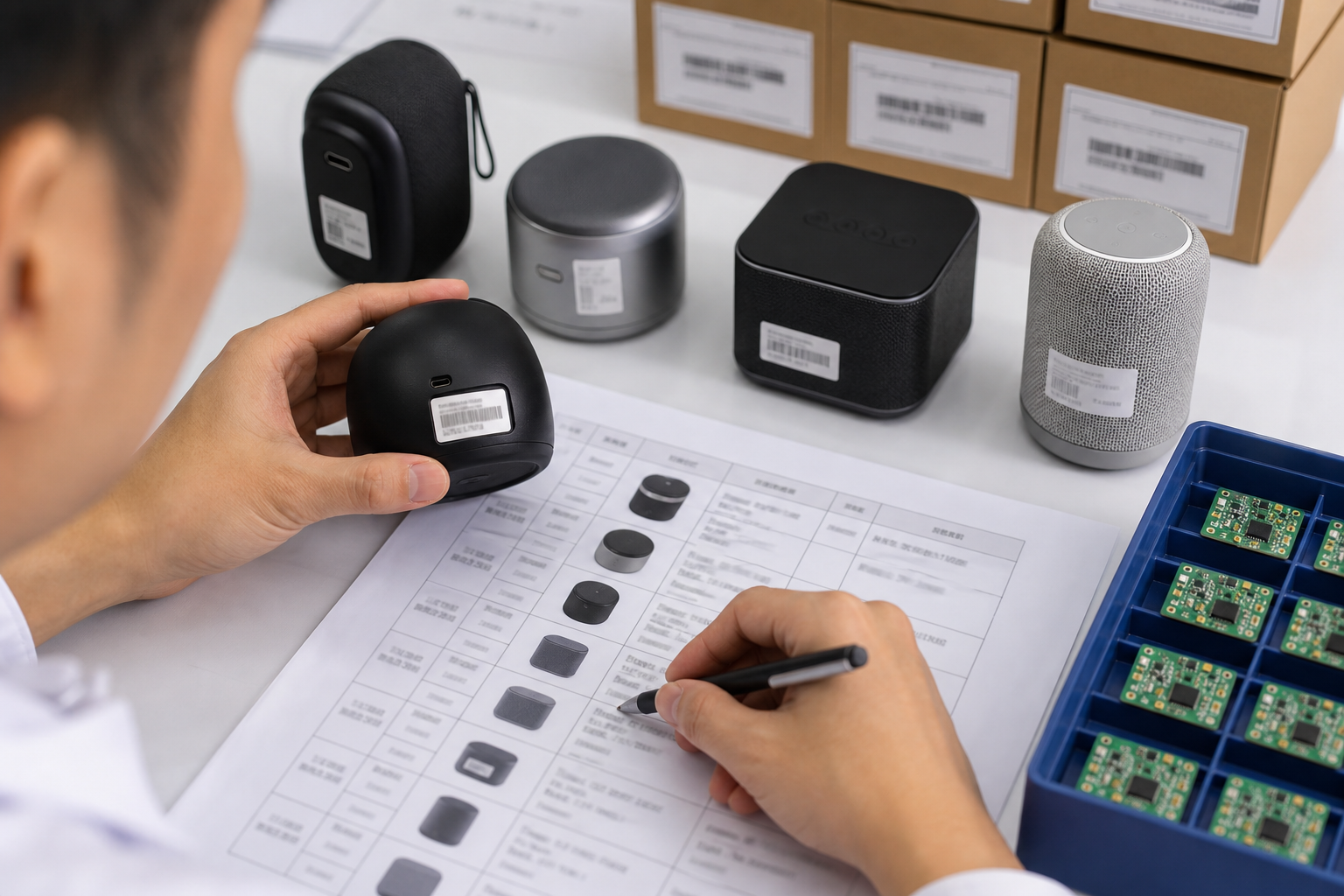
At shipment inspection, compare model and FCC identifiers on product, package and manual; confirm the installed module where accessible; sample basic radio function; check accessories and power ratings; and photograph production labels. This inspection verifies reproduction, not RF compliance itself.
Mid-Article CTA
Sourcing a wireless product? Browse the KudBo product catalog and email info@kudbo.com with your destination, SKU list, quantity, packaging format and review requirements. KudBo can coordinate product data, samples, artwork and factory-side inspection evidence for your importer, laboratory or adviser to evaluate.
Turn the Requirement Into a Controlled Specification
A useful specification is more than a product name and photograph. Give every requirement an owner, method, tolerance, evidence type and approval status. Separate legal requirements, retailer rules, performance targets and preferences so a supplier does not treat every note as interchangeable. Identify the governing revision and attach dated drawings rather than circulating files with similar names.
For a wireless product, create a matrix with columns for requirement, source, applicable SKU, component, verification stage, responsible party and record location. Mark unanswered points openly. An unanswered question is manageable before artwork or tooling release; an assumption hidden in email becomes expensive after packaging is printed.
Use precise language. Strong, premium, compliant and export quality are not measurable. State material evidence, dimensions and tolerances, functional sequence, color reference, label file, package structure and verification method. Where a specialist must decide applicability, make that decision a hold point.
Sample Stages and Approval
Use different samples for different decisions. A concept sample confirms size and function while temporary color or packaging may remain. A customization sample checks logo method. A pre-production sample should represent approved materials, construction, labels and packaging closely enough to release production. A shipment sample documents what was packed.
Label retained samples with SKU, revision, date and approval scope. Photograph them under consistent lighting and record accepted deviations. Sample approved is unsafe when one team approved appearance but another assumed it approved materials, labeling and performance. State what remains open.
Supplier Document Review Without Paper Compliance
Request documents by exact product and component, not as a generic certificate folder. Record issuer, report number, applicant, manufacturer, model, sample description, dates, methods and conclusion. Compare photographs, ratings and bill-of-material details with the item purchased. A genuine report can still be irrelevant when it covers another model or earlier construction.
Check whether each file is a laboratory report, certificate, declaration, data sheet, invoice or internal test record. They serve different purposes. Confirm the issuer through an official database where one exists, and ask the responsible professional to review scope. Do not edit supplier PDFs or treat a logo as proof every requirement is covered.
Create a change-review calendar even if a document has no printed expiry. Regulations, standards, components and production locations change. The practical question is not only whether the document is valid, but whether it still describes the product to be shipped.
Factory Testing and Production Readiness
Before mass production, convert critical requirements into work instructions operators and inspectors can follow. Define incoming-material checks, first-piece approval, in-process checks, line-clearance controls, final function checks and packaging verification. Ask for representative records, but never claim a test occurred without dated evidence for the order.
Installation preparation also matters. Confirm included parts, compatible power or interface assumptions, assembly sequence, warning placement, manual language and protective packaging. A product may pass a bench check yet create returns because an accessory is missing or setup is unclear.
When a requirement depends on an instrument, record equipment identity, range and calibration status appropriate to the measurement. For appearance checks, use boundary samples or photographs showing acceptable and unacceptable conditions. Factory teams need a repeatable rule, not only a buyer expectation.
Change Control During Production
Require written notice before changing material, component supplier, formulation, radio module, battery, antenna, coating, factory, mold, firmware, label, instruction or package. The notice should describe reason, affected lots, comparison with the approved version and proposed verification. Silence is not permission.
Not every change requires the same response. A typo correction may need artwork approval; a safety-related component change can require technical evaluation and new testing. The buyer, laboratory and responsible party should decide before changed goods are made. Keep obsolete artwork away from the line while preserving it in records.
Shipment Inspection as the Final Evidence Check
Inspection preparation begins with a complete packing list and confirmation that enough finished, packed goods are available. The inspector should sample across cartons and pallet positions, identify the lot and record quantities. If production is incomplete, report the limitation rather than treating a partial lot as the ordered shipment.
The checklist should cover identity, workmanship, dimensions, function, accessories, labels, retail packaging, barcodes, inner packs, cartons and loading condition as applicable. Link each item to a specification or sample. Photograph failures with scale and context, and record measured results rather than only pass.
Inspection cannot validate facts requiring laboratory equipment, legal interpretation or long-duration testing. It can confirm production appears consistent with approved evidence and detect obvious substitutions. Escalate discrepancies before shipment; do not rewrite requirements after seeing results.
Commercial Comparison and Landed-Risk Thinking
Compare suppliers on the same scope. Include samples, tooling, customization, packaging, third-party review, inspection, corrective work, export packing, freight assumptions and replacement support. A low unit price can be offset by missing evidence, an unstable component, oversized packaging or a schedule without correction time.
Assign cost and schedule contingencies to unresolved items. Confirm who pays for retesting after an unauthorized change, reinspection after rejection, reprinted packaging and disposal or return of nonconforming goods. These terms belong in the purchase agreement with appropriate advice.
Work backward from the required arrival date: requirement closure, sample dispatch, approval, document review, artwork lock, material booking, first-piece review, production completion, inspection, correction, booking and loading. Protect the correction window; shipping immediately after inspection removes the buyer's ability to respond.
Records to Retain
Maintain the RFQ, quotation assumptions, purchase order, specifications, bill of materials, approval samples, artwork proofs, declarations, relevant reports, change notices, production evidence, inspection report, packing list and shipping documents. Use consistent SKU and revision identifiers.
Retention periods depend on market and product obligations. Set the schedule with qualified advice. Records must remain retrievable for complaints, recalls, customs questions, retailer audits and repeat orders. A structured evidence pack reduces work when the same unchanged model is reordered.
A Practical RFQ Checklist
Send suppliers the exact product model and revision, destination markets, annual and first-order quantities, sales channels, packaging hierarchy, required documents, artwork ownership, sample schedule, change-notification rule and shipment-inspection plan. Ask for facts and evidence, not a one-word promise of compliance.
Compare quotations on the same scope. Separate product price, customization, packaging, testing coordination, inspection support and logistics assumptions. Confirm which work is included, which is performed by independent specialists and which remains the importer’s responsibility.
Frequently Asked Questions
Is a CE mark enough for the US?
No. US FCC requirements are separate from EU conformity requirements.
Does a certified Bluetooth module approve the host?
Not automatically; module conditions and host obligations must be reviewed.
Can a private-label brand use the supplier’s FCC ID?
Sometimes, if the authorization and labeling rules are satisfied; obtain qualified review.
When should a product be retested?
Review any radio, antenna, enclosure, power, firmware or simultaneous-transmission change before implementation.
Can shipment inspection prove RF compliance?
No. It can verify identifiers and configuration, while authorization relies on the applicable technical process.
Related KudBo Resources
Browse the KudBo product catalog, explore the buyer guide library, read more Wholesale Buying sourcing guides, or send your product requirements for a focused sourcing discussion.
Conclusion
Reliable sourcing turns a broad requirement into controlled product, document, artwork and shipment checkpoints. The buyer remains responsible for market access and acceptance decisions; the supplier should provide accurate, model-specific evidence and reproduce approved specifications consistently.
Final CTA
Review KudBo products, read our private-label sourcing guide, or email info@kudbo.com with your a wireless product brief. We will help organize a practical shortlist and sample-review plan.