Introduction
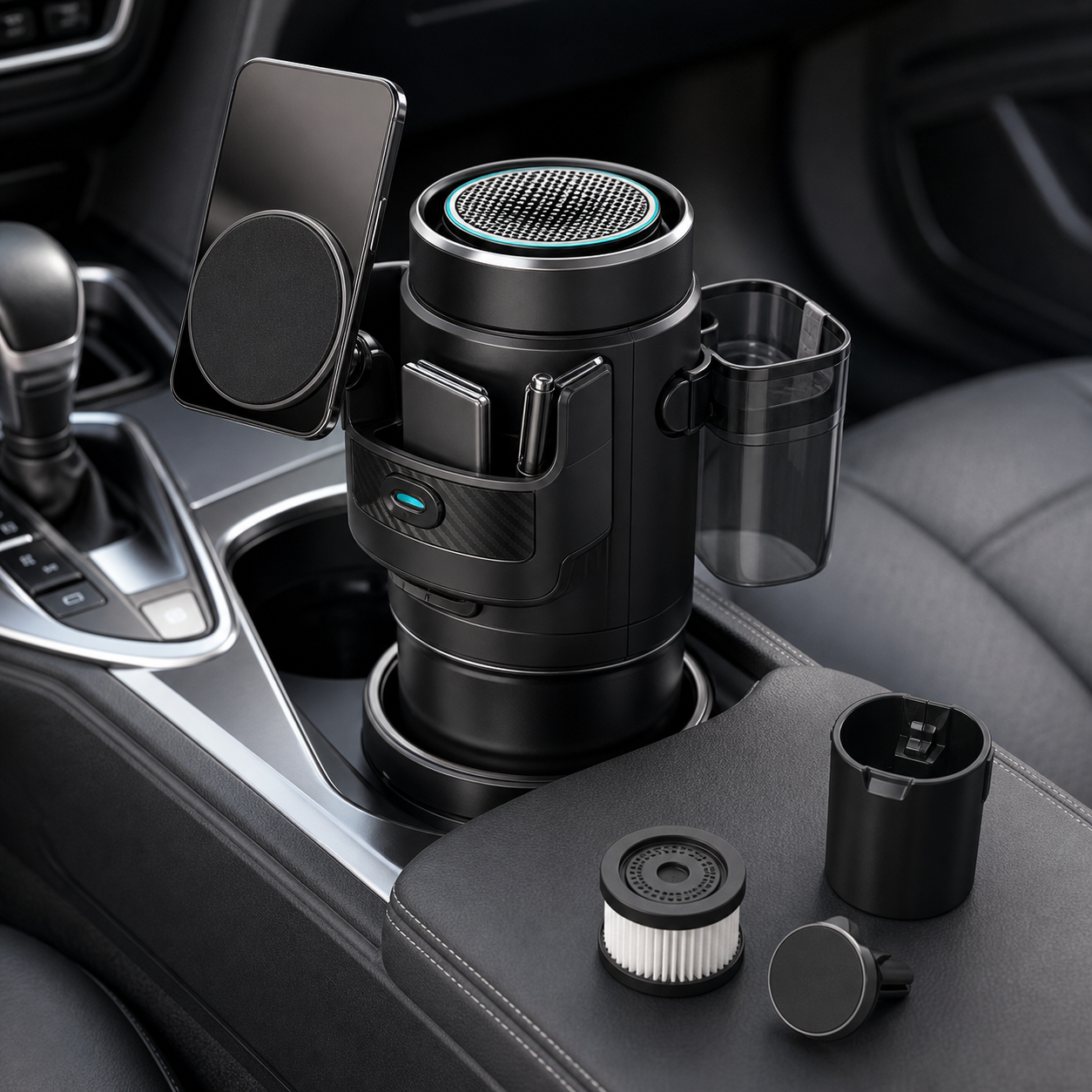
The best cabin organizer is the one that stays out of the driver's way. A combination of storage, a trash cup, phone mounting and a fragrance or filter cartridge can sound efficient in a catalog. It can also crowd controls or invite interaction while driving. The KudBo car organizer purifier is described with these functions; buyers should verify the exact quoted components rather than treating the entire concept image as an in-box promise.
The related filter-claims buyer guide addresses claim language. Here the focus is placement and driver behavior. The sample checks are suggested buyer protocols, not evidence that a specific vehicle or filter has already passed them. Vehicle interiors differ enough that “universal fit” deserves particular skepticism.
Map the Vehicle Interaction Zone
Photograph the center console of target vehicle types while parked, with the seat at its forward and rearward settings. Mark the gear selector, parking brake, hazard button, cup holders, charging ports and knee clearance. Position the accessory as instructed, then reach each safety-relevant control. A product that fits one cup holder may obstruct another car's climate controls or make a frequently used switch harder to reach.
Look at the accessory from the driver's normal eye position, not only from a camera above the console. A tall phone mount may block a sightline. A trash cup lid may require the user to look down and twist. Ask a reviewer to perform setup only while parked; do not turn a moving-vehicle trial into a marketing demonstration. NHTSA's distracted-driving guidance explains why visual, manual and cognitive distraction matter. It does not certify any organizer, but it is a sound reason to keep routine interaction away from driving.
Check for airbag and seat-motion interference. The product page should not imply suitability for every car because it fits a typical promotional interior. If a proposed position is close to an airbag deployment area, obtain vehicle-specific guidance; NHTSA's air-bag resource is general background, not a fit approval. Exclude unsafe placements from imagery and instructions.
Evaluate Mounting Stability and Spill Control
Check cup-holder diameter, depth and taper with the exact vehicles targeted by the retailer. If the unit has an adjustable base, test the full adjustment range and how firmly it stays set. A loose accessory can rattle, spill or shift during ordinary turning. Use a parked, controlled setup for the preliminary review and define further vehicle testing with qualified personnel where required. An accessory should not rely on a full trash cup for ballast.
Remove and reinstall the unit several times. Some consoles have rubber liners that pull out with the accessory; others have removable cup-holder inserts. Note whether a phone cable snags at the mounting point. Test the trash cup with realistic small waste, then remove it for emptying. If the user has to disassemble the purifier to empty trash, the functions conflict rather than reinforce one another.
Ask what can be cleaned with water and what must remain dry. Food wrappers and beverage drips are foreseeable. A spill that reaches an electrical fan or charger is different from a wipeable plastic bin. Retail instructions should separate those parts clearly. If replacement liners or cups are offered, confirm SKU and fit across production versions before planning a refill business.

Mid-Article CTA
Send Your Requirements with target vehicle classes, intended mounting positions, filter format and destination market. Email info@kudbo.com for a fit and pack-out brief.
Separate Fragrance From Air Cleaning
A fragrance cartridge changes odor perception; it does not establish particle removal. A filter may capture some contaminants under defined flow and media conditions, but its presence alone does not support a broad “purifies your car” claim. Ask for the filter medium, dimensions, airflow path, replacement interval basis and actual test report for the assembled product. Distinguish test-chamber performance from what occupants experience in a moving, ventilated vehicle.
The EPA guide to air cleaners discusses how air-cleaner type, flow and room conditions affect performance. It addresses home equipment, not a specific vehicle console product; use it to frame questions rather than import a home rating into a car claim. If the unit contains an ionizer or other active technology, evaluate that exact mechanism separately and avoid unexplained health promises.
Fragrance has another issue: tolerance varies by occupant. Offer a clear fragrance-free use path if the product supports one, and list cartridge ingredients and handling requirements where relevant. A “fresh air” picture should not imply a medical benefit. The instruction card should say what the customer can replace, when and how, with no hidden assumption that an unavailable proprietary filter will be easy to find later.
Inspect the Quoted Kit and Retail Claims
Define every component on the quotation: organizer body, trash cup and lid, phone holder, fan or filter module, cartridge, cable and mounting adapters. Photograph the complete kit on a table. If any prop appears in lifestyle photography, mark it as a prop. Confirm whether the phone holder is actually adjustable, what device dimensions it supports, and whether charging is included or simply accommodated by cable routing.
At shipment inspection, count cartridges, check fit and finishes, verify the power function if present and compare label instructions with the approved copy. A pilot customer-service sheet can distinguish “will not fit cup holder,” “fan does not run,” “fragrance too strong” and “trash cup difficult to empty.” Those are different problems; only some are solved by changing the filter. Record returns by model and placement to refine the fit statement.
Avoid vehicle imagery that shows hands operating the accessory while moving. Make the first instruction: install, adjust and empty only when parked. Be precise about the function delivered by the quoted version. If a filter test has not been supplied, the product can still be marketed as a practical organizer, but its air-cleaning claim should remain appropriately narrow.
A Claims and Placement Approval Gate
Before launch, have one reviewer approve physical placement and another approve air-cleaning copy. The placement reviewer checks the vehicle matrix, control clearance, stability and cable route. The claims reviewer checks the actual filter medium, flow path, replacement interval and evidence for any pollutant or odor statement. A successful placement test cannot substantiate filtration, and a laboratory filter result cannot prove driver safety. Keep those approvals in separate files linked to the same product revision.
If the listing uses the word “purifier,” explain exactly what the product is designed to do and what it is not tested to do. A fragrance cartridge, passive charcoal insert and powered particulate filter are different systems. Claims about allergy relief or health outcomes require stronger evidence than claims about a replaceable filter accessory. Avoid visual clouds disappearing around a dashboard; they can imply a level of air treatment the small device may not deliver.
The buyer should also plan an end-of-life route for consumables. Can the customer obtain a replacement filter after the first one is used? Does a version change make old cartridges obsolete? How is a trash cup cleaned without wetting any electrical element? These questions affect repeat satisfaction. A narrow, truthful offer that fits real vehicles and can be maintained is stronger than a long feature list with no service plan.
A Parked-Vehicle Fit Matrix
Build a fit matrix with at least three interior layouts relevant to the retail audience: a narrow center console, a wide console with deep cup holders and a vehicle where the cup holders are close to controls. For each, record the holder dimensions, nearby switch positions, sightline and accessible charging port. State the tested vehicle model and configuration internally, but avoid converting three samples into a universal claim. A fit guide should show both successful and unsuccessful positions.
Place the accessory in each vehicle while parked. Adjust the seat, reach the belt buckle, select gears only according to safe stationary procedures and open nearby lids. The buyer should notice whether the organizer becomes a physical barrier even when not in use. A high phone mount may be stable but obstruct part of the dashboard; a low one may demand too much downward gaze. The correct solution may be to market the storage function while leaving the phone-mount module off certain vehicle types, if the quoted design supports modular use.
Document the filter or fragrance module separately from mounting. If it is powered, note its input source, cable route and what happens when the vehicle turns off. If it is passive, avoid implying active air circulation. The replacement-cartridge price and supply period affect long-term customer value. Ask a reviewer to remove a spent cartridge, insert a new one and dispose of the old one using actual instructions. If this is messy or unintuitive, product copy should not call replacement effortless.
For a retail pilot, classify returns by fit, noise, fragrance preference, power and cleaning. A customer who dislikes a scent has not necessarily received a defective organizer; a customer whose cup holder is blocked may have encountered an inadequate fit statement. A support form that captures the vehicle and mounting position can identify avoidable compatibility problems. Retain the exact sample and part numbers so a later filter or base revision does not silently change the customer experience.
A Complete Retail Sample Decision
After vehicle placement and filter review, make a sample decision across four dimensions. First, state which target vehicles accept the base without obstructing controls. Second, identify every included function and its power needs. Third, write exactly what the filter or fragrance component is claimed to do and which evidence supports it. Fourth, confirm that the user can empty, clean and replace consumables without dismantling the wrong part. A sample that fails one dimension may still have a narrower useful role, but the listing must match that role.
The buyer should distinguish filter media from the whole assembled unit. A filter-material data sheet does not describe airflow through a small console device. A fragrance ingredient list does not describe particle removal. If the supplier offers multiple cartridges, evaluate each separately and label them by exact SKU. Ask for a replacement supply schedule, because an air-cleaning function advertised at launch loses value if the correct cartridge disappears after a short selling season.
Run a customer-support rehearsal with three realistic questions: “Will it fit my car?”, “Does it remove smoke?” and “Can I wash the trash cup?” An agent should answer from the vehicle matrix, test evidence and component-care sheet, not by guessing from the hero image. If the answers are unclear, the product is not ready for a broad listing. Refine the scope or documentation before ordering more stock.
The strongest final offer may be an organizer with a clearly described optional cartridge, rather than a sweeping purifier promise. Marketing it honestly is not timid. It lets the buyer separate the practical cabin organization benefit from evidence-sensitive air claims and prevents a safety concern from being hidden behind a list of attractive functions.
Frequently Asked Questions
Can a car organizer purifier fit every cup holder?
No. Cup-holder diameter, depth, shape and nearby controls vary. Test the target vehicle set and describe verified fit conditions rather than claiming universal compatibility.
Does a fragrance cartridge remove pollution?
Fragrance may mask odors; it does not demonstrate pollutant removal. Ask for mechanism-specific evidence before making air-cleaning claims.
What is the most important safety check?
Confirm that the installed accessory does not obstruct driving controls, sightlines, seat motion or airbag deployment areas, and that the user can avoid handling it while moving.
Should the buyer request replacement filters?
Yes, if filtration is part of the offer. Secure exact part numbers, compatibility, availability and a justified replacement interval before printing refill claims.
Can the trash cup be washed?
Only if the maker's instructions permit it. Separate washable waste-contact parts from any electrical or absorbent components and test the emptying routine on the sample.
Conclusion
More cabin functions are useful only when they do not crowd the driver or overstate air-cleaning benefits. A good purchasing review begins with vehicle placement, stable mounting and a realistic empty-clean-replace routine. Product claims should follow measured evidence and the exact pack-out, not a stylized console photograph.
Final CTA
Ask for Product Details by emailing info@kudbo.com with your target vehicles and feature list. Compare KudBo products, the blog and the product sourcing collection before committing to a variant.