Introduction
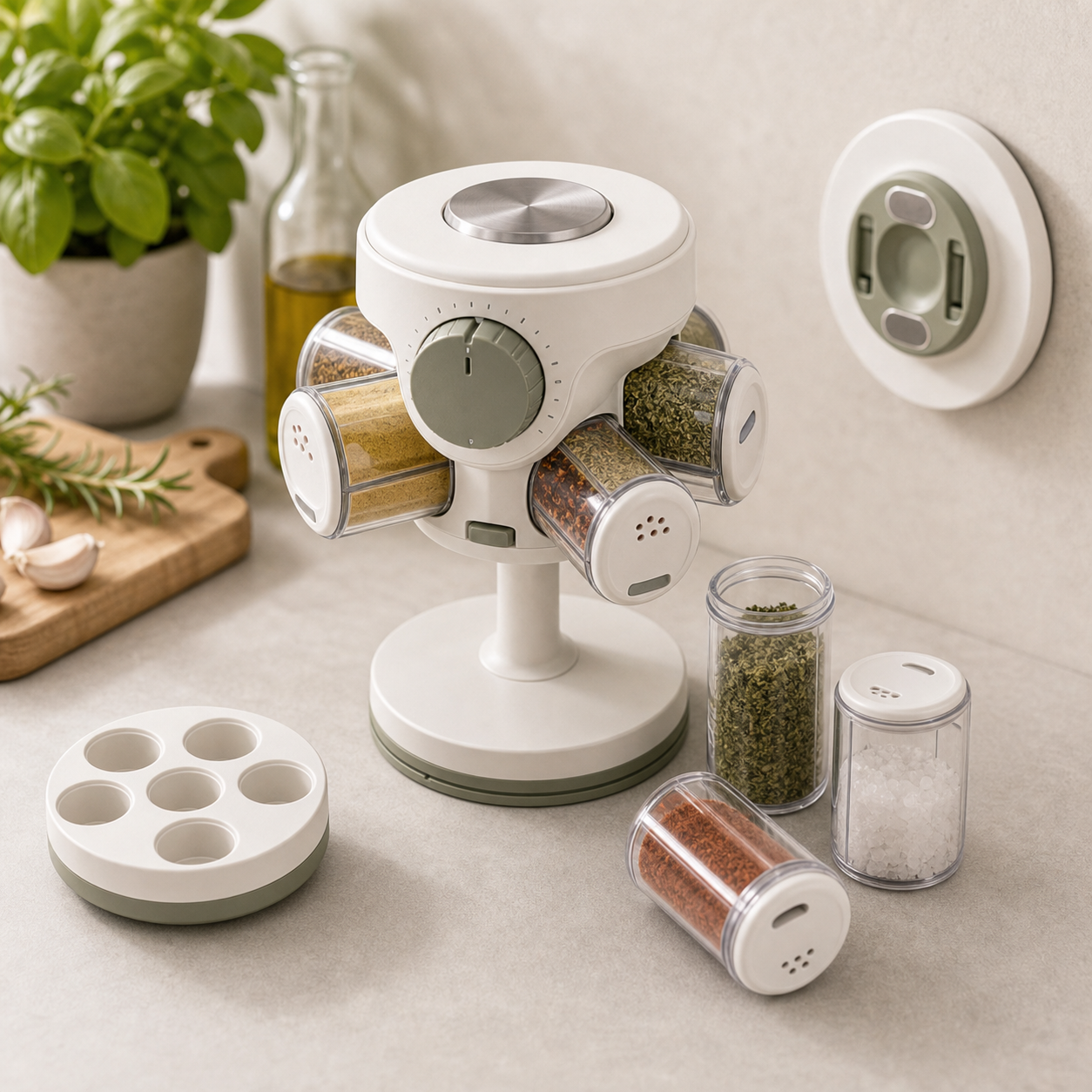
A spice carousel's weak point often appears at the first refill, not the first dispense. The KudBo automatic spice carousel is positioned as a countertop spice-dispensing product. Buyers should confirm the actual container count, mechanism, power source and accessories for the quoted SKU. When jars are emptied and refilled, users need to know what is inside, when it was added and how to clean the dispenser without damaging the mechanism.
Existing guides discuss refill and cleaning and food-contact materials. This article focuses on the information system around the jars: labels, inventory rotation and repeat use. The sample checks are proposals, not claims of completed KudBo factory trials.
Follow a Real Household Refill
Select several common dried spices with different particle sizes, such as fine powder, coarse flakes and whole seeds, only where the maker states the dispenser supports them. Fill each jar to the approved level and operate the dispenser according to instructions. Note whether the last portion dispenses consistently or whether material remains trapped. Do not extrapolate from one spice to all ingredients; oil content, humidity and granule size can change flow.
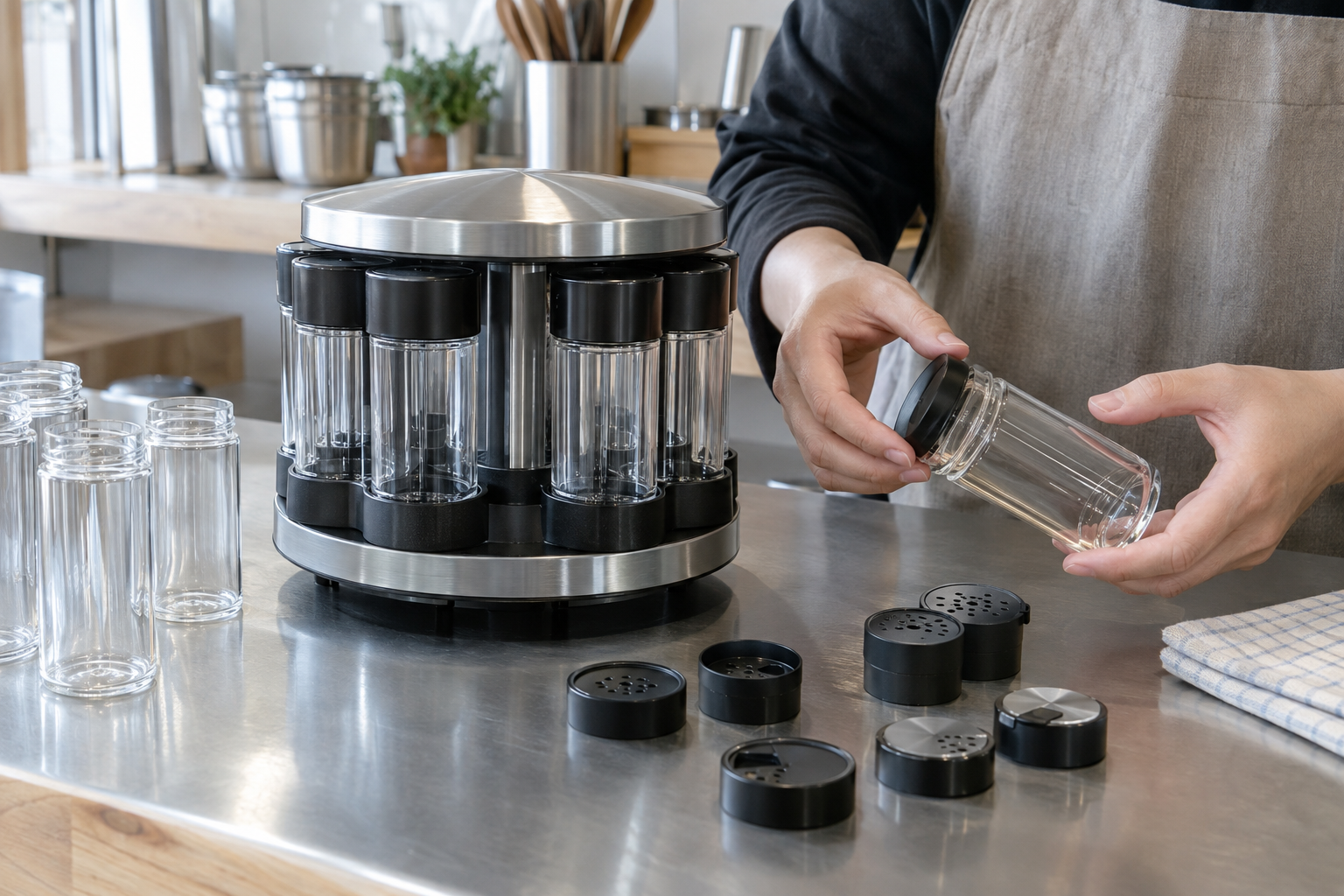
Empty and refill the same jar. Does the user remove the lid without contaminating the next jar? Is there a clear maximum fill line? Can the container be returned to the wrong slot? A rotating carousel that helps access but obscures labels behind a central body may be less useful than a simple rack. Test readability from normal standing height, not a studio close-up.
Label design should allow both identity and optional purchase or refill date. If labels are supplied, verify adhesion to the actual jar finish after washing. If none are supplied, reserve a practical label area. For retail copy, avoid claiming the carousel preserves freshness unless closure, material and storage evidence support it. A lid can reduce spills without creating an airtight long-term storage system.
Inventory Rotation as a User Task
Ask a reviewer to load a partly used set, then add a new jar of the same spice. Do the instructions encourage using older stock first and keeping a record? The device need not automate inventory to be useful, but a buyer should not imply that dispensing automatically tracks ingredient age. If the product has electronic reminders, verify them on the actual version; if not, a simple date label can be more honest.
Test the visibility of fill level and the effort to rotate jars. Cloudy plastic or dark tint may hide contents. Glass may be clear but change weight and breakage risk. Ask about material-specific shipping protection. After a few days of ordinary kitchen humidity, check whether powder clumps in the outlet and whether users can reach it for cleaning. Document the test conditions rather than promising universal anti-clump performance.
The FDA food-contact overview and FDA conditions-of-use resource show why material suitability depends on the substance and its use. They do not certify this carousel. Request documentation for each food-contact container, seal and dispensing path for target markets.
Mid-Article CTA
Send Your Requirements with jar count, intended spices, target market, label format and cleaning expectations. Email info@kudbo.com for a component-level sample discussion.
Clean the Dispensing Path, Not Just the Jar
Check which parts are removable, washable and dry-only. Fine spice powder may collect at the dispense outlet, under the turntable or around a button. A jar that is dishwasher safe does not make the entire electrical base dishwasher safe. Write the care instructions by component. If the product has a rechargeable motor, verify charging location and keep cleaning water away from power interfaces as directed.
After cleaning, fully dry the parts and perform a second dispense. Trapped moisture can make powder clump and can obscure whether a mechanism is defective. Inspect seals after repeated removal. For replacement jars, secure material, dimensions and lid compatibility with the approved revision. A seemingly minor thread change can make a spare jar unusable.
At shipment inspection, count jars, lids, label sheets and cables, check clear surfaces for scratches, then run a short dispense test with an approved dry test medium. Avoid using a factory test that contaminates customer units with an undeclared ingredient. The inspection protocol should define whether sample units are opened and how they are handled after testing. Check printed food-contact and electrical information for the destination market.
Labeling Across Markets
A product headed for several countries may need different language, electrical and food-contact information. Keep the jar label separate from mandatory product labeling: a spice-name sticker is a user aid, not evidence of legal compliance. Ask whether users can remove and replace the sticker without leaving residue in the cleaning area. If a printed spice list is supplied, check that it reflects common ingredients in the target market rather than a random demonstration set.
For professional kitchen buyers, identify whether the carousel is intended for household-only use or a faster shared environment. More users mean more refills and a higher chance that jars are returned to the wrong position. A simple numbering system and spare lids may help, but test the actual workflow. Do not present a household unit as commercial food-service equipment without appropriate suitability and documentation.
Returns data should distinguish jammed mechanism, damp or unsuitable spice, broken jar, unclear label and missing replacement part. The remedy differs: better instructions, a redesigned outlet, a spare jar or a narrower ingredient claim. Tracking these causes by production revision lets the buyer improve the next order rather than absorbing every complaint as a generic defect.
A Six-Week Pantry Simulation
The product should be reviewed after multiple refills, not just on the day when every container is clean and full. A buyer can create a six-week observation schedule with ordinary, shelf-stable dry ingredients and a written inventory card. Label each jar with identity and date, then have different reviewers dispense and refill it according to instructions. The purpose is to identify practical confusion, not to claim a measured shelf-life extension. If hygiene rules or manufacturer instructions limit an ingredient, exclude it from the trial.
During the first week, note label visibility from standing height and from the side where the carousel will sit on a typical counter. On a crowded counter, containers at the back may be hard to see. A shopper who cannot tell cumin from cinnamon without removing several jars will not benefit much from automatic rotation. Check whether labels can be placed where they remain readable without covering a fill-level window. If the supplied label sheet is too small for the destination language, revise it before printing a large run.
In later weeks, deliberately let one jar run nearly empty while another remains full. Is the dispense mechanism predictable at both levels? Does the user understand whether a low-fill condition is a mechanical problem or simply lack of stock? If the product has no electronic inventory tracking, the instructions should not suggest that it reminds users when to buy more. A simple date field and transparent jar can help the user rotate stock honestly without creating a software promise.
At each cleaning interval, inspect the outlet, turntable and lid. Dried spice powder can migrate beyond the jar mouth. Ask whether the non-food-contact base needs only a dry wipe while removable jars can receive a separate wash. Dry all washed pieces before refilling to avoid clumping and contamination. Document how easily a user reassembles seals and lids; a reversed gasket can create a leak or jam even when the motor is sound.
Procurement Handover and After-Sales
The quotation should distinguish base unit, jar count, lid count, labels, cable or power supply and any cleaning tool. For each spare jar, confirm diameter, thread or bayonet profile, food-contact material and part number. A newer jar may look visually identical yet fail to engage a previous carousel. If the supplier updates the mechanism, require a compatibility notice for retailers with existing stock. This matters particularly when the buyer sells spare jars as a repeat-purchase item.
For a pilot shipment, ask customer support to classify “won't dispense” reports into empty jar, damp spice, blocked outlet, incorrect jar seating, low power or true motor fault. Each needs a different response. A short illustrated troubleshooting sheet can prevent unnecessary full-unit returns. Do not recommend dismantling electrical parts or using water in a dry-only base. If a food-contact complaint arises, retain lot records and the material declaration for the specific container, not a generic kitchenware certificate.
A product page should show the real jar count and one refill action. Avoid a carousel photograph filled with unlabeled colorful powders that do not correspond to the included containers. Explain whether the spices pictured are props. Accurate pack-out, label and cleaning information may be less spectacular than a high-speed dispensing video, but it gives serious kitchen retailers the information they need to plan stock and service.
Compare Manual and Automatic Options
An automatic carousel should be compared with a manual rotating rack or simple labeled jars, not only with a cluttered shelf in an advertisement. The automatic option may be more convenient for dispensing one-handed, but it can introduce power, cleaning and spare-part requirements. Ask the buyer's target customer what problem they actually want solved: finding spices, measuring a portion, conserving counter space or keeping ingredients fresher. Each leads to a different specification.
If the main problem is identification, label visibility may matter more than motor speed. If it is portion control, test the actual dispense consistency with the intended spice forms. If it is counter-space management, measure the carousel's footprint including clearance to remove jars. A tall product placed under wall cabinets may have less practical clearance than a low open rack. Document these conditions rather than asserting that automatic dispensing is always superior.
The electronic version also needs a plan for no-power situations and after-sales repair. Can jars be removed and used independently if the base fails? Does the unit retain any setting after a power interruption? These are configuration-specific questions, not assumed features. For a pilot order, ask users to refill the same container several times. If they repeatedly place it in the wrong slot, a better label system or keying may be worth more than another electronic mode.
Retail copy should present the exact jar count, supported ingredients, cleaning routine and power input. Avoid claiming universal freshness or food safety from a tidy countertop image. A buyer who can explain the manual-versus-automatic trade-off clearly is more likely to attract the right customer and fewer expectation-driven returns.
Frequently Asked Questions
Does an automatic spice carousel keep spices fresh?
Do not assume so. Review seal performance, storage conditions and supported shelf-life language separately. Rotation and dispensing convenience are not preservation evidence.
Can all spices be dispensed equally well?
No. Particle size, oil content and humidity affect flow. Test representative ingredients within the maker's stated use scope and explain exclusions.
Should refill dates appear on the jars?
They can help users rotate stock. Provide a clear label area and truthful instructions; do not imply the device tracks age electronically unless it actually does.
Is the whole unit dishwasher safe?
Only if the manufacturer specifically supports that, which is unlikely for an electrical base. List washable and dry-only parts separately.
Why are spare jars important?
They allow users to replace lost or damaged food-contact parts. Confirm dimensions, lid fit and materials across product revisions before advertising refills.
Conclusion
The carousel is valuable when users can identify, refill, dispense and clean every jar without confusion. Buyers should assess label space and inventory rotation alongside mechanism performance. A complete quotation and component-specific documentation make that decision much clearer than a polished countertop image.
Final CTA
Get a Quote at info@kudbo.com with preferred jar count and market. Compare the product catalog, buyer articles and product sourcing collection before approving the retail pack.