Introduction
Adhesive mounted organizer sourcing should define the surface, load direction, environment and removal expectation before choosing a tape or printing a capacity claim. A pad that holds well on a clean tile sample may behave differently on textured paint or a coated desk. Overseas home-accessory and ecommerce buyers need evidence for the complete mounted product and clear installation preparation instructions.
The right question is not simply which adhesive is strongest. A cable clip, bathroom caddy and removable rental-home hook solve different problems. Their loads, bond areas and removal requirements differ. This guide helps buyers compare mounting systems, request useful samples and translate technical information into a realistic private-label specification without promising universal surface compatibility.
Quick Answer: Specify the Mounting System
List approved substrates, excluded surfaces, organizer material, adhesive identity, pad geometry, intended load and direction, installation conditions, waiting period, service environment and removal method. Ask the supplier to identify the evidence behind each claim. Keep the organizer, pad and instructions together as one controlled product configuration.
3M’s VHB application guidance emphasizes surface preparation, tape application and pressure. This manufacturer guidance explains why installation is part of performance. It is not evidence that an unbranded foam pad is VHB or that any organizer using tape will meet the same conditions.
Start With a Surface Matrix
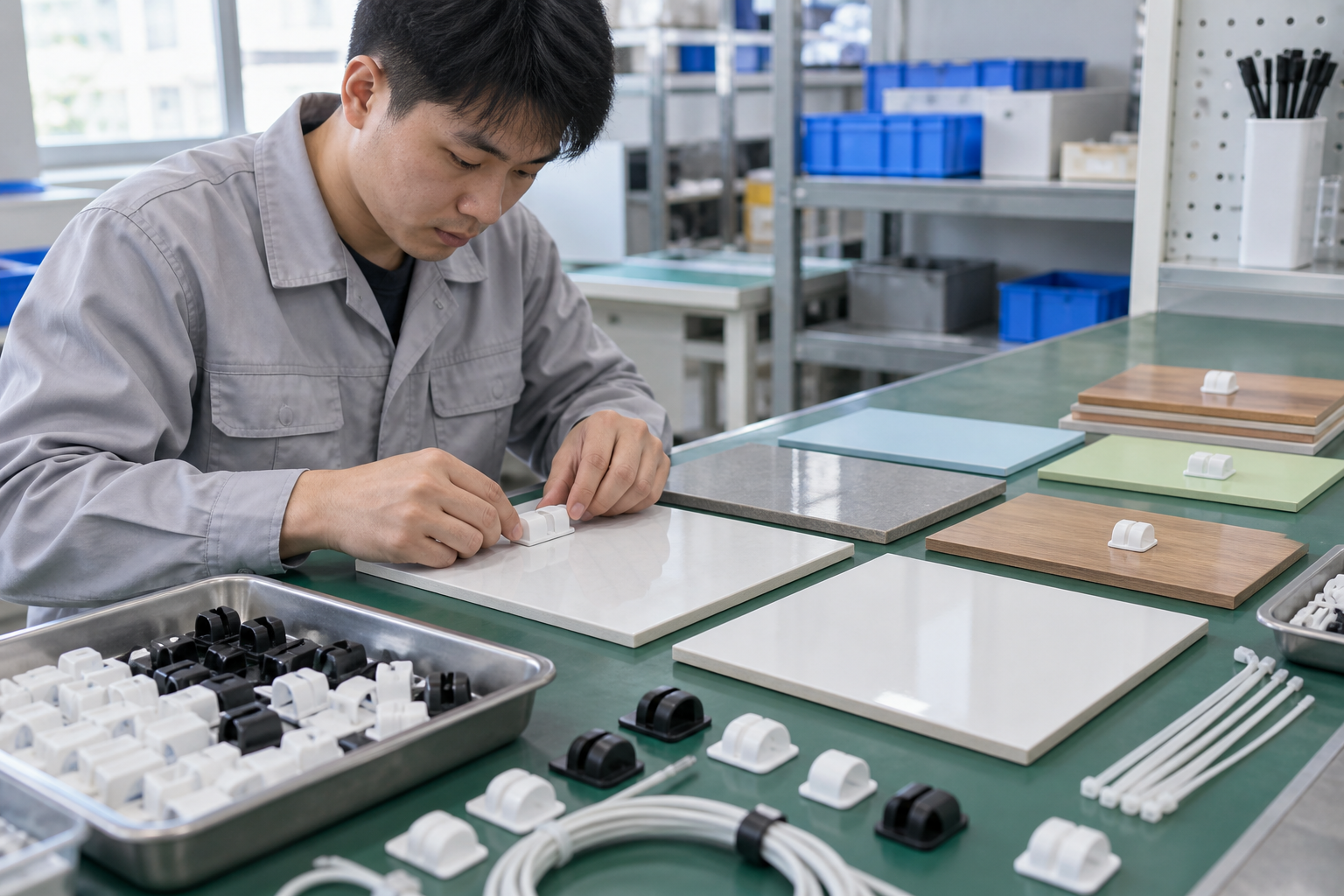
Ask where the customer is expected to install the product. Ceramic tile, glass, painted walls, coated metal and laminated furniture are different surfaces. Even two painted panels can differ in coating chemistry, age, texture and adhesion to the underlying wall. A broad “all surfaces” claim leaves too much unspecified.
Create separate rows for the surfaces you want to support. Record finish, condition and cleaning instructions that can realistically be followed by the end user. If the project is a desk cable organizer, request samples of the intended desk finishes where practical. A polished test plate alone does not represent every office installation.
State Exclusions Clearly
Decide whether wallpaper, porous masonry, rough paint or delicate finishes are outside the supported application. Confirm exclusions with the adhesive supplier and product evaluation. Do not bury essential limitations in a long leaflet after showing the product attached to the excluded surface on the carton.
A simple installation choice guide can reduce ambiguity: identify the surface, check its condition, follow preparation instructions, apply the product and wait as directed. This is a proposed content structure, not a universal adhesive procedure. Exact cleaners, pressure and waiting periods must come from the selected system’s supported instructions.
Separate Holding Strength From Removability
Permanent bonding and controlled clean removal are different design objectives. A strong bond may damage a weak coating during removal. A removable system may require a specific release tab, pull direction or replacement strip. Ask which behavior the product is designed to deliver instead of combining “permanent strength” and “damage-free” casually.
The Command application instructions describe product-specific application, waiting and removal steps. They are an example of a designed mounting system with an associated procedure. Do not copy those instructions onto a different adhesive or assume that all foam tapes can be removed by stretching.
If rental-home use is central to the brief, evaluate removal on the supported finishes as well as initial holding. Record residue, coating lift and visible marks under defined conditions. Avoid promising that no surface can be damaged. The claim should reflect the tested surfaces, installation method and removal process.
Identify the Adhesive and the Converter
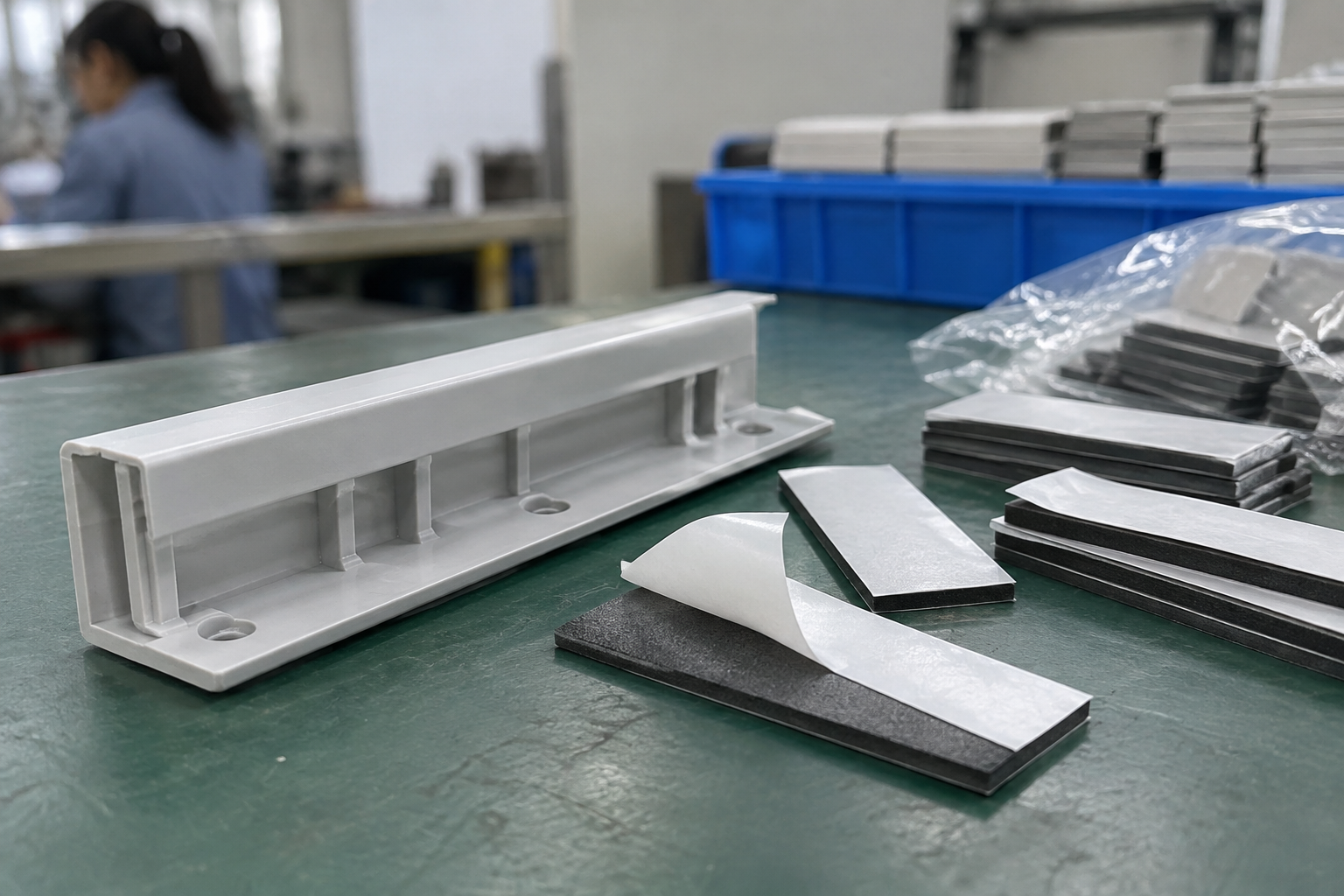
Request the tape manufacturer and exact product reference where a named adhesive is specified. If the supplier uses a converted die-cut pad, identify the converter, thickness, liner and cutting dimensions. A raw-material brand name does not establish how the pad was stored, cut or applied to the organizer.
Ask whether the adhesive is the same on both faces and how each side is matched to its substrate. One side may bond to the organizer while the other bonds to the installation surface. Review both interfaces. A wall-side failure and a pad separating from the plastic base are different problems that need different corrections.
Keep traceability for adhesive batches and converting lots. Require disclosure of substitutions, including a different liner or pad geometry where that affects handling. A red or white release liner is not proof of a particular tape family. Procurement should verify identity through documentation and controlled supply, not color recognition.
Review Base Geometry and Load Direction
The organizer’s mounting base determines how the adhesive is loaded. A shallow cable clip differs from a projecting shelf because the load acts at a different distance from the bonded surface. Ask a qualified technical provider to assess the geometry instead of calculating capacity only from pad area.
Review flatness, ribs, recesses and the actual contact area on the molded part. A nominally large base may contact the pad only at raised regions. Request a drawing showing the adhesive placement and any tolerance that affects contact. A soft pad does not automatically compensate for every irregularity.
Include User Interaction
An organizer can experience more than a steady hanging load. Users may pull cables, open a cover or lift an item from a holder. Define ordinary interactions in the test brief. Keep unexpected pulling or misuse separate from the advertised capacity, while considering foreseeable behavior during design review.
For desk cable raceway kits, ask whether opening the cover applies force to the mounted base and whether cables create persistent side loading. The catalog item is a starting point for discussing the application. Its listing does not replace a mounting-system evaluation for your chosen surface and configuration.
Make Installation Preparation Realistic
Instructions should specify approved cleaning and drying without expecting industrial processes that consumers cannot safely or reliably perform. If a bond requires primer, abrasion or specialized pressure, discuss whether that system suits a consumer organizer at all. A technically capable adhesive can still be inappropriate for a simple retail installation promise.
3M’s surface-preparation resource explains that preparation varies across substrates and that bond development takes time. Those principles support a careful installation brief. Use the selected product’s guidance for actual settings and follow applicable handling instructions for any cleaner or treatment.
Review the waiting instruction from the user’s perspective. State when the organizer may be loaded and whether temperature or surface conditions limit installation. Do not use an arbitrary one-hour or twenty-four-hour statement because it appears on another product. The waiting period must fit the specific adhesive system and evidence.
Mid-Article CTA
Send Your Requirements. Explore KudBo’s product catalog and email info@kudbo.com with intended surfaces, organizer dimensions, load, environment and removal expectations. Ask for a comparison of mounting methods and a sample plan that includes installation and removal.
Design a Useful Test Matrix
Separate substrate, environment and loading variables so results remain interpretable. A proposed matrix might compare a supported smooth tile and a specified painted panel under normal indoor and intended humid-use conditions. These are illustrative categories, not a universal qualification standard. The final matrix should reflect the sales claim and technical assessment.
Record sample preparation, installation pressure or method, time before loading, temperature, humidity, load direction, duration and observations. Identify both the pad and organizer revision. Without those details, a photograph of a hanging weight says little about repeatability or relevance to another surface.
Include removal evaluation if that is part of the product promise. Record the supported removal process and inspect the surface afterward. For a refillable system, determine whether a new pad is required and how the old material is removed from the organizer. Avoid suggesting that a used pad can be reapplied unless the design and evidence support that use.
Distinguish Failure Locations
Ask the evaluator to describe whether separation occurred at the wall interface, organizer interface, within the adhesive or within the surface coating. Also record organizer deformation or breakage. Different outcomes point to different design or preparation issues; a single “fell off” category is insufficient for supplier correction.
Avoid Capacity Claims Without Conditions
A capacity statement should identify the complete model and supported application. Ask how the claimed load was established, whether the organizer’s own mass is accounted for and what orientation applies. Technical review should address the geometry and expected interactions rather than merely selecting a large round number.
Do not multiply the capacity of one pad by the number of pads without a justified assessment. Uneven loading and installation differences can affect how forces are shared. A multi-pad organizer should be evaluated as the actual assembly. Explain restrictions in language a customer can understand.
For lightweight cable management, a detailed load headline may be less useful than clear cable-size compatibility and installation instructions. Choose claims that help the customer decide. Removing an unsupported number can make a listing more trustworthy while preserving its practical value.
Compare Adhesive, Suction and Mechanical Alternatives
An adhesive system may offer a low-profile installation, while a suction system or mechanical fastener may better suit another application. Compare them against the same surface, environment and removal brief. Do not assume that “no drilling” means every mounting method is interchangeable.
| Buyer priority | Question for adhesive mounting | Alternative to consider |
|---|---|---|
| Easy removal | What release method and surfaces are supported? | Designed removable system |
| Humid use | Is the complete assembly evaluated in that environment? | Application-specific mechanical or suction design |
| Repositioning | Is a fresh pad required? | A system designed for repeated relocation |
| Projecting load | How is leverage on the base assessed? | Suitable mechanical mounting |
| Delicate finish | What removal evidence exists? | Freestanding organizer |
| Simple installation | Can consumers follow the required preparation? | A less preparation-sensitive design |
The table is a selection aid, not a performance ranking. A suction cup has its own surface and load limitations, and mechanical installation introduces different requirements. Ask suppliers to explain tradeoffs rather than changing mounting methods only to meet a target price.
Control Shelf Life, Storage and Packaging
Request the selected adhesive’s shelf-life and storage guidance and identify how dates or batches will be tracked. Distinguish the raw tape’s storage requirements from those of the finished converted product. Do not assume that a pad stored for a long time in a hot warehouse behaves like a newly prepared sample.
Packaging should protect the liner from lifting and the pad from contamination. Review the actual retail pack, including loose hardware or sharp edges that could damage the liner. If customers receive spare pads, label them clearly and keep them protected until use. An unsealed loose refill may create avoidable handling problems.
Ask how the supplier manages first-in, first-out stock and how remaining shelf life will be communicated at shipment. For a seasonal order, consider the expected time between production and installation. A low unit price can be misleading if a large stock commitment exceeds the supported storage window.
Prepare Factory and Shipment Controls
Define where the pad is applied, how the organizer base is prepared and how placement is checked. Ask the factory to record relevant process conditions and adhesive lot identity. If pads are applied by hand, review how operators avoid touching the bonding face or trapping contamination.
During shipment inspection, check pad dimensions, placement, liner integrity, part count and instruction revision. Use agreed functional checks appropriate to the shipment scope, recognizing that full bond-development testing may require time unavailable during a short visit. Plan those activities before the inspection date rather than shortening them to fit a schedule.
Keep retained samples where practical and document any change in molding material, surface texture, release agent or adhesive supply. A visually identical base may have a different surface condition. Require technical review when a change could affect bonding, even if the retail model name stays unchanged.
Turn Returns Into Better Specifications
Collect the installed surface, preparation steps, time before loading, use environment and failure photographs when investigating a return. Request only information relevant to diagnosis. Do not assume every failure is installation error; a pattern may reveal unclear instructions, a surface mismatch or production inconsistency.
Compare the returned configuration with the approved evidence. If marketing showed a surface outside the supported list, correct the content as well as the customer response. If a new batch differs, identify affected inventory and investigate the process. A replacement without root-cause information may repeat the same failure.
The home organization sourcing guide provides broader assortment questions. Use this adhesive-specific review to go deeper on installation requirements, especially for products where the mounting method is central to the customer’s experience.
Frequently Asked Questions
Will one adhesive organizer work on every painted wall?
Do not assume so. Paint chemistry, texture, age and attachment to the underlying surface can vary. Define supported finishes and obtain relevant evidence. Clear exclusions and installation instructions are more useful than a universal wall claim that cannot be verified for the product.
Does a stronger adhesive guarantee clean removal?
No. Holding and removal are different design objectives. A strong bond can remove weak paint or leave residue. If clean removal matters, select a system designed for that purpose and evaluate the supported surfaces using the stated removal procedure. Avoid copying instructions from unrelated products.
How long should users wait before adding weight?
Use the waiting period supported for the selected adhesive, surface and conditions. Do not borrow a duration from another brand or tape family. Include the instruction prominently and make it consistent across the leaflet, carton and online listing so customers can install the organizer correctly.
Can buyers use tape area to calculate a retail capacity?
Area alone is insufficient. Base geometry, load direction, surface condition, adhesive behavior and user interaction also matter. Ask a qualified provider to assess the complete assembly and establish relevant evidence. Do not multiply a single-pad claim into a multi-pad capacity without justification.
What information should be included in the RFQ?
Provide substrate examples, organizer dimensions, intended contents, load direction, humidity or temperature exposure, installation expectations, removal requirements, destination and quantities. State whether the product must be repositionable. Ask for adhesive identity, sample testing, instructions and storage requirements as part of the quotation.
Related KudBo Resources
Browse the KudBo product catalog, explore the buyer guide library, read more Wholesale Buying sourcing guides, or send your product requirements for a focused sourcing discussion.
Conclusion
Adhesive mounted organizer sourcing succeeds when the surface, base, pad and installation process are evaluated together. Define supported use, distinguish holding from removal, verify claims with a relevant matrix and preserve adhesive identity through production. Clear instructions and realistic surface limits make the product easier to select and support.
Final CTA
Get a Quote. Use KudBo’s contact section or email info@kudbo.com with your mounting brief and quantities. Request sample options, supported surface guidance, installation instructions and a shipment inspection plan before approving packaging claims.